
The objective of Stage 2 is to develop and document the charging model, and consult with stakeholders. For regulatory activities, this stage objective will include development and publishing of the Regulatory Charging Statement (RCS).
Develop detailed charging model
A charging model is made up of 2 separate components:
- cost model - expected costs to the entity,
- price model - price to the user (individual or organisation)
Benefits of cost control
A well-developed charging model enables Accountable Authorities to compare expected expenses and revenues to actual expenses and revenues, to:
- ensure prices charged remain aligned to the policy authority for the level of the price and the requirements of the Charging Policy
- measure and improve efficiency
- minimise the over- and under-recovery of costs of the activity
- manage costs and monitor performance
- justify how prices have been calculated and how they relate to the costs of the activity through appropriate attribution of outputs and subsequent charges
- determine the balance of funding needed, based on the alignment of expenses
A well-developed charging model improves the Accountable Authority and staff’s understanding of the activity costs (that is, the entity’s cost consciousness). The cost information and control of the charging expenses assists the accountable authority or governing board in meeting their requirements under the PGPA Act to govern their entity in a way that promotes the proper use and management of public resources for which they are responsible (PGPA Act, s.15).
Charging model - Introduction
At Stage 2, to progress with the charging implementation, Accountable Authorities need to develop a detailed charging model. The detailed charging model must be consistent with the high-level charging design approved as part of the policy.
The detailed charging model should be proportional in scale to the materiality, complexity and sensitivity of the activity.
A well-developed model improves the Accountable Authority and staff’s understanding of the activity costs for both regulatory and non-regulatory activities (that is, the entity’s cost consciousness).
The cost model should:
- identify outputs and business processes of the activity
- accurately measure and assign costs to outputs and business processes
- the costs for the activity includes the direct and indirect costs
- use relevant proxies for the allocation of indirect costs
- track the degree of alignment between expenses and revenue
- produce relevant and timely performance reports for the activity
- specific for regulatory activities:
- the cost model should accurately measure and assign costs to outputs and business processes
- where it has more than one activity, identify the business processes that are used to produce the distinct output
- where a discernible relationship between the effort caused and a user is not clear, these costs should not be allocated to an output
Change of funding approach
If, in developing the detail within the charging model, it appears that it would not be practical or effective to charge in the high-level charging design (that is, the policy objective of the activity will not be supported by charging), the Accountable Authority must ensure this information is in the decision process for the Government or themselves as the decider for a non-regulatory activity, including options that may better achieve the Government’s purpose. Accountable Authority should ensure staff consider engaging with Finance to assess whether this may be undertaken through the Budget process.
In developing a detailed charging model, the Accountable Authority ensures the following steps are taken:
- Step 1 - Identifying outputs and business processes
- Step 2 - Costing the activity - developing cost model
- Step 3 - Pricing the activity - developing pricing model
Step 1 – Identifying outputs and business processes
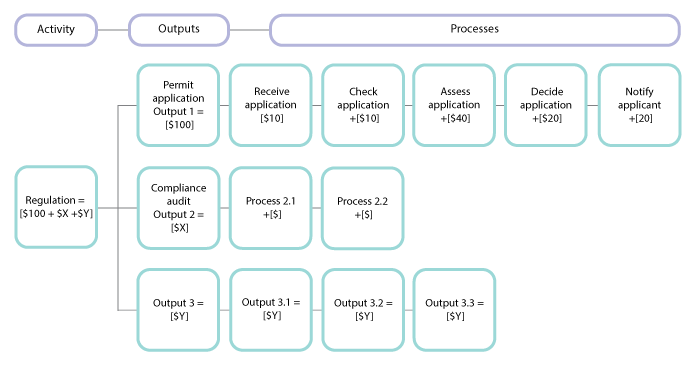
In developing a charging model entity staff break down the activity into distinct outputs (for example, registrations, audits, or the development of standards) and the key business processes that are used to produce those outputs. Techniques for identifying business processes include process modelling, performance measurement and workflow analysis. Staff should monitor and re-examine business processes periodically to ensure that the processes continue to produce outputs efficiently and effectively.
The level to which the activity is broken down (for example, outputs versus business processes) for reporting and costing purposes needs to be proportional to its complexity, materiality and sensitivity. As an example, the following business processes may be involved in the assessment of a permit application (that is, the output of the cost recovered activity):
- receiving an application
- checking the accuracy of information in the application
- assessing the application
- deciding on the application
- notifying the applicant of the decision.
Figure 1: Activity outputs and business processes—concept and example
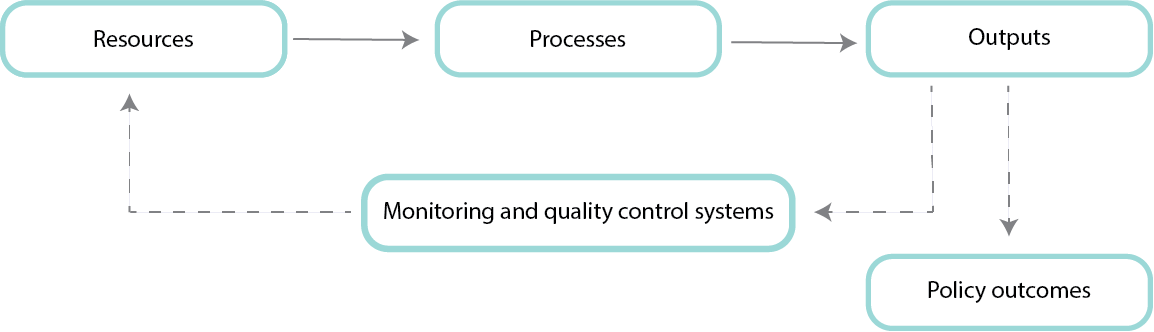
Step 2 - Costing the activity – developing cost model
Once entity staff have broken down the activity into outputs and related business processes, the relevant costs can be identified and attributed to the outputs and processes. The approach used to cost the activity, and the level at which it is costed (for example, activity, output or process), would be proportional to the complexity, materiality and sensitivity of the activity and be based on clear methods for:
- categorising costs into direct and indirect costs
- easuring direct and indirect costs
- attributing costs to the activity processes and outputs.
Entity staff are expected to document the costing methodology and apply it consistently. The costing methodology must attribute indirect costs as well as direct costs. It must reference to some indirect costs that apply to all activities i.e. link across the whole entity. The more activities that are charge for the greater the need to show this attribution in more detail.
When relevant, it is a good practice for the Accountable Authority of the entity to ensure benchmarking of activity costs and processes against similar government activities and/or organisations in Australia or overseas. Benchmarking can be against either the whole activity, or where there is no directly comparable activity against part of the activity (for example, business processes). Benchmarking similar activity's costs may assist an entity in comparing and improving activity efficiency, as well as manage the activity's performance. Benchmarking against the private sector may not always be appropriate, as Commonwealth entities have a range of accountabilities to the public and the Parliament and some activities have unique cost drivers.
Assumptions
Assumptions about cost drivers are an important part of costing. They may relate to the expected demand volume of outputs, the cost of resources or other variables that affect financial estimates for the activity. The choice of assumptions depends on the activity; for example, there may be higher costs in registering a new product compared to an established product; or there may be less activity during an economic downturn compared to a period of economic growth.
Furthermore, financial estimates for the activity may be sensitive to changes in the assumptions - the change in the assumed demand value of a variable (for example, the number of products submitted for registration) might not result in a proportional change in the affected financial estimate (for example, registration expenses may rise at a lesser rate due to economies of scale/efficiency gained). Where this is the case, the Accountable Authority should ensure clarity of the level of sensitivity in the RCS.
Efficient costs
Financial estimates are expected to be based on efficient costs for regulatory activity and total annual costs for non-regulatory activity.
Efficient cost is defined as the minimum cost of the effort necessary to provide the activity while achieving the policy outcomes and legislative functions of the Government. Effort here covers capability, time and assets employed.
Efficient costs change over time – it is the existence of a process of monitoring, evaluation and change to achieve the lowest cost after considering all factors, that allows a cost to be called the efficient cost. The process also supports Accountable Authorities demonstrate the proper use and management of public resources. Efficient costs are particularly important in the context of capital assets. ‘Gold plating’, or installing assets that are unnecessarily large or sophisticated, is an example of inefficient costs that should be avoided.
Types of costing models
There are several options for demonstrating costs. Techniques to identify output costs and business processes include:
- a ‘bottom-up approach’ of attributing cost, effort, and resources per unit output to determine the unit cost and then aggregating this to the policy program level to provide the basis for the activity’s total cost. This process may for some activities involve consideration of the expected annual demand, but may not be relevant for all activities.
- a ‘top down approach’ uses annal cost amount and divides it by expected demand for the year, to get an average output cost.
The issue with the 'top down approach' is the average cost based on what was spent or allocated may not be the efficient cost of doing activity.
Accountable Authorities are encouraged to consider a ‘bottom up approach’ as it enables the price to be based on the cost for delivery of actual activity output, not the allocated or average cost.
In addition, a ‘top down approach’ does not capture the effort variation between users for the same output or the difference between average expense and actual cost that must be known for a regulatory charge and should be known for a non-regulatory charge.
Using a ‘bottom up approach’ provides transparency that assists in avoiding:
- cross subsidisation between users
- charging being perceived as taxation (for example, charging an individual more than the cost of the output the individual caused)
The calculation of effort should be based on the typical time of a proficient officer for the delivery of the output, and the resources required to support this effort.
Figure 3 - Cost modelling approaches
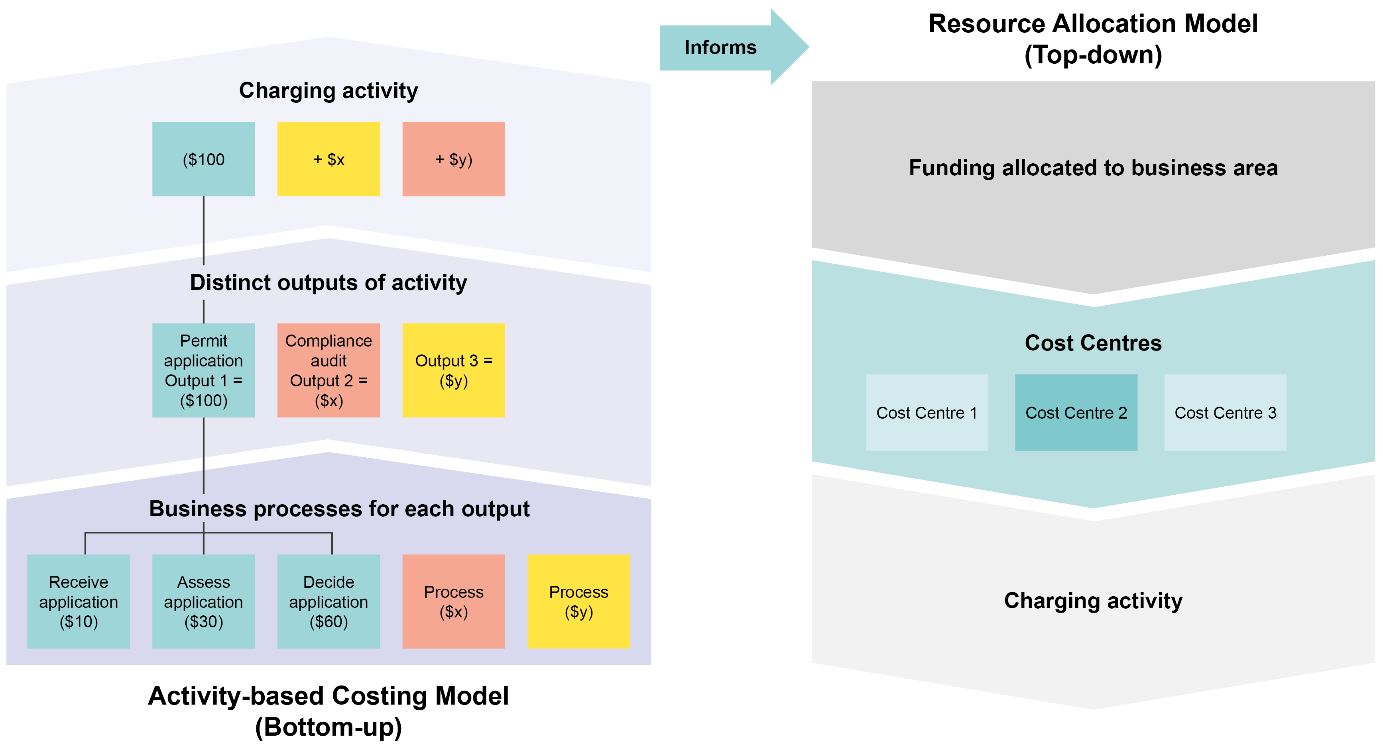
Determining the process for each output and appropriately attributing costs enables analysis, benchmarking and demand driven budget estimates. It allows for the development of efficient costs, the demonstration of transparency and accountability, and supports stakeholder engagement, as required in the principles for charging. It also enables Accountable Authorities to inform and affirm the total resourcing and budget forecasts.
Accountable Authorities must ensure there is documentation of the data behind the costing methodology and that the process is applied consistently. It is this record of process, effort and cost allocation that allows assurance that costs are efficient and consistent with the charging principles.
Recoverable and non-recoverable costs
When building a cost model, the model must distinguish activity due to effort caused by industry and activity due to effort caused by government (for example, internal reporting or policy development). This ensures only relevant costs are inputs to the pricing to the non-government sector.
Some costs are not appropriate to be charged to the non-government sector, unless the Government decides otherwise. These costs must be funded in another way (for example, Taxation or Budget funded through appropriation). The costs excluded from being recovered via a regulatory charge include:
- activities that do not have policy approval or policy authority to be charged for
- activities incurred from direction by government, for example, a strategic review or relocation of premises
- policy development of new or significant changes to existing activities, including policy development of regulatory standards.
- building the business case for making changes to existing regulatory requirements, introducing new regulatory requirements, or introducing charges for existing regulatory activities.
- drafting of legislation or changes to legislation for new or changes to existing activities
- development and promulgation of advisory material or educational material not for those being regulated
Figure 4 – Attribution of costs to regulatory (cost recovery) charges
| Regulatory (cost recovery) fee | Regulatory (cost recovery) levy | |
|---|---|---|
| Characteristics of the activity, outputs and business processes | The direct regulation of an individual or organisation, performed for or at the request of that particular individual or organisation (demand driven). | The direct regulation of a group of individuals or organisations performed for or at the request of that particular individual or organisation (demand driven). |
| Examples of activities whose costs could be charged for | Costs of the activity, output or business process that can be reasonably attributed to an individual or organisation (for example, direct costs and an appropriate share of indirect costs). These costs could include the cost of:
| Costs of the activity, output or business process that can be reasonably attributed to a group of individuals or organisations (for example, direct costs and an appropriate share of indirect costs). These costs could include the cost of:
|
| Examples of costs that should not be included |
For example
|
For example
|
Allocating costs
Once the method and level of costing are decided, then total costs, which generally consist of direct and indirect costs, are allocated to cost objects (for example, activities, outputs or processes):
- direct costs are the costs of effort or resources that directly attribute to the output of a sub-activity or activity with a high degree of accuracy. The allocation of direct costs to sub-activities is relatively straightforward if the entity’s financial system is able to generate relevant information. The most common direct costs are staff salaries (including on-costs, such as training, superannuation and leave) and supplier costs (for example, office supplies and workers compensation premiums). Direct costs may or may not vary.
- indirect costs are those costs that cannot be easily linked to the output of a sub-activity or activity, or costs for which the costs of tracking outweigh the benefits. Indirect costs should be apportioned to a cost object using the entity’s documented internal costing methodology. Common indirect costs include overhead costs such as salaries of staff in corporate (for example, finance, human resources) and technical support (for example, legal) areas, or accommodation costs (for example, rent, maintenance, utilities). The appropriateness of recovering all or some of indirect costs is determined on a case-by-case basis.
Direct and indirect costs can be further detailed, depending on the complexity, materiality and sensitivity of the activity. Costs that may need to be identified separately include:
- different categories of capital costs (for example, operation and maintenance, depreciation, capital investment). The appropriateness of recovering all or some of these costs is determined on a case-by-case basis. For example, the Government may make an upfront investment in a capital asset for the activity and recover that investment over an appropriate period, which may be close to the useful life of the capital asset.
- costs split between commercial or resource charges activities and activities funded via other mechanisms (for example, Budget funded), where the same resources are used in their provision (for example, shared capital assets).
- costs incurred by parties other than the responsible entity (for example, an outsourced service provider).
Two main methods are used for apportioning indirect costs:
- traditional based costing (that is, simple cost allocation) typically uses volume-based cost drivers, such as floor space or average staffing levels. This method may not suit a complex charging if a volume-based cost driver is not representative of the use of resources in the activity outputs and processes.
- activity-based costing focuses on activity-based cost drivers, which convert indirect costs into direct costs and assign them to a cost object. The use of an activity-based costing method enables more informed analysis of the efficiency of outputs and business processes of the activity.
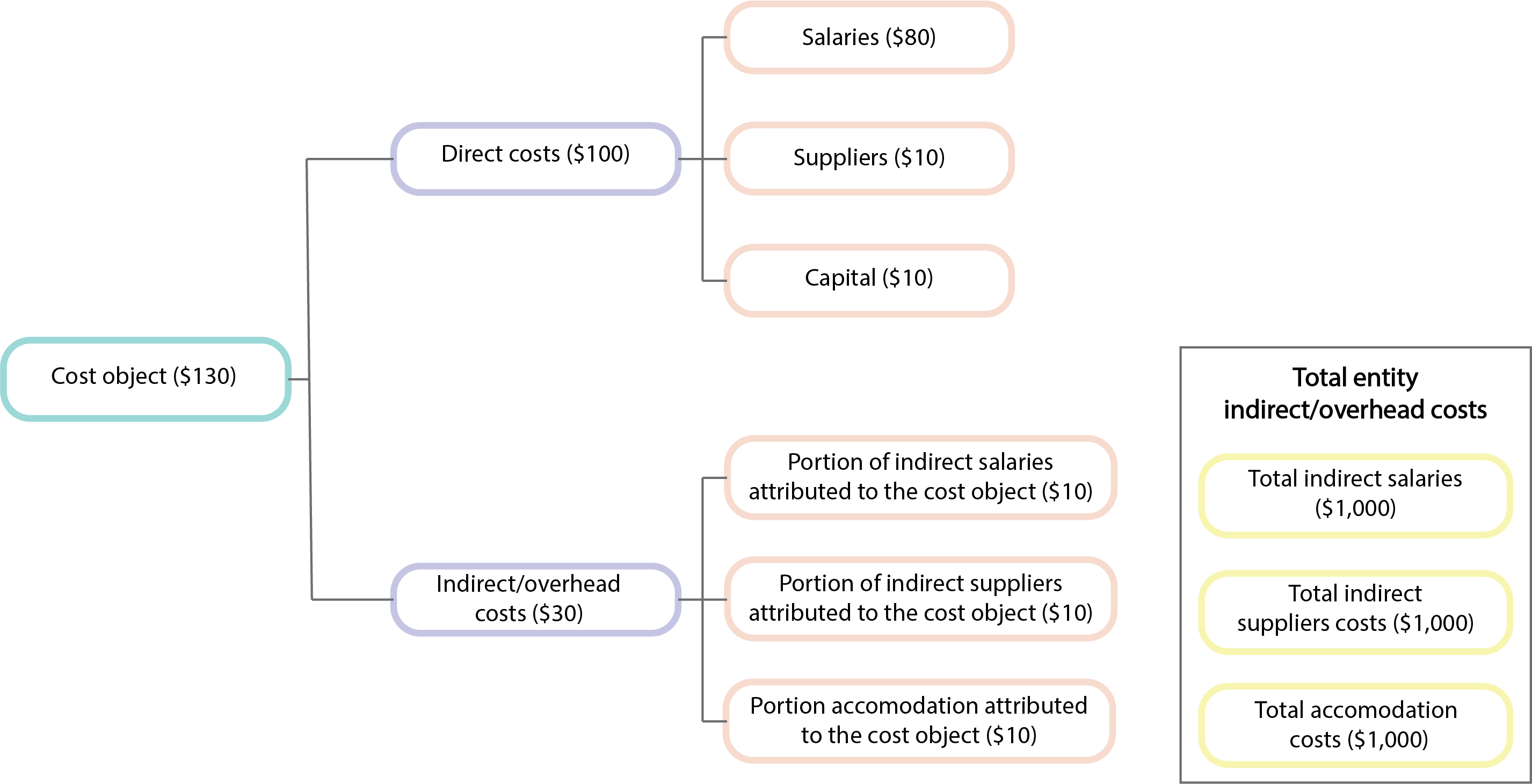
Figure 5 shows an example of how direct and indirect costs can be attributed to a cost object (for example, an output). The costs of staff, suppliers and capital incurred in producing the output are directly allocated to the cost object. Where the same staff work on more than one output, an appropriate method of apportioning their costs to relevant cost objects is required. Indirect costs (for example, the entity’s overhead supplier and accommodation costs) are apportioned to the cost object using relevant cost drivers.
Figure 5: Allocating and apportioning costs to a cost outputs
Use of estimations and cost drivers
If the costs of producing a specific output vary substantially, a variable fee may be more appropriate. For example, an assessment of a permit application may require specialist advice depending on its complexity, which means that it may be difficult to estimate total assessment costs in advance. In these circumstances, tiered fees (based on different levels of assessment complexity) or input-based fees (based on the number of staff hours) could be used.
When designing a levy, staff should select a relevant cost driver as the basis for the distribution of levy payments among individual levy payers that best reflects their cost contribution. The cost driver should approximate the level of resources used to provide the activity to levy payers. Depending on the activity, this may be done by distributing the levy payments on an equal basis (a flat levy rate). Alternatively, differentiated levy rates could be used to more closely reflect resources used by different groups of levy payers based on their risk, size or other criteria. Complex activities may justify the use of more than one cost driver to determine levy rates. The potential for cross-subsidisation among levy payers may increase if a levy rate does not bear a reasonable relationship to the cost driver of the activity.
Depreciation costs
Depreciation cost is the recovery of the investment over the useful life of an asset. The depreciation cost is the annual amount determined following a policy approval for a capital investment by the Government or the Accountable Authority. A schedule of depreciation should be documented to ensure an appropriate amount is recovered each year from the activity or group of activities using the asset, so that over the business cycle, all of the cost of the investment tis recovered. For regulatory activity that is charged for, a depreciation schedule should be published in the RCS to show aggregate asset value, accumulated depreciation and value outstanding, to demonstrate that over recovery is not occurring.
Step 3 – Pricing the activity – developing pricing model
The level of the price is driven by the nature of activity and the policy objective.
The design of the price model should be consistent with the Government policy objective for the activity and the high-level charging approach approved as part of policy decision. The price model will also vary depends on the activity type.
All charges should be:
- clear and easy to understand
- closely linked to the specific outputs of the activity
- set to recover the full efficient costs of the specific activity as default
- efficient to determine, collect and enforce
- set to avoid volatility, while still being flexible enough to allow for changes based on fluctuations in demand or costs.
Flexibility of price
Accountable Authorities must ensure that the price model has appropriate mechanisms in place to ensure that the decision on the price reflects any change in costs, including increases or decreases due to demand, indexation, process changes or technological developments. This review of alignment of price to the decision should occur at least annually and on a shorter time frame where evidence exists that the price may not be reflecting the true cost of the effort.
Balance in price effort
Accountable Authorities must ensure appropriate advice is provided to balance the need for an administratively simple price model against the legal and policy need to closely link the price paid to the cost caused.
- Less frequently changed regulatory (cost recovery) fees or levies generally provide more certainty for both non-government stakeholders and the entity. This makes the charging simpler to administer, but may require stakeholder consultation about the risk of actual prices not aligning to actual costs and careful planning, budgeting and management to ensure final revenues and expenses align over the period.
- A single price point is only appropriate where the effort each individual causes is substantially the same.
- A tiered price model would only be appropriate where it is clear the effort each individual causes can be clearly grouped, with little variation within the grouping and few, irregular or ad hoc instances, where the effort the user causes is between these points.
Example – An assessment of a permit application may require specialist advice depending on its complexity, which means that it may be difficult to estimate total assessment costs in advance. In these circumstances, tiered fees (based on different levels of assessment complexity) or input-based fees (based on the number of staff hours) could be used.
Accountable Authorities should consult with Finance on any proposal to use a price model that does not closely align the expected actual costs of an output.
Examples of Pricing Model by Activity Type
| Regulatory pricing | |
Regulatory charge:
| There are 2 types of regulatory charges: Regulatory (Cost recovery) fees are a charge for a good, service or regulation (in certain circumstances) to a specific individual or organisation. Regulatory (Cost recovery) levies are a charge imposed when a good, service or regulation is provided to a group of individuals or organisations rather than to a specific individual or organisation. A regulatory levy is a tax and is imposed via a separate taxation Act. It differs from general taxation as it is ‘earmarked’ to fund activities provided to the group that pays the levy. |
| Full cost recovery | Charging the non-government sector all of the efficient costs of a specific government activity. |
| Partial cost recovery | Partial charges the non-government sector some of the efficient costs of a specific government activity. |
| Non-regulatory: Value-based pricing – Resource activity | |
| Fee for privilege | A charge imposed in relation to access to a public resource that confers a clear right or privilege (including access to a limited resource). This could include a royalty payment calculated in respect of the quantity or value of things taken, produced or copied, or linked to the occasions upon which the right is exercised. |
| Access fee | A charge for access to or use of a specific public resource (for example, entering an exhibition or leases of a building or equipment). |
| Non-regulatory: Commercial pricing | |
| Market-based pricing | This is sometimes referred to as competitive-based pricing and is based on the prices of similar products in the market or a proxy, where there are no actual competitors. Depending on whether the Australian Government activity has more or less features than the competition, the government can set the price higher or lower than the competitor pricing, taking into account competitive neutrality policy. |
| Consumption, subscription and freemium models | Consumption-based pricing is based on demand (for example, transactions or website traffic) rather than a fixed fee per month. It is a quantitative charge based on the amount of goods, services or resources consumed. The Australian Government will quantify the services it provides, and charge individuals or organisations according to their use. Subscription-based pricing is based on charging a fee to access a specific service on a daily, monthly or annual basis. Subscription users have infinite use of the service at a flat rate for a designated period of time. Customers are not charged per use, but per unit of time as determined by their subscription. Freemium pricing is a pricing model that offers a base product or service free of charge (for example, base-level data and statistics) while charging a premium price for advanced or additional related products or services (for example, tailored data provision). |
| Dynamic-based pricing | This pricing is based on demand for that activity (for example, auctions). Pricing is adjusted in response to market demands. That is, when demand is low and elastic, prices are adjusted lower to increase the attractiveness of the government activity. |
The default position for any regulatory activity is to charge a price equal to the full cost of the effort the individual or organisation causes.
The price model for a regulatory activity or group of activities will show the price for each output is aligned with the cost of the output.
The price model for a regulatory activity is set by a Government decision, which may be in the form of: an explicit amount; a formula (for example, the percentage of the cost of an activity); or an aggregate amount where by total revenue from group of regulatory outputs may not exceed a percentage of the total costs of the regulatory activity outputs.
Where the Government sets the aggregate amount to be charged as a percentage of the total costs of the regulatory activity, no one regulatory output may be priced greater than its cost., wit the aggregate revenue from all activities that are charged for equalling the government’s objective.
Fees and levies
| Fee | Levy |
|---|---|
Prices for a regulatory (cost recovery) fee must align to the costs of the regulatory output that the individual or business causes. There must be alignment of the price and cost the individual causes and alignment of the total cost and total revenue for the activity (unless the Government chooses to subsidise the price through with other funding. | When designing the price model for regulatory (cost recovery) levy, staff should select a relevant cost driver so that the price model reasonably aligns to the cost attribution among individual levy payers. The cost driver should approximate the level of effort and resources used to provide an output to each levy payer. Depending on the activity cost profile, this may result in levy prices that are equal for all users (a flat levy rate) or different rates to different levy payers based on other criteria (for example, time, risk, size or sector specific) that may cause more effort. Complex activities may use more than one cost driver to determine levy rates. |
Accountable Authorities must ensure transparency to stakeholders about the pricing methodology for a regulatory charge in the Regulatory Charging Statement. For example, a ‘regulatory charge’ for an audit on site of an identifiable individual may determine the costs on a per hour basis, utilising the fee methodology. The identifiable individual would only incur the costs of the activity delivered.
For example, a ‘regulatory charge’ for an audit on site of an identifiable individual may determine the costs on a per hour basis, utilising the fee methodology. The identifiable individual would only incur the costs of the activity delivered.
In some circumstances, the costs of a regulatory activity may be recovered using a combination of both regulatory (cost recovery) fees and regulatory (cost recovery) levies.
Example – A regulatory (cost recovery) fee is charged to recover the costs of a permit application process, while a regulatory (cost recovery) levy is charged to recover monitoring and compliance costs.
Stakeholder engagement
Stakeholder involvement will generally result in better design, planning and implementation of government activities. Successful stakeholder engagement is most likely to occur when it is well planned and when government entities enter into a meaningful dialogue with stakeholders, consider their views and, where appropriate, take action.
Stakeholder engagement is particularly important for regulatory charging, as regulatory charges are mandated and cannot be negotiated or the service acquired elsewhere. This requirement is strengthened by the separate principles to be adopted by Accountable Authorities administering regulatory charges.
For regulatory (cost recovery) charges, stakeholders, particularly those directly affected by charges, should be consulted on the draft documentation (such as a RCS) and draft legislation, while giving stakeholders adequate opportunity to provide feedback. The circulation of the public documentation to support consultation is a good basis for engagement with stakeholders.
Accountable Authorities should consider the Best Practice Consultation available on the Department of the Prime Minister and Cabinet website.
When developing the charging model and legislation, entity staff should engage with all relevant stakeholders. At this stage of the charging process, engagement is likely to focus on:
- the rational for the activity
- the rationale for the charging
- costing model for the outputs of the activity
- the price model for the outputs of the activity (the design of charges)
- implementation timing and the readiness of stakeholders for the commencement of charges
- how the activity will be undertaken (for example, the outputs and business processes of the activity)
- performance measures for the activity
Entity staff would need to consider the most effective means of reaching stakeholders, particularly if they include small businesses. Methods may include bilateral and multilateral meetings, targeted consultation rounds, publishing consultation papers with options for considerations.
Stakeholders’ engagement and the effectiveness of charge and the impact on the activity objectives is also reported in the Portfolio Charging Review
Developing Regulatory Charging Statement
A Regulatory Charging Statement (RCS) is needed where regulatory activity is charged for.
The RCS is an explanatory document that provides key information on how cost recovery for a specific government activity is implemented. The RCS should explain the business processes and the allocation of resources (people, assets and supplies) for outputs of the regulatory activity. If the activity has multiple outputs and business processes to the same user group for the same policy objective, it may be appropriate to group them together for presentation in one RCS.
After charging commences, the RCS also becomes a continuous disclosure tool.
Finance has developed a RCS template that outlines the required information.
Finalise the RCS
Following stakeholder feedback, the draft RCS is finalised in preparation for appropriate approvals. It is important part of implementation, particularly where changes are expected for charges, that the final RCS is informed by stakeholder views.
One of the RCS content requirements is a summary of the most recent engagement with stakeholders on regulatory charging matters. Stakeholders should be provided with an opportunity to check that summary before its inclusion in the final RCS.
Reviewing the regulatory charging
Accountable Authorities must ensure the review of charging at least annually to:
- validate business processes, outputs and activities
- validate direct and indirect costs, including proxies (cost drivers)
- apply indexation to relevant cost elements for the charges to reflect efficient cost
- validate cost attribution to business processes, outputs and activities
- address variation in demand.
The charging model will assist with updates to the financial estimates used in the RCS and Budget Estimates.
Financial estimates are forward projections of what is expected, for both costs and revenues. All types of charging financial estimates should be based on the efficient costs and price of outputs, for an expected demand level.
Where the charging model shows a difference in estimated or forecast costs to actual costs for a specific demand and this difference is considered significant, the model and the data supporting the efficient cost should be reviewed.
Charging financial estimates may be developed at the activity, function and entity level to support different policy and operation objectives.
Budget Estimates may be updated in the course of a year as circumstances change (for example, actual demand was significantly different to the estimated demand for that year). The cost and price models provide the evidence to seek to change Budget Estimates, and therefore should be up-to-date to support the Budget process.
The RCS must be kept up to date and must be updated with the financial estimates for regulatory charging on at least an annual basis. Accountable Authorities should ensure indicators for users and stakeholders, with appropriate analysis (for example, various scenarios), of the degree of sensitivity of costs and prices in the RCS and what is done. This will lead to appropriate risk management strategies and revision of prices should the circumstances change. Where appropriate, RCS should also justify changes to the charging outlining reasons in costs level.
For both resource and commercial activity, Accountable Authorities should have a charging model that summarises the direct and indirect costs and the rationale for how the price has been determined.
All costs of the activities, outputs or business processes of the entity may be recovered by non-regulatory charging.
As per the Charging Policy Statement, the default position for any non-regulatory activity is to charge a price equal to the full cost of the effort the individual or organisation causes, noting that the Government or Accountable Authority may charge any price needed to achieve the policy objective of the activity.
Accountable Authorities must ensure there is advice on the balance of the need for an administratively simple in the price model against the legal and policy needs for the price to reflect the actual cost of the effort caused.
Less frequently changed non-regulatory prices generally provide more certainty for both non-government stakeholders and the entity. This makes the charging simpler to administer, but risks the prices not aligning to the decision of the Government or Accountable Authority over time. Careful planning, budgeting and management is needed to ensure final revenues and expenses are appropriate over the period.
It is also worth noticing that it is entirely possible for the nature of non-regulatory activity to change depending on where it is delivered, or if the Government wants to provide the activity irrespective of cost.
For example - Access to a government sporting ground facility when it is the only sporting ground available (for example, regional area) would be a resource type activity, while the government sporting ground facility in urban area competing with other private facilities of this sort should be commercial type of activity.
Pricing resource activity
For resource activity, the price should be set taking into account: the cost of the activity, where appropriate the market price; the impact of accessing the resource; and the policy intent and legal objectives of the activity and or the entity.
For the resource charging, where the government is the sole supplier or only reasonable supplier from the perspective of the user, both value-based pricing or regulatory pricing are suitable. The pricing model used will depend on the nature of the activity and policy objectives.
Charging for resource activity should demonstrate awareness of the economic advantage a business may gain from the price, and when the Government’s policy objective from the price chosen may be achieved.
Example – A royalty payment is calculated on the value in the market of things accessed, produced or copied. It does not align to any costs of government to administer the activity. If the objective is economic development and innovation, as well as recognition of the Australian resource, then pricing options might be to start charging after period of time or increase charges incrementally. Linking a royalty to the profits of the non-government entity should not be done as a non-government entity is then incentivised to financially structure itself, so that profits of the producing entity are low.
Example – Access to a government facility/sporting ground in urban area with multiple commercial sporting ground available. The entity needs to consider the market price and set prices in line with the Competitive Neutrality Policy, most likely not aligned with costs of government to administer the activity.
Pricing commercial activity
For the commercial charging, market-based pricing should be applied, unless the Government directs a government good or service to be priced to only recoup the costs or part of the costs.
Charging for commercial activity should be consistent with all applicable policy, including Competitive Neutrality policy.
Further guidance on competitive neutrality is available from the Department of Treasury.
Example – Access to a government facility/sporting ground where there is choice available (for example, urban area) could be priced on a commercial basis. Pricing Models For non-regulatory activities, the pricing model may be set to recover above, at or below costs.
Pricing Models
For non-regulatory activities, the pricing model may be set to recover above, at or below costs.
| Pricing models | |
|---|---|
| Non-regulatory (resource) charge pricing | |
| Value-based pricing | A fee for privilege is a charge imposed in relation to access to a public resource that confers a clear right or privilege (including access to a limited resource). An access fee is a charge for access to or use of a specific public resource (for example, entering an exhibition or leases of a building or equipment). |
| Non-regulatory (commercial) charge pricing | |
| Market-based pricing | This is sometimes referred to as competitive-based pricing and is based on the prices of similar products in the market or a proxy, where there are no actual competitors. Depending on whether the Government activity has more or less features than the competition, the government can set the price higher or lower than the competitor pricing, taking into account competitive neutrality policy. |
Where the price charged does not recover the full cost of output to the non-government sector or does not achieve other policy objectives of the Government (for example, Competitive Neutrality or Data Access), the pricing should be reviewed to achieve the policy objective of the activity.
Cost and price models should be reviewed for alignment to policy and financial objectives at least annually to support appropriate governance, outcomes, financial reporting and forecasts, unless the Accountable Authority decides otherwise.
In addition, entities review cost and price models every three years as part of the Portfolio Charging Review.
Engage with stakeholders
Stakeholder involvement will generally result in better design, planning and implementation of government activities. Successful stakeholder engagement is most likely to occur when it is well planned and when government entities enter into a meaningful dialogue with stakeholders, consider their views and, where appropriate, take action.
Reviewing the non-regulatory charging model
Accountable Authorities must review the charging model at least annually.
The charging model will assist with updates to the financial estimates used in the Budget Estimates.
Where the charging model shows a difference in estimated or forecast costs to actual costs for a specific demand and this difference is considered significant, the model and the data supporting the costs should be reviewed
Budget Estimates may be updated in the course of year as circumstances change (for example, actual demand was significantly different to the estimated demand for that year). The cost and price models provide the evidence to seek to change Budget Estimates, and therefore should be up-to-date to support the Budget process.
