
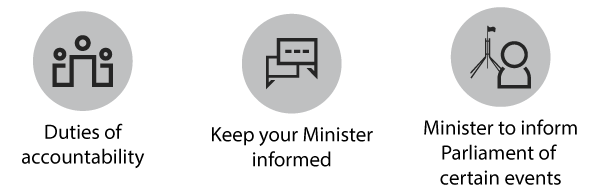
As an accountable authority, section 19 of the Public Governance, Performance and Accountability Act 2013 (PGPA Act) requires that you assist your minister in discharging their duties of accountability to the Parliament and the public. This includes that you:
- keep your minister informed of the activities of the entity and any subsidiaries
- provide your minister and the Finance Minister with any reports, documents and information they require about those activities
- notify your minister of any significant decision you make about the entity or any of its subsidiaries
- give your minister reasonable notice of any significant non-compliance with the finance law that may affect your entity or any of its subsidiaries, with a copy provided to the Finance Minister
- notify your minister if you become aware of any significant issue that has affected the entity or any of its subsidiaries.
You may also need to advise your minister of their responsibilities under the PGPA Act. This requirement may arise, for example, when your minister:
- approves a proposed expenditure, or
- is required to inform parliament about an entity’s involvement in a company.
Notifying your minister about significant decisions and issues affecting the entity
The PGPA Act (section 19) requires, among other things, that accountable authorities of Commonwealth entities notify their responsible Minister of any significant decisions or issues that have affected or may affect the entity. Accountable authorities must also notify the Finance Minister if significant issues involve non-compliance with the finance law. These issues must also be disclosed in entity annual reports.
What should be reported?
It is a judgement for the accountable authority to determine if a decision or issue is ‘significant’ (that is, important; of consequence) in the context of their entity. Whether a decision or an issue is ‘significant’ will depend on a range of factors, including, but not limited to:
- Materiality - the importance of the issue relative to the entity’s size and operations (including the value and volume of non-compliance)
- Occurrence - whether the non-compliance is one-off or systemic, and
- Risk - whether the issue is likely to be politically sensitive and the likely or actual impact on the reputation, public perception, financial position or financial sustainability of the entity or that of others (bearing in mind that consequences may be non-financial).
Examples of issues that accountable authorities may consider significant, depending on the entity’s context, would include:
- issues that involve significant non-compliance with the finance law (as described in RMG-214 Notification of significant non-compliance with the finance law).
- a significant deterioration in the entity’s financial position, whether or not caused by events outside the control of the entity.
- instances of non-compliance with other laws that is not isolated and/or minor, including non-compliance with the entity’s enabling legislation, privacy, employment, work health and safety, or other generally applicable laws.
Notifying the Finance Minister of significant non-compliance with the finance law
Accountable authorities must notify the Finance Minister if significant issues involve non-compliance with the finance law. These issues must also be disclosed in entity annual reports. See RMG-214, RMG-135 Annual reports for non-corporate Commonwealth entities and RMG-136 Annual reports for corporate Commonwealth entities for more information.
An issue can be a significant issue for the purposes of section 19 without involving significant non-compliance with the finance law. For example, non-compliance with the primary legislation establishing the entity may be a significant issue affecting the entity requiring notification to the responsible minister but may not involve non-compliance with the finance law. Conversely, systemic or high value instances of spending that is not supported by a valid appropriation may involve significant non-compliance with the finance law. In those cases, the accountable authority must notify both their responsible minister and the Finance Minister, and disclose the issue in the entity’s next annual report.
PGPA Act section 72: Minister to inform Parliament of certain events
Your responsible Minister also has responsibilities under the PGPA Act which you should make them aware of. Section 72 of the PGPA Act requires that the responsible Minister informs the Parliament of the Commonwealth's or a prescribed entity's involvement in a company, or in one of the events listed under section 72.
Finance have developed a template for ministers to inform Parliament. This is available under Tools and templates.
Explore your other duties
