
Non-regulatory activities are generally those where the government provides a good or service on a discretionary basis. They may involve a good or service that could be substituted by another service or supplier. Whether the activity is being provided by the government as a sole supplier or in a competitive market determines whether the activity is deemed resource or commercial.
Charging for a non-regulatory activity may require a Government decision or may be made by the Accountable Authority and/or responsible Minister, depending on the level of complexity, sensitivity and materiality.
Resource
Non-regulatory activities of a resource nature involve the provision of specific rights, privileges or access to Commonwealth property, goods and services where there is no reasonable commercial alternative.
A charge for resource activities generally utilises value-based pricing, with prices set to reflect the potential value of the resources to the recipient. The price relates to the potential value of the activity to the individual or group, based on the value of the resource, or access to the resource.
Some situations may have components that appear regulatory in nature and require legislation, others may involve commercial contracts.
Commercial
Non-regulatory activities of a commercial nature involve situations where the Government is involved in a competitive or potentially competitive market, and the user has accessible and comparable alternatives. Even when the Government is the sole provider of the activity, there is usually a degree of user discretion (that is, it is voluntary) about whether the good or service is used.
A charge for commercial activities generally utilises open market pricing, where pricing relates to the closely comparable product or next best alternative.
Charging for non-regulatory activities
Charging for non-regulatory activities requires a specific benefit to an individual or group, based on the value of good or service consumed.
Charging for non-regulatory activity is not restricted to the cost of delivery to the individual or group. Pricing decisions are driven by the policy intent, relevant legislation, an understanding of the full cost of delivery, consideration of the value the user has for the output and if a similar good or service is easily substituted.
| Type of government activity | Resource | Commercial | |
| Nature of the activity | Non-regulatory activities involve a degree of user discretion. The price is usually not required to be determined by a legal instrument. Compliance and enforcement is contract based. | ||
| Relationship between activity and the individual or group charged (reciprocity) | Direct causal relationship between individual charged and the output being delivered is required. | ||
| General characteristics | The Government is the only supplier or the only supplier that is reasonably accessible. | The Government as a supplier is one option compared to other comparable goods and services. | |
| Policy approval or policy authority to charge | Government or Responsible Minister and/or Accountable Authority | ||
| Statutory basis to charge | Legislation is required | ||
Charging Model
| Costing model | Accountable Authorities should understand and document costs of the activity | |
Pricing model | Value-based pricing | Market based pricing, with the price always above cost | |
| Relationship between charges (revenues) and costs (expenses) at the output | Charges based on the potential value of the activity to the recipient (R</>E) | Charges based on market rates (R>E) | |
| Publicly available documentation | Accountable Authorities should ensure the appropriate level of publicly available documentation for non-regulatory charging | ||
| Public reporting under the PGPA Act | Annual Report (financial statements and performance) | ||
| Governance Finance Statistics reporting classification | Non-taxation revenue | ||
Requirements for charging
Charging Policy provides principles and minimum requirements for all non-regulatory charging, and additional requirements for high risk (material, sensitive and complex) non-regulatory activities.
Following information also offers tools, processes, and better practice that may support accountable authorities responsible for non-regulatory charging in discharging their duties of proper use of public resources by improving the effective cost control, transparency of the charging processes and assist in documentation of decision making.
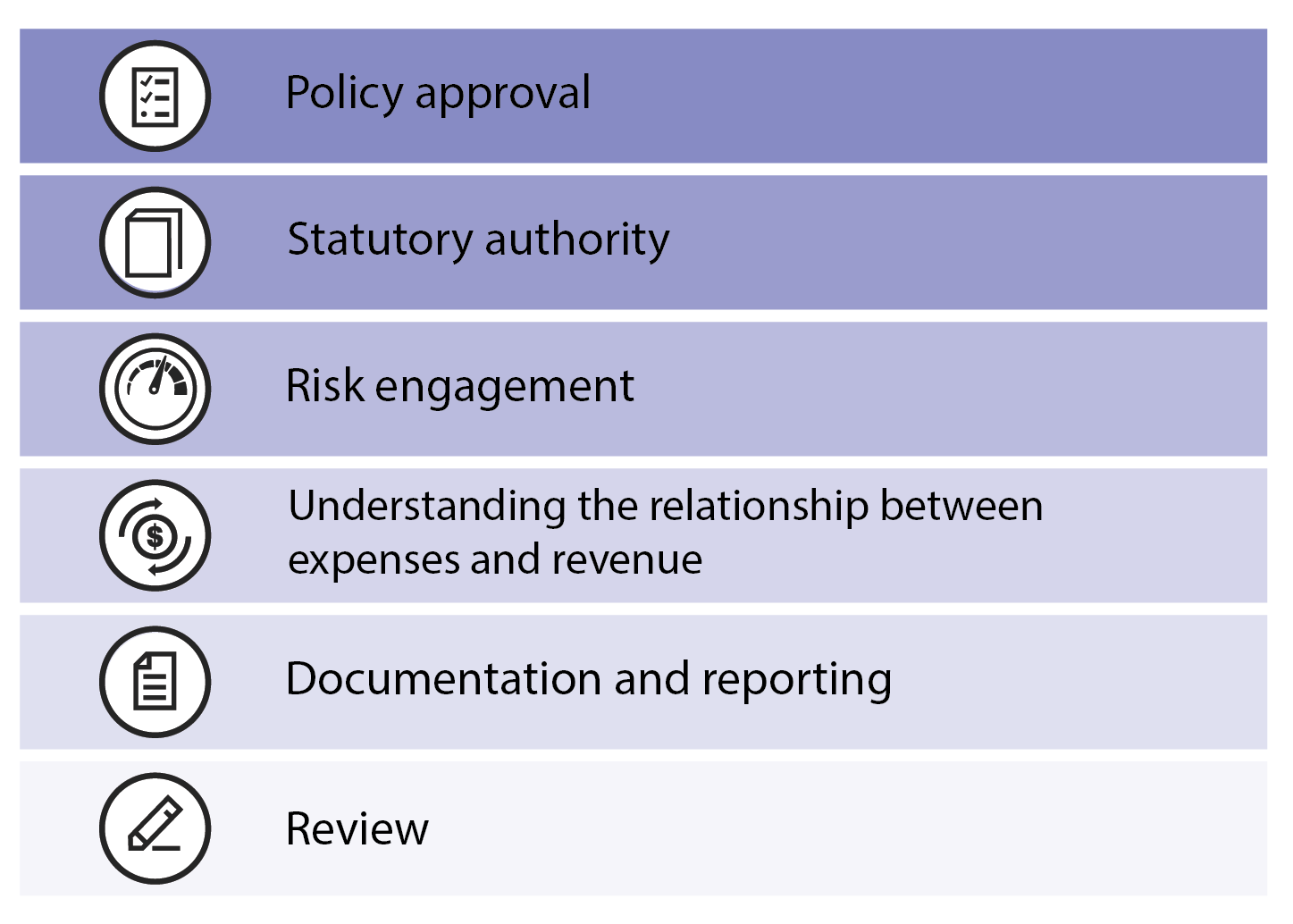
Policy development and design
The Accountable Authority of an entity is responsible for ensuring there is authority to charge for non-regulatory activities from the Government, or the responsible Minister or themselves (depending on the risk assessment of materiality, sensitivity or complexity).
Appropriate approval to enable charging for an activity requires separate decision points. The decisions may be sought separately or concurrently with the policy approval, depending on the circumstance and the nature of the activity.
Decisions are needed to provide:
- approval to provide the activity to the non-government sector to achieve the policy objective
- approval to charge the non-government sector for the activity and at what level (for example, below, at, or above full cost)
- approval to develop or change legislation if required.
Nature of resource or commercial activities for policy development
Entity staff are expected to conduct appropriate research and analysis when assessing the potential to charge and the level of a charge, for new or existing government activities or when making changes to the level of a charge. This analysis will help determine whether there is a policy rationale to charge or not and what the outcome of charging is likely to be. This analysis will also assist in determination of whether the charges are of resource or commercial type.
Accountable Authorities are expected to ensure a risk assessment of the materiality, sensitivity and complexity of the activity undertaken, as well as determining whether the policy objective will be achieved if charging is implemented. The nature of resource or commercial activities, along with its charging risk assessment, determines the approval process and treatment of these activities and charges.
Undertaking charging risk assessment early in the planning process will assist in this determination. For more information refer to the risk engagement section.
Approval of the policy
Resource and commercial charging require policy approval from the responsible Minister or Accountable Authority unless the charging is considered high risk. Once the charging meets this criteria of material, sensitive or complex, the Accountable Authority of the entity should consider seeking policy approval from the Government (from the Cabinet or Prime Minister). The Government authority is also needed when developing of new legislation or changing the existing one, and therefore consider whether policy approval from the government is also required.
Where non-regulatory activities require the Government decision to commence charging or the level of the charge, Accountable Authorities for in scope entities should consider contacting both the Office of Impact Analysis as part of the New Policy Proposal and applying the Regulatory Policy, Practice & Performance Framework when developing a regulatory policy proposal.
Where the policy approval is needed for the material, sensitive or complex resource or commercial charging, it is sought by preparing a policy proposal and recommendations for Government consideration in accordance with the Budget Process Operational Rules. If policy approval is sought from Cabinet, authority to bring the proposal forward for consideration is required – refer to the Budget Process Operational Rules and Cabinet Handbook.
Accountable Authorities are required to ensure records are maintained of the policy approval to undertake charging for the activity (the Budget paper), including authority for relevant legislation.
In certain circumstances, an entity’s enabling legislation or other legislation may provide the statutory authority to charge for a non-regulatory activity. If charging is not supported by existing legislation, new charging may require new or amended legislation to give a legal basis to charge.
When charging for resource activities that involve the provision of specific rights, privileges, or access to public resources, infrastructure and/or equipment some elements may have a regulatory component that require legislation, others may involve commercial contracts.
Charging for commercial activities that include the provision of specialist or expert services; retail; manufacturing; tailored data provision; advertising and sponsorship authority is likely through commercial contractual arrangements.
Accountable Authorities should ensure guidance from Finance and the Department of the Prime Minister and Cabinet is sought early in the policy development that enables charging.
Risk engagement involves ongoing assessment and management of charging risk. A key element of planning, designing and managing charging is to identify and engage with risk at each stage of the charging process.
During the development of policy, implementation and review of charging arrangements, Accountable Authorities must ensure the assessment of the risks associated with the charging. This will have an impact on who makes the decision to charge, the risk management strategy to ensure the charging achieves its stated intentions, the scale and detail of the charges and the stakeholder engagement strategy.
When analysing charging risk, Accountable Authorities must ensure the consideration of the entity’s operating environment and factors that influence charging across 3 areas: complexity, materiality and sensitivity.
This analysis could include the following:
| Complexity relates to the structures, processes and implementation of the specific activity. Complexity may be influenced by: |
|
| Materiality relates to the financial value of the charging and may be influenced by: |
|
| Sensitivity relates to the level of interest in the activity or the charge for the activity from government stakeholders, non-government stakeholders, the media and the Parliament. These considerations include: |
|
Accountable Authorities must ensure the assessment of the risks associated with materiality, complexity and sensitivity for any new or amended non-regulatory charging, as part of the policy proposal process and for subsequent changes to charging arrangements.
A charging model is made up of 2 separate components, the determination of expected expenses (through a cost model) and the determination of pricing for the output to the user (through a price model).
Cost model
An effective and up to date cost model enables Accountable Authorities to establish the costs and assist with developing an appropriate price model.
Accountable Authorities are expected to have a good understanding of what the costs are to the entity for delivering a particular activity.
For example, for a:
resource charge, the Accountable Authority should know how much it costs for an output and the activity.
commercial charge, the Accountable Authority should know how much it costs for an output and the activity .
This assists Accountable Authorities when required to:
- justify the proper use of public resources
- measure and improve efficiency and performance of delivered activities
- managing effectively any amendments required to the activities scope or charging level.
Price model
For non-regulatory activities are voluntary in nature and the user may pay a price for a good or service received.
The price may be set to recover above, at or below costs and there are a range of pricing models available.
- Charging for commercial activity should be based on market prices and consistent with all applicable policy, including Competitive Neutrality policy.
- Charging for resource activity, where the Government is the only reasonable supplier from the perspective of the user, should be on a value based model. Consideration should be given to the economic advantage a business may gain from the price and when in the future it will be clear the Government’s policy objective from the price chosen may be achieved.
Examples may include: licences to access or utilise natural resources, use of public infrastructure, or sale of government publications.
A better practice charges would be:
- clear and easy to understand
- closely linked to the specific activity
- set accordingly to the price model of the specific activity
- efficient to determine, collect and enforce
- set to avoid volatility, while still being flexible enough to allow for changes based on fluctuations in demand or costs.
Charges review and indexation
As a default, non-regulatory charges should be reviewed on an annual basis with a view to applying indexation to the costs and appropriately adjusting the price. A charging is only exempt from the annual cost increases if policy outcomes are significantly adversely impacted.
Where the price does not rise aligned to the change in cost, there will be a budget impact. The Accountable Authority must make sure the appropriate budget process occurs when prices do not change on an annual basis where the cost does change.
Accountable Authorities must ensure that
- internal documentation that demonstrates achievement of charging objectives are maintained.
- actual expenses and revenue at an aggregated level for the charging with respect to the decision to charge and any annual financial statements are reported
- where appropriate, resource and commercial activities non-financial charging performance measures are in the Corporate Plan and report on these measures in its Annual Performance Statement.
A better practice for charging documentation will typically summarise the purpose for charging for an activity and, when appropriate, refers details of the authority to charge (for example, legislation or Budget paper). The documentation, irrespective of the type of charge, would also provide information on how charging is implemented, managed and monitored. It would also collect information on how the activity is performing on an ongoing basis, including how the entity has addressed the charging principles and requirements.
This documentation may also be used in Portfolio Charging Reviews and supports the Accountable Authority to meet their responsibilities under the Public Governance Performance Accountability Act 2013.
Non-regulatory charges Financial Performance
Annual reports and Annual Financial Statements
A Commonwealth entity must report in accordance with the Public Governance, Performance and Accountability (Financial Reporting) Rule 2015 (FRR).
For more information on Financial Statements reporting requirements and Annual Reports see the RMGs in the right hand menu under tools and templates.
Non-financial performance
The Accountable Authorities of a Commonwealth entity must measure and assess the performance of the entity in achieving its purposes. Delivery of the resource and commercial activities may contribute to achieving these purposes.
Performance measures and other information are key inputs used by Commonwealth Accountable Authorities in evaluating whether outputs have been produced and outcomes have been achieved.
The primary planning document outlining entities non-financial performance is the corporate plan. It provides Parliament, the public and stakeholders with an understanding of the purpose of an entity, its functions, objectives and role.
Accountable Authorities should consider whether consultation with stakeholders relating to commercial or resource charging may be appropriate and make these public where appropriate.
Over time, charging or a level of the charge may no longer be consistent with government policy priorities or may become inefficient. In such circumstances, entity staff should consider whether the activity of charging or the charge should be reviewed.
When reviewing existing charging, Accountable Authorities should consider whether the policy intent of the activity is being appropriately supported by the price level of the charge.
Accountable Authorities may need to make changes to charging as a result of changes in cost, stakeholder feedback/changes in the open market/operating environment, policy changes or internal monitoring and evaluation. The nature of the changes will determine how they should be approved and implemented. Accountable Authorities may need to seek advice on the potential policy or legal implications of expected or potential changes to the charging or the level of the charges.
The treatment of changes to regulatory charges depends on the charging risk assessment (complexity, materiality and sensitivity) of the charge to the user and the total costs and revenues to the government.
Regular review provides assurance on how the level of the actual charge aligns to the policy objectives, Government decision and relevant legislation or contractual obligations.
