RMGs are guidance documents. The purpose of an RMG is to support PGPA Act entities and companies in meeting the requirements of the PGPA framework. As guides, RMGs explain the legislation and policy requirements in plain English. RMGs support accountable authorities and officials to apply the intent of the framework. It is an official’s responsibility to ensure that Finance guidance is monitored regularly for updates, including changes in policy/requirements.
Audience
This guide is for officials in non-corporate Commonwealth entities (NCEs). It helps you advise your accountable authority on when consultants, independent contractors or their employees can be prescribed as officials of an NCE under subsection 9(1) item 1A of the Public Governance, Performance and Accountability Rule 2014 (PGPA Rule).
Key points
A consultant or independent contractor is not considered an official of a Commonwealth entity for Public Governance, Performance and Accountability Act 2013 (PGPA Act) purposes (see section 13 of the PGPA Act). Exceptions apply to entities listed in section 9 PGPA Rule and with particular listed entities.
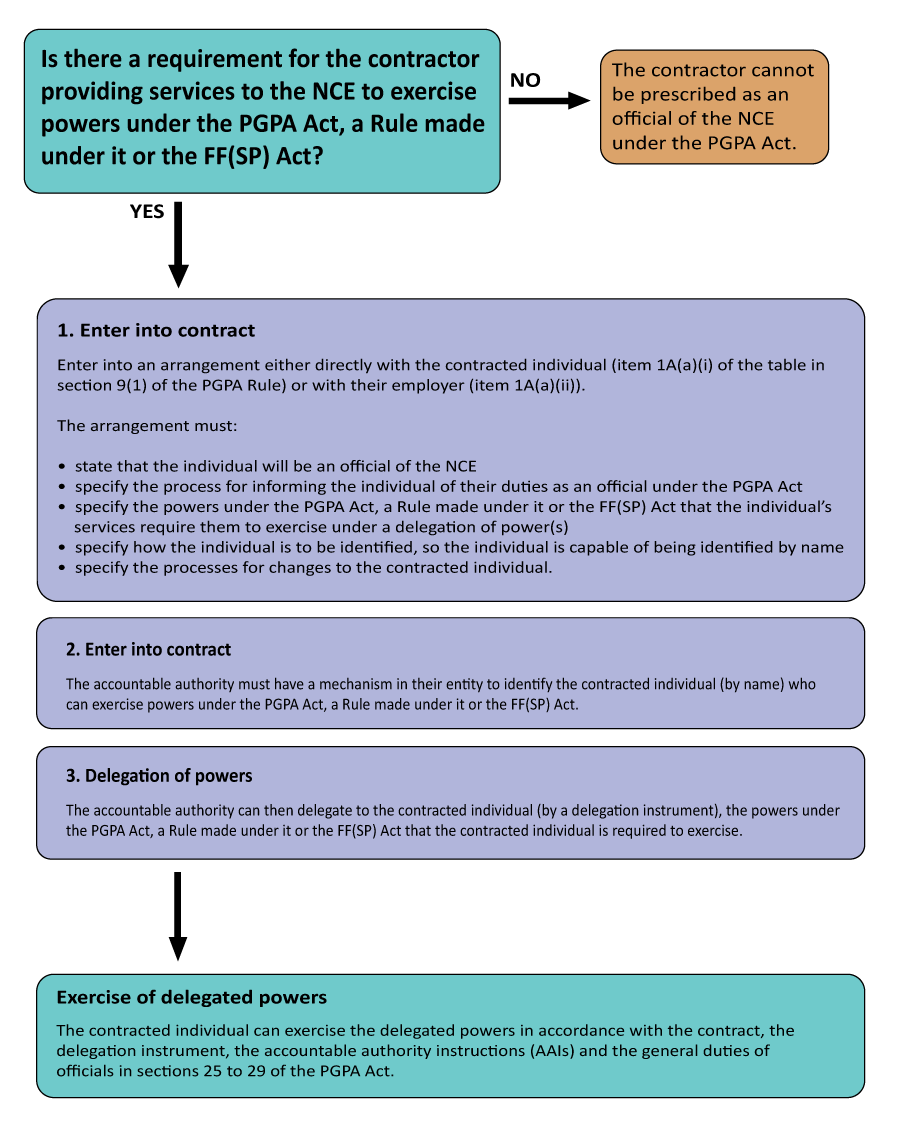
Item 1A of the table in subsection 9(1) of the PGPA Rule prescribes a consultant or independent contractor or their employee (collectively described in this guide as a ‘contractor’) as an official of an NCE, if the requirements listed in item 1A are met.
If the requirements in item 1A are met, the contractor is an official of the NCE and may be delegated powers under:
- the PGPA Act,
- any Rule made under it, or
- the Financial Framework (Supplementary Powers) Act 1997 (FF(SP) Act).
As a ‘prescribed official’ under the PGPA Rule, the person:
- is subject to must follow the general duties of officials under the PGPA Act while they provide relevant services to the Commonwealth,
- is subject to the entity’s internal controls, including any accountable authority instructions, and
- requires a delegation of powers, duties or functions in the PGPA Act, a Rule made under it or the Financial Framework (Supplementary Powers) Act 1997 (FF(SP) Act) that they are required to exercise (as well as any instructions if required).
Resources
Related resources including other guidance, links, glossary terms, publications, and relevant sections of the PGPA Act and Rule are in the right-hand menu.
When should powers, duties or functions be delegated to a contractor prescribed as an official?
An accountable authority would only rely on item 1A of subsection 9(1) of the PGPA Rule when the contractor is required to exercise a delegated power, perform a function or discharge a duty under the PGPA Act, a Rule made under it, or the FF(SP) Act as part of their services. This is a necessary condition under item 1A(b) of subsection 9(1).
It is expected that an accountable authority would only rely on the PGPA Rule to class a contractor as an official where it is not practical for an existing official to exercise the relevant powers, perform functions or discharge duties.
Conditions for prescribing
A contractor is prescribed as an official of an NCE by the PGPA Rule where they are:
- an independent contractor, consultant or an employee of an independent contractor or consultant.
- engaged to provide services to a NCE that require exercising powers, perform a function or discharge a duty under the PGPA Act, a Rule made under it or the FF(SP) Act, and
- can be identified by name by the accountable authority for the purposes of item 1A of the table in subsection 9(1).
If a contractor does not need to exercise powers, perform a function or discharge duties as part of their services, they cannot be defined as an official under item 1A of subsection 9(1).
Examples of tasks that do not require exercising powers, performing functions or discharging duties under the PGPA Act, a Rule made under it or the FF(SP) Act include:
- making payments of relevant money under the direction of an official of the entity;
- collecting relevant money under the direction of an official of the entity, and
- a contracted individual from a salary packaging company transferring money from a Commonwealth entity’s bank account to a supplier that provides employee benefits.
Where a person holds money as an agent of the Commonwealth, the money is ‘other CRF money’ under section 105 of the PGPA Act and section 29 of the PGPA Rule. This does not require the person to be prescribed as an official of the relevant entity.
For more information on other CRF money, see RMG-303 Other CRF money.
Case studies
These scenarios cover common arrangements used by NCEs to engage contractors to use and manage public resources. They are designed to help determine whether a contractor is exercising a power, performing a function or discharging a duty under the PGPA Act, a Rule made under it or the FF(SP) Act.
A contractor is engaged to collect fees from the public for a Commonwealth service. Under the direction of an official of the NCE, a contracted individual (an employee of the contractor) collects money for the Commonwealth on Commonwealth premises, and deposits it in the NCE’s bank account.
The contracted individual does not make decisions about the fees to be paid and only processes the task.
Outcome: The contractor’s services to not require exercising powers under the PGPA Act, a Rule made under it and cannot be prescribed as an official under the PGPA Rule. The contractor’s rights and obligations need to be specified in their contract.
An external property service provider makes payments to a property owner on behalf of an NCE that leases its premises. Payments are made by drawing from the NCE’s bank account, in accordance with the contract between the Commonwealth and the provider.
Whether an employee of the property service provider exercises a power under the PGPA Act depends on whether the individual makes decisions in relation to the payments (that is, ‘administers’ an arrangement under section 23 of the PGPA Act) or only processes payments.
- If the individual performs processing tasks under instruction without making any decisions, they are not exercising a power under the PGPA Act or a Rule made under it.
- If the individual’s services includes making decisions about the arrangement, they may be administering the arrangement under section 23 of the PGPA Act (that is, exercising a power in the PGPA Act). They must be prescribed as an official under item 1A of subsection 9(1) and delegated the relevant powers.
In this case, the contract with the service provider must:
- State that the relevant individual will be an official of the NCE.
- Explain how the individual will be informed of their obligations as an official.
- Specify the powers under the PGPA Act they will exercise.
- Detail how the individual will be identified by name (as required by the PGPA Rule) and how the accountable authority will be informed of any changes to the individual required to exercise the powers.
An NCE engages a contractor (an employment firm) to provide the services of a contracted individual. as part of their services, the individual is required to exercise powers under the PGPA Act, a Rule made under it or the FF(SP) Act.
Outcome: The contract between the contractor and the NCE must:
- State that the individual will be an official of the NCE;
- Explain how the individual will be informed of their obligations as an official. This may include briefing them of their duties under the PGPA Act before they begin.
- Specify the powers they will exercise.
- Detail how the individual will be identified by name (as required by the PGPG Rule) and how the accountable authority will be informed of any changes to the individual required to exercise the powers.
An NCE engages a contractor to purchase equipment on its behalf. The NCE will be invoiced directly for the equipment.
The NCE provides the contractor with the authority to decide what goods to purchase and to make the purchase. Employees of the contractor are therefore required as part of their services to enter into an arrangement under subsection 23(1) of the PGPA Act. They are also required to approve the commitment of relevant money under subsection 23(3).
Outcome: In this case, the arrangement between the contractor and the NCE must:
- State that the contracted individuals will be officials of the NCE.
- Explain how the individuals will be informed of their obligations as officials. This may include briefing them of their duties under the PGPA Act before they begin.
- Specify that the contracted individuals are required to exercise powers under section 23 of the PGPA Act.
- Specify how the contracted individuals will be identified by name; and
- Detail how the Contractor must notify the accountable authority if there are any changes to the contracted individuals required to exercise powers.
How to prescribe a person as an official of an NCE?