
Australian Government Charging Policy 2026 replaces the Australian Government Cost Recovery Policy 2014 and Australian Government Charging Policy 2015 from 1st October 2026.
Introduction
The Australian Government provides a diverse range of services, support and benefits to the Australian public to achieve its policy outcomes. These activities are funded through a mix of revenue sources, including general taxation, investment returns and charging. Charging a price to an individual or group is one mechanism the Government uses to fund activities in a way that supports policy outcomes, promotes equity, and enables sustainable use of public resources.
The Australian Government Charging Policy (Charging Policy) is to be applied by Commonwealth Government entities when charging for the provision of services, products and regulation to the non-government sector. The focus of this policy is the price paid by those being charged.
The Charging Policy establishes a framework to guide decision making on whether to charge, including who should be charged and the appropriate level of charging, based on relevant costs. It sets out the considerations, principles and requirements that support transparent, evidence based and well governed charging arrangements, while allowing flexibility to reflect specific policy contexts.
The Charging Policy is designed to both minimise the price for regulatory activities to no more than cost and to support effective regulation while minimising financial burden on individuals and groups. The policy provides standards and reporting to assess regulatory charging, manage risk, stakeholder engagement and ensure charging arrangements remain aligned with policy objectives over time.
For all activities that are charged for, the policy aims to improve the quality and consistency of, and confidence in, government charging practices.
This policy is supported by and should be read in conjunction with other policies, including those that cover:
- New Policy Proposals (Department of the Prime Minister and Cabinet)
- Competitive Neutrality (Department of the Treasury)
- Budget Process Operational Rules
- The Portfolio or Departmental Accountable Authority Instructions
- Relevant Department of Finance Resource Management Guides (RMG), including:
- Commonwealth Entity Financial Statements
- Regulator Performance
- Retainable Receipts.
Download:
- 2026 Australian Government Charging Policy PDF [605KB]
- 2026 Australian Government Charging Policy Summary of Changes PDF [279KB]
The 2026 policy changes compared to the combined Australian Government Charging Policy 2015 and Australian Government Cost Recovery Guidelines 2014.
The following are the key changes to the Charging Policy:
- Consolidating three existing policies into a single, simpler policy to streamline requirements, with improved formatting and infographics to support compliance.
- The consolidation of 9 principles into 6, comprising effectiveness, efficiency, transparency, accountability, stakeholder engagement, and performance. This simplifies expectations, streamlines the policy and reduces complexity, consistent with the Government’s regulatory reform agenda.
- Requiring Portfolio Charging Review (PCR) reports to be sent to the Minister for Finance to confirm delivery against the agreed Terms of Reference.
- Reduce internal administration by discontinuing the biennial charging survey. Comparable data will instead by collected through more frequent PCRs.
- PCRs to be undertaken on a 3-year cycle instead of 5-yearly, to enable more timely consideration by Government of opportunities for new or amended charging.
- Confirm that regulatory cost recovery prices must be adjusted in accordance with changes in expenses and reviewed annually. This supports the collection of non-taxation revenue in line with the relevant government policy decision and will ensure that revenue is better aligned to entity expenses.
- Remove the requirement for Finance to agree a low rating in a Charging Risk Assessment where charging is being updated (i.e. not new charging). This provides simpler on-going administration and implementation as entities will be able to make timelier administrative reviews and amendments.
Charging Policy
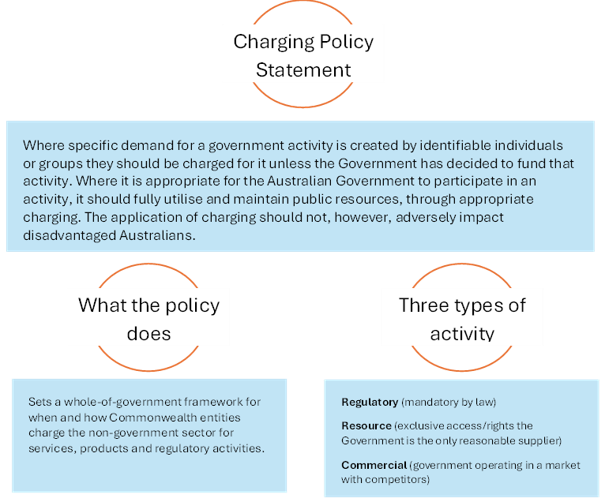
- The Australian Government Charging Policy (the Charging Policy) is driven by the Charging Policy Statement. It guides the decision to charge or not charge an individual or a business and the level of charging, based on the Charging Policy Statement, the purpose for charging and the relevant policy considerations. Figure 1 summaries the policy approach.
- The Charging Policy Statement:
‘Where specific demand for a government activity is created by identifiable individuals or groups, they should be charged for it unless the Government has decided to fund that activity. Where it is appropriate for the Australian Government to participate in an activity, it should fully utilise and maintain public resources, through appropriate charging. The application of charging should not, however, adversely impact disadvantaged Australians’.
Sets a whole-of-government framework for when and how Commonwealth entities charge the non-government sector for services, products and regulatory activities.
Regulatory (mandatory by law)
Resource (exclusive access/rights the Government is the only reasonable supplier)
Commercial (government operating in a market with competitors)
Purpose of charging
- The Government may charge the non-government sector for goods, services and regulation for a number of reasons, including to:
- recover part, all or more than full cost of the goods, services or regulation.
- promote equity, whereby the individual or group that creates the need for a government activity, bears the cost of activity, rather than the general public.
- influence demand for government activities or services.
- improve the efficiency, productivity and responsiveness of government entities providing the activities.
- improve accountability and transparency of the cost and pricing arrangements for the activity.
- increase cost consciousness among all stakeholders, including those being charged, the entity conducting the activity or service and for budget processes.
Entities In-scope
- The Charging Policy applies to all non-corporate Commonwealth entities (NCE) and to selected Corporate Commonwealth Entities (CCEs) under the Public Governance Performance and Accountability Act 2013 (PGPA Act). 1
Activities in and Out-of-scope
- All activities undertaken or performed by in-scope entities for the non-government sector - whether currently charged for or not - are subject to the policy, unless the activity is specifically excluded2.
- Activities of entities in-scope that are not subject to the Charging Policy and therefore excluded are:
- inter- and intra-government activities. These are transactions between Commonwealth entities or between the Commonwealth Government and Foreign, State and Territory or Local Governments. They are not in-scope unless the non-government sector creates the need for them.
- partnership activities or similar arrangements.
- activities of Commonwealth courts3 in conducting their prescribed business, including the imposition of penalties and settlements, court fees and similar fees.
- any one-off or ad hoc event, activity or service.
- investment activities that result in investment returns, interest, dividends, debt charges and related charges being paid to the Commonwealth Government.
- loan activities that result in repayments to the Commonwealth Government.
- activities that are established in response to an arrangement whereby the Government receives co-payments or co-funding.
- activities involving grants, donations or similar amounts.
- sale of assets, investments or similar capital items.
- Law enforcement, defence, and national security activities undertaken by designated law enforcement, defence, or national security entities, will usually be excluded activities. However, activities of these entities that support or are ancillary to these entities’ primary functions are in-scope activities, unless excluded.
Out-of-scope activity categories:
- Statutory marketing authority activity
- raising Custom duties or Goods and Services tax
- Commonwealth courts conducting their prescribed business, including the charging of penalties and settlements
- Inter- or intra-government activities
- Realising contractual penalties
- Investment or loan activities
- Partnership, grants, or co-funding activities
- One-off or ad hoc events
In-scope activity categories:
- Approvals
- Registrations
- Monitoring compliance
- Government Licences or permissions
- Access to public assets
- Sale of government goods or services
- Entry to institutions
Type of activity
- To guide charging, the Charging Policy establishes consistent definitions for types of in-scope activity. These definitions do not override other definitions, such as definitions for legal or accounting purposes, or those in related other policies.
- For charging purposes, in-scope activities are divided into 3 types:
- Regulatory
Regulatory activities are activities that are mandatory and imposed by law on the individuals and groups that they otherwise would not have done. There is no discretion available to the individuals or groups regarding undertaking the activity or how it must be carried out. - Resource
Resource activities involve the provision of specific rights, privileges, and access to public resources or services by the Government to individuals in the non-government sector, that only the Government may provide4. - Commercial
Commercial activities are those activities where the Government is providing products or services to individuals in the non-government sector in a market where there are actual or potential competitors5.
- Regulatory
- Resource and Commercial activity may be referred to collectively as non-regulatory activities for the purpose of this policy.
- The three types of in-scope activity result in three types of associated charging. Where a charging approach is adopted that is not as defined by the Charging Policy e.g. by a decision of government, this decision moves the charging arrangement outside the policy- Figure 3 provides examples.
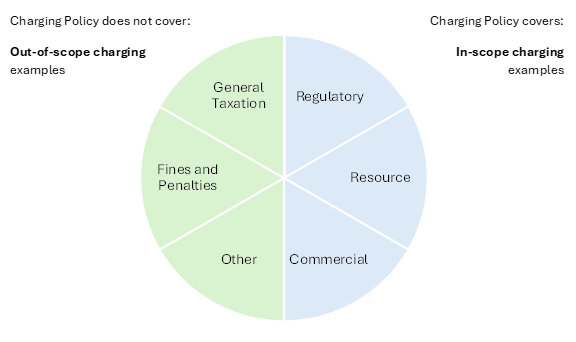
Out-of-scope charging examples:
- General taxation
- Fines and penalties
- Other
In-scope charging examples:
- Regulatory
- Resource
- Commercial
Elements of the Charging Policy
- The Charging Considerations, Principles and Requirements guide how to determine whether to charge and the level of the charge.
Considerations
- In considering whether it is appropriate to charge for a new or existing activity and/or the appropriate level of charge, the Accountable Authority of the in-scope entity (the Accountable Authority) must ensure that the Government, or themselves as the decision maker, are advised of all of the following for each charging arrangement:
- if the entity or the activity is excluded by the Charging Policy and for what reason.
- the purpose(s) of both the activity and of potentially charging for the activity.
- the identifiable individuals, organisations or group that receives the outputs from government activity or creates the need for them.
- that it is possible to charge the identified parties.
- application of the principles and the type of activity.
- the cost of both the activity and its outputs.
- how the charging might affect:
- those who are charged over a range of different price levels, including the price that recovers the full cost.
- the outcomes or purpose of the activity.
- other government policies and legislation (consistency).
- Australia’s obligations under international treaties.
- how the outcomes from charging will support other Australian Government policy priorities and policies, including the specific outcomes and policy objectives for the activity.
- the impact of charging on competition, innovation or the financial viability of those who may need to pay the charges and the cumulative effect of other government activities.
- the risk associated with different levels of charging, including where the price equals the cost, and how these risks will be appropriately managed, including with regard to the impact of the complexity, sensitivity and materiality of the charging on those being charged, the government and entity.
- whether the charging arrangement is straightforward and practical, readily understood by those being charged, and feasible for the entity to collect.
- This means balancing the simplicity of the charging arrangement against the value of, or need to ensure, close alignment of the charge to the cost of the output.
- the cost of setting up or connecting to a charging system and maintaining the arrangement, as part of the total cost of the activity, and how much of this total cost of activity may is charged for, after all other considerations are addressed.
Principles
- The six charging principles assist in the design, implementation and review of charges for new and existing activity. Accountable Authorities must ensure the principles are considered when developing arguments to charge, or not to charge, and the level of any charging for new and existing activity.
- The principles are:
- Principle 1 - effectiveness – the degree of achievement of the Government’s purpose for charging for an activity.
- Principle 2 - efficiency - delivering activities at the lowest possible cost of effort, while meeting policy objectives for charging and the activity.
- Principle 3 - transparency - open communication and appropriate scrutiny of the level of government charging, charging decisions and management processes.
- Principle 4 - accountability – clear roles and responsibilities for key stakeholders in all stages of the charging process and appropriate governance structures.
- Principle 5 - stakeholder engagement –consultation on the impact of charges.
- Principle 6 - performance - regular review of charges and charging processes relative to the purpose of charging for an activity6.
Requirements
- Charging for different types of activity is agreed by different parties:
- the Government will determine whether it is appropriate to charge for and the price for a regulatory activity.
- the Accountable Authority will determine whether it is appropriate to charge for, and the level of the price for, a resource or commercial activity, unless the Accountable Authority considers that the complexity, sensitivity and materiality of the charging options warrant a Government decision.
- The Accountable Authority must ensure that the Government, or themselves as the decision maker, is presented with options for the implementation of new and existing charging, consistent with the Australian Government policy approval, relevant legislation, this policy and the broader resource management frameworks. This includes:
- establishing internal controls;
- ensuring that staff have the skills to manage the activity; and
- maintaining records and reporting.
Legal authority
- The ability to charge must be prescribed in legislation. This legal authority may be in the entity’s enabling legalisation, legislation that enables the activity or other legislation.
- For each existing activity that is to be charged for or a new proposed charging arrangement, the Accountable Authority must ensure there is legal authority to charge.
Policy Authority
- There must be policy authority to charge and policy authority for level of the charge7.
These two authorities may be made together or separately:
- for each regulatory activity that is charged for, the Accountable Authority must ensure there is:
- policy approval from the Australian Government to charge.
- policy approval from the Australian Government for the level of the charging.
- for each resource or commercial activity that is charged for, the Accountable Authority must ensure there is:
- policy approval from the Australian Government or the Accountable Authority to charge.
- policy approval from the Australian Government or the Accountable Authority for the level of the charging.
Cost requirements
- The Accountable Authority must ensure that the Government, or itself as the decision maker for resource or commercial charging, is advised of the total estimated cost of the activity and the estimated cost of an output to those being charged.
- The Accountable Authority must ensure that the identification and attribution of the cost of the effort to an output is consistent with the activity type:
- For a regulatory activity, the total cost of the activity will be sum of the efficient cost of each regulatory output, caused by an individual or group member and provided to that same individual or group member, over the appropriate business cycle for the output.
- For a resource and commercial activity (non-regulatory activity), the total cost of activity will be the sum of the cost of the effort required to conduct all the outputs the individuals cause over the appropriate business cycle for the activity.
- Where an activity is done for the non-government sector by one Commonwealth entity (the Lead entity), supported or enabled by the capability and assets of other Commonwealth entities, these supporting entity relevant costs are also costs of the activity that is being charged for the purposes of the Charging Policy:
- For a regulatory activity, the Accountable Authority of the supporting entity must ensure records are maintained to show that the relevant costs of the effort provided are only the efficient costs of that effort8.
- For a non-regulatory activity, the Accountable Authority of the supporting entity should ensure records are maintained to show the relevant costs.
Price requirements
- The Accountable Authority must ensure price levels are developed consistent with the activity type:
- For a regulatory activity, the price charged to the individual or group member will not exceed the efficient cost of the effort the individual or group member causes the government.
- For a resource activity the price charged to the individual will be determined by reference to the cost of the effort each individual reasonably causes the government and be set to achieve the policy objectives of the activity and Government’s broader policy agenda. For these activities, the benefits gained by each party may be considered in setting the price. The price per output may be below, at or above cost.
- For a commercial activity the price charged to the individual will be determined by reference to the cost of the effort individual reasonably causes and be set to achieve the policy objectives of the activity and Government’s broader policy agenda. For these activities, the benefits gained by each party may be considered in setting the price. The price per output must not be below cost and must comply with other Government policies.
The charging decision
- The Accountable Authority must ensure the Government or itself as the decision maker is provided with information regarding the impact the charging will have on both those who are paying and the Government. This includes:
- different levels of charging, unless the Government has already agreed a level.
- the risks and advantages for each level of charging for those who are paying and for government.
- the likely impact of charging on competition, innovation or the financial viability of those who may pay the charges.
- For a regulatory activity, the Accountable Authority must ensure the Government is presented with the indicative price that is equal to the efficient cost of the output. They may present options to partially recover, or not recover, the costs of an output.
- For a non-regulatory activity, the Accountable Authority must ensure the opportunity to maximise revenue from the activity, with respect to cost, is considered as part of the price decision.
Alignment of cost and price
- The costs used as the basis for a price update should be developed using knowledge of the business cycle for the activity, the type of activity, current processes for the output, the current year’s actual (or likely actual) volumes and input costs.
- The Accountable Authority must ensure prices are maintained consistent with the level approved as part of the relevant policy authority and the relevant cost, at least every twelve months. That is, maintain proportionately between cost and price. For example, where full cost recovery was approved, pricing should be maintained at a level that continues full cost recovery:
- for regulatory activity, the pricing for an output must maintain a discernible link with the efficient cost of the output and align to the pricing decision, and the entity has records to show how this alignment is achieved and ensured.
- for resource and commercial activity, the entity has processes and records to show how prices for outputs are set and maintained with respect to both the total cost of the activity and the cost of an output.
- Appropriate indexation rates may be used to provide estimated costs for next year.
- An exception to this is when a different amount or approach is set by either the Government, relevant legislation or the contract.
- Should prices not be changed annually for a regulatory activity that is charged for consistent with the Government’s pricing decision, the Accountable Authority must ensure the revenue impact of not achieving a price level consistent with the Government’s charging decision is presented to Government for agreement.
- Requirements are summarised in Figure 4.
Figure 4: Summary of requirements
| Requirement area | What it means in practice |
|---|---|
| Legal authority | You must have legislation that authorises charging (statutory authority). For each existing or new charge, ensure the legislative authority exists before charging. |
| Policy authority | You must have policy approval to charge, and policy approval for the level of the charge. Authority to keep receipts (e.g. special accounts/retainable receipts) does not provide authority to charge. |
| Costing | Regulatory: total cost is the sum of the efficient cost of each regulatory output (over the appropriate business cycle). Resource/Commercial: total cost is the sum of the effort required to deliver outputs caused by users (over the appropriate business cycle). Where multiple entities contribute (lead & supporting entities), relevant supporting-entity costs are included in the activity cost. |
| Price rules | Regulatory: price must not exceed the efficient cost of the output caused by the payer. Resource: price may be below, at, or above cost (depending on policy objectives and broader priorities). |
| Keep cost and price aligned | Maintain prices consistent with approved levels and costs at least every 12 months (unless a different approach is set by Government, legislation, or contract). For regulatory outputs, keep a clear, documented link between efficient cost and price. |
Reporting
- For each activity that is charged for, regardless of financial value, the Accountable Authority must maintain the required public reports. This includes:
- reporting all charging consistent with the reporting requirements of the Financial Reporting Rules9.
- reporting regulatory charging in the Regulatory Charging Statement (RCS)
- For each regulatory activity that is charged for, the following reporting is required
| RCS / CRA requirement (regulatory charging) | When |
|---|---|
| Prepare and publish a Regulatory Charging Statement (RCS) for each regulatory activity (or grouped activities) that is charged for. | Before charging starts |
| Publish the RCS on the entity’s website and update it at least every 12 months (or sooner if key details change significantly). | Ongoing (at least annual) |
| Complete a Charging Risk Assessment (CRA) when an RCS is initially prepared or updated; agree the CRA rating with Finance in certain cases (e.g., new charging; changes with medium/high risk). | Before publishing / updating RCS |
| If CRA rating is high, Finance Minister agreement is required before the RCS is released. | Before charging starts |
Regulatory Charging Statement
- A Regulatory Charging Statement (RCS) must be prepared for each regulatory activity or group of regulatory activities that are charged for.
- The focus of a RCS is the amount charged to those who pay and an assurance of control of the level of charging for Government10.
- Regardless of whether the charging covered by a RCS is new charging or existing charging, the Accountable Authority must ensure that a RCS is:
- prepared and published on the entity’s website
- published before charging commences
- updated at least every twelve months or sooner if financial and non-financial details change significantly.
- certified by the Accountable Authority of the entity (or their delegate) for a low risk CRA11.
- approved by the responsible Minister (or their delegate)12.
- agreed for release by the Finance Minister, if the Charging Risk Assessment for the level of the proposed charging risk is high.
- The Accountable Authority must ensure the RCS includes details prescribed at Table 1: Regulatory Charging Statement Requirements below.
- A RCS is prepared regardless of the financial value of the activity or the level of the charge.
- The Accountable Authority must ensure an annual update of a RCS, focusing on what has and is expected to change in the financial and non-financial information.
- Where one Commonwealth entity charges for the regulatory activity (the Lead Entity), but the effort to enable the regulatory output is conducted by more than one entity, the Accountable Authority for the Lead Entity must ensure the RCS reports all effort and cost.
Charging Risk Assessment for a charge for a regulatory activity
- Before a Regulatory Charging Statement is published, enabling charging to commence or continue, the Accountable Authority responsible for the activity that is charged for must ensure that the risks associated with materiality, complexity and sensitivity for any new or existing regulatory charging is assessed. This assessment must be informed using the Charging Risk Assessment (CRA).
- A CRA is needed when a RCS is initially prepared or updated, regardless of financial value.
- The purpose of the CRA is to assess the impact from the new or changed regulatory charging together with the risk engagement strategy in a RCS.
- The CRA rating must be agreed by officers of the Department of Finance where:
- the activity has not been charged for before; and
- for changes to existing charging arrangements, where the proposed or expected risk for the change is medium or high.
- Where a CRA rating for a revised existing charging arrangement is evidenced to be low:
- the Accountable Authority (or their delegate) must agree the low rating
- records of this agreement and supporting evidence must be kept
- this low CRA rating need not be agreed by officers of the Department of Finance.
- The outcome of the CRA determines whether the RCS needs to be agreed for release by the Minister for Finance in addition to the responsible Minister.
- A CRA rating of ‘high’, ‘medium’ or ‘low’ leads to one of three outcomes:
- High: the responsible Minister must seek the Minister for Finance agreement to relevant charging risk mitigation strategies prior to the release of the RCS and before charging begins or continues.
- Medium: the responsible Minister may release the RCS and does not also require the Minister for Finance agreement for release before charging begins.
- Low: the responsible Minister may release the RCS without further consultation with Finance.
- Figure 6 is the flow chart of the CRA process and outcomes, and how the outcomes change who approves a Table 1: Regulatory Charging Statement (RCS) for publication.
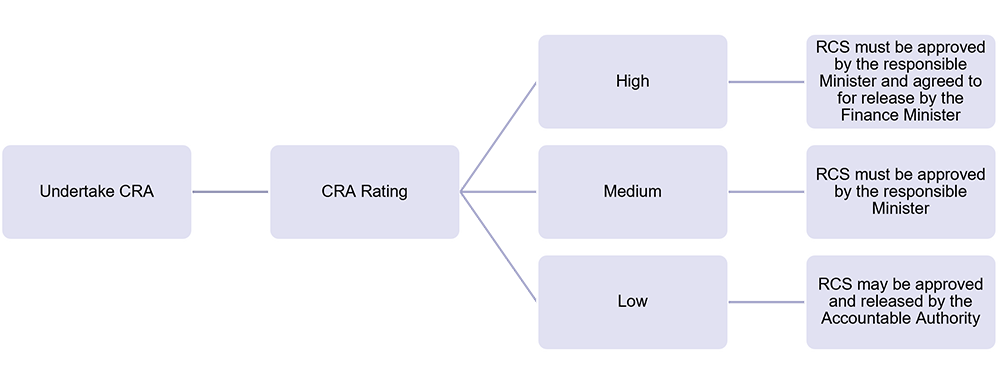
Table 1: Regulatory Charging Statement Requirements.
A Regulatory Charging Statement is for the non-government sector who pay the charges for a specific regulatory activity.
The RCS provides those who are charged with visibility of: the authority to charge, the cost and price management to keep the charge aligned to Government intent, charging outcomes and stakeholder engagement. It must include:
- background information on the regulatory charging, including its purpose, policy outcomes and outputs
- a description of the regulatory activity and the stakeholders who pay the charges or may be affected by the charges
- details of the Australian Government policy approval to charge for the regulatory activity. This may include the date and details of any relevant public announcements
- details of the legislation authorising the regulatory charges, including links to primary and secondary legislation
- an explanation of the effort attribution and cost management approach used to cost each regulatory activity output. This may include a description of how the output has been broken into tasks or processes and how these have been costed, including cost drivers and input assumptions
- the design of the regulatory charges, including which type of charges have been used and why, including the alignment (by dollar amount or methodology) of the price charged and the expected cost, their link the outputs and processes of the activity
- the processes in place to manage variations between forecast and actual cost, with respect to the price and the decision on the level of the charge, its impact on those being charged, the Government and the entity, on at least an annual basis
- the stakeholder engagement strategy for regulatory charging, including a summary of the latest engagement round and how views have been addressed, i.e. who was consulted and when, what their views were
- financial estimates for the charging (i.e. expenses and revenue) for the budget year and forward estimates
- financial and non-financial performance of the charging at the aggregate totals, including how actual outcomes compare to budget and expected non-financial assumptions
- key forward dates and events, including the next Portfolio Charging Review.
Performance
- The Accountable Authority for a Commonwealth entity must ensure assessment of the entity’s charging outcomes.
- A charging outcome is the extent to which the current charging approach and the level of charging is meeting Government’s policy objectives for both charging for the activity and the activity itself.
- Performance against charging objectives to determine charging outcomes may be assessed in several ways, including against:
- financial objectives
- legal standards
- audit findings
- program evaluations
- assurance reviews
- capability review
- the entity’s purposes and performance measures13.
- The measures used for charging performance should be:
- quantitative, qualitative and milestone information or be phrased in such a way that it is clear when the charging outcomes have been achieved
- authorised or endorsed by Ministers, Accountable Authorities or their delegates, whichever is appropriate
- documented
- reviewed at least every twelve months and whenever policy changes are made to the charging or activity.
Portfolio Charging Review
- A Portfolio Charging Review (PCR) is a review of all portfolio activities covered by the Charging Policy. It consists of whether current charging and the implementation of charging is consistent with this policy and the Government’s objectives and intensions.
- The PCR looks at a broader range of charges than just regulatory or cost recovery charges. By type of activity, it is an opportunity to:
- assess the extent of charging across the portfolio
- identify the potential for charging for new and existing activities
- compare and analyse different charging
- evaluate the performance of charging
- identify opportunities to amend or discontinue charging
- assess the effectiveness of stakeholder engagement strategies and opportunities for improvement.
Portfolio Department responsibilities
- The Accountable Authority for the portfolio Department must ensure a PCR is conducted for all in-scope activities of the Portfolio and existing and potential charging for each in-scope activity is assessed.
- A PCR must be conducted by each Portfolio at least once every three years.
- The PCRs must be done in accordance with the published schedule of PCRs. The schedule will be provided and updated by the Finance Minister from time to time, in consultation with the responsible Ministers.
- The Accountable Authority of the portfolio Department is responsible for coordinating information supplied by each entity in the portfolio and completing the PCR report to the Portfolio Minister in accordance with the schedule for PCRs.
- A PCR results in a report to the Portfolio Minister with recommendations to address any issues and opportunities for changes in charging to align with policy / Government intent.
- For each activity in-scope, the PCR reviews the legal authority and decisions to charge or not charge, including the level of charging. It notes what is being achieved, what should be achieved and any potential issues and opportunities.
- In conducting a PCR, the Accountable Authority for the portfolio Department must ensure:
- the relevant Portfolio Minister and the Minister for Finance agree the Terms of Reference (ToR) for the relevant PCR, prior to the PCR commencing.
- the PCR identifies issues and opportunities for charging associated with all in scope activity, presenting recommendations to the Portfolio Minister and the responsible Minister for actions that may start, stop, continue, adjust or improve charging or charging outcomes.
- the PCR includes reporting on the operating strategies and record keeping for charging and appropriate cost control for each activity.
the PCR is conducted by each entity in the Portfolio, consistent with the ToR agreed by Ministers and details as prescribed at Table 2: Portfolio Charging Review (PCR) Requirements. - records are kept of the process and information used to meet the details at Table 2: Portfolio Charging Review Requirements.
- the PCR Report is developed consistent with the details as prescribed at Table 3: Portfolio Charging Review Report Requirements.
- the PCR Report is submitted to the Minister for Finance to show that the PCR was conducted consistent with the PCR Requirements and agreed Terms of Reference (see Table 2: Portfolio Charging Review (PCR) Requirements).
- the PCR Report is presented to the Portfolio Minister and the Minister for Finance in the next Budget context.
Budget Authority
- Where the Portfolio Minister agrees with a recommendation to address an issue or opportunity identified in the PCR report that requires Government agreement to implement, a New Policy Proposals (NPP) may be brought forward as part of the relevant Portfolio Budget Submission for Government consideration during the Budget process, without the Portfolio Minister being required to seek further policy authority.
Table 2: Portfolio Charging Review Requirements.
At the request of the Portfolio Accountable Authority of the portfolio Department, the Accountable Authority of each portfolio entity must provide the following information to the Portfolio Accountable Authority as part of the PCR process.
- a list of all the entity’s activities that are in-scope of the Charging Policy and are charged for, including a description of who is charged and what they are charged for, including:
- the type of charging used for each activity (and whether the charging approach is consistent with the Charging Policy or not).
the Government’s purpose(s) for charging. - policy approval to charge (e.g. Accountable Authority, Cabinet).
- the policy approval for the level of the charge (e.g. the full cost, percentage of costs to be recovered and the range of effort that must be charged for).
- the legal authority to charge.
- the amount of actual revenue and expense each year for each activity.
- an evaluation of the effectiveness of stakeholder engagement.
- a summary of ongoing stakeholder feedback for each activity that is charged for (further stakeholder engagement is not required for the PCR).
- an analysis of any policy, legal and operational issues and risks identified for the charging.
- an assessment of any issues or opportunities relating to the level or approach to charging, compared to the policy authorities, charging purpose, or legal and operational situation, including should the charging start, not continue or be changed to be more consistent with the Charging Policy or the policy objectives of the activity, and on what basis.
- the type of charging used for each activity (and whether the charging approach is consistent with the Charging Policy or not).
- a list of all the entity’s activities that are in-scope of the Charging Policy and are not charged for:
- the policy approval to NOT charge (e.g. Accountable Authority, Cabinet).
- the rationale for NOT charging for each activity.
- an assessment of the rationale not to charge and whether it is appropriate for charging to commence.
Table 3: Portfolio Charging Review Report Requirements.
The PCR Report must:
- briefly describe all existing activities of the Portfolio that are in-scope of the Charging Policy across the portfolio (whether charged for or not).
- for each activity in-scope of the Charging Policy that is charged for:
- assess the performance of charging by activity, with respect to the Government’s agreed policy for the level of the charging for that activity.
- evaluate the relevance of existing charging for each activity and its consistency with the Australian Government’s policy intent.
- identify by activity better charging practices and potential for the application of such practices.
- outline by activity any historical policy, legal and operational issues and risks related to existing charging.
- a summary of stakeholder feedback for each regulatory activity that is charged for.
- assess the effectiveness of stakeholder engagement across the portfolio
- state by activity, consistent with the current policy, legal and operational situation, whether changes to any charges or charging arrangements are needed and why.
OR
state by activity whether the charging should continue and on what basis.
- for each activity in-scope of the Charging Policy and that is not charged for:
- outline by activity, the stated historical policy, legal, operational issues and risks for NOT charging.
- consistent with the current policy, legal, operational situation, state by activity whether charging should now commence and on what basis.
- provide an appendix by in-scope activity against the criteria in Table 2.
- draw portfolio-wide conclusions and conclusions by activity on the administration and outcomes of charging, with respect to the Charging Policy or other policies of Government that are impacted by charging.
- make recommendations for the Portfolio and the responsible Ministers on issues and opportunities to improve charging outcomes and operational arrangements for charging.
- The process for the PCR that the Portfolio Accountable Authority is responsible for is summarised at Figure 7. This figure provides a high level view of how a PCR is initiated, conducted, and finalised.
Figure 7: End to End PCR Process (Portfolio Level)
- Portfolio Minister and the Minister for Finance agree the Terms of Reference (ToR) for the Portfolio Minister’s PCR.
- Portfolio Department Accountable Authority initiates PCR
- Portfolio entities provide required information (see Table 2 requirements)
- Portfolio Department consolidates and analyses all entity inputs
- The PCR assesses for each activity:
- legal authority to charge/not charge
- performance of charging
- alignment with policy objectives
- stakeholder engagement
- issues, risks, opportunities
- Portfolio Department drafts the PCR Report (see Table 3 requirements) and recommendations
- Portfolio Minister receives the PCR Report in time for the next Budget process
- Simultaneously, a separate copy of this final report is submitted to Minister for Finance (the compliance report)
- Based on the Portfolio Minister’s decisions on the recommendations, if Government decisions are required an NPP may be submitted in the Budget process
65. The process for the PCR for is summarised at Figure 8. This figure summaries how each Entity Accountable Authority contributes to the PCR.
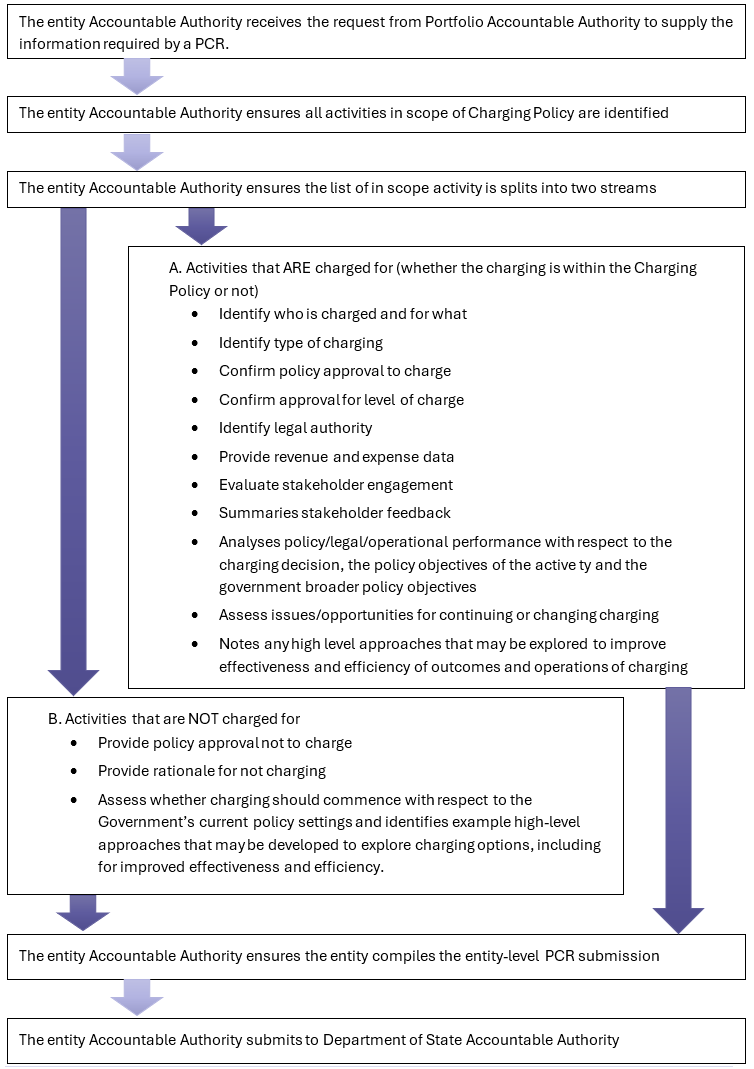
The entity Accountable Authority receives the request from Portfolio Accountable Authority to supply the information required by a PCR.
The entity Accountable Authority ensures all activities in scope of Charging Policy are identified
The entity Accountable Authority ensures the list of in scope activity is splits into two streams:
A. Activities that ARE charged for (whether the charging is within the Charging Policy or not)
- Identify who is charged and for what
- Identify type of charging
- Confirm policy approval to charge
- Confirm approval for level of charge
- Identify legal authority
- Provide revenue and expense data
- Evaluate stakeholder engagement
- Summaries stakeholder feedback
- Analyses policy/legal/operational performance with respect to the charging decision, the policy objectives of the active ty and the government broader policy objectives
- Assess issues/opportunities for continuing or changing charging
- Notes any high level approaches that may be explored to improve effectiveness and efficiency of outcomes and operations of charging
Activities that are NOT charged for
- Provide policy approval not to charge
- Provide rationale for not charging
- Assess whether charging should commence with respect to the Government’s current policy settings and identifies example high-level approaches that may be developed to explore charging options, including for improved effectiveness and efficiency.
The entity Accountable Authority ensures the entity compiles the entity level PCR submission
The entity Accountable Authority submits to Department of State Accountable Authority
Footnotes
- A government policy order under the PGPA Act applies the Australian Government Charging Policy, or sections of it, to the named CCEs: see Public Governance, Performance and Accountability (Charging for Regulatory Activities) Order 2017
- An activity with a charging mechanism that is enabled by a tax Act is not of itself an excluded activity for purposes of the Charging Policy. If it is unclear if the charging for the activity using a tax Act raises revenue that best fits the description of taxation revenue or non-taxation revenue, discuss the situation with the Department of the Treasury and the Department of Finance
- An activity with a charging mechanism that is enabled by a tax Act is not of itself an excluded activity for purposes of the Charging Policy. If it is unclear if the charging for the activity using a tax Act raises revenue that best fits the description of taxation revenue or non-taxation revenue, discuss the situation with the Department of the Treasury and the Department of Finance.
- The Government is in affect the only reasonable supplier.
- The Government is not the only reasonable option as the provider of the goods or services.
- For regulatory activity, this regular review of performance should be consistent with the Regulatory Policy, Practice & Performance Framework (https://www.finance.gov.au/sites/default/files/2025-10/Regulatory-Polic…). For non-regulatory activity that is charged for, this will relate to the regular assessment of the financial and non-financial objectives and outcomes of the contracts that agree the charging.
- Authority to charge is separate from any authority to retain money (for example, through a special account or retainable receipts arrangement under the PGPA Act). Equality, a decision to allow an entity to keep funds it has lawfully collected does not give the entity the legal power to charge or impose a fee.
- The supporting entity will invoice the Lead Commonwealth entity providing the activity for the cost of their effort – this cost is part of the total cost of the activity the primary entity is delivering. This exchange and charging is not Internal Government Charging and not excluded from the Charging Policy.
- Financial Reporting Rules (FRR): In accordance with FRR section 34A and RMG 125, entities must report all regulatory charging consistent with the FRR requirements.
- Where a Regulator regulates multiple groups that describe themselves uniquely or are considered distinct for policy or legislative reasons, the Regulator may have multiple RCSs, one for each regulated group, or break its RCS into distinct sections by regulated group.
- Delegation criteria should be in writing as per Ministerial or Accountable Authority Instructions.
- Delegation criteria should be in writing as per Ministerial or Accountable Authority Instructions.
- For more information see section 38 of the PGPA Act
Glossary
activity is a term with multiple means, including describing an action that is occurring or to occur, or the doing of something, for a purpose14 . What the word activity may refer to in a Government decision is contextual to the situation, entity and the policy.
the activity is the general name used in policy papers, budget decisions and reviews, usually for a specific thing that is being done (the effort) by an entity to achieve a Government decision. It creates either: a single output; a number of outputs; or a whole organisation’s output. Despite the singular reference of “the activity”, the “action” (effort) that is occurring, or will occur, will vary in scale, complexity and sensitivity with the context.
- For the purposes of costing and pricing consistent with the Charging Policy, ‘the activity’ is the name for the doing/delivering an output (singular) to the non-government sector that will or may be charged for. A Charging Model of the ‘the activity’ will contain one or more of these outputs.
- For the purpose of reporting in both a Regulatory Charging Statement and a Portfolio Charging Review (PCR), ‘the activity’ refers to the name given by a Government decision to the act of delivering a program, function or an entity’s purpose. The scale and nature of the program(s) or function(s) within in ‘the
activity’ will vary in scale and may encompass the whole entity. The Charging Model’s aggregated outcomes of cost, revenue and output will align to the Government decision for the activity (group).
business cycle for the activity – the number of years over which specific assets used by the activity that is charged for are depreciated to zero. Where justified, the length of a business cycle may be a longer period than the Budget and forward years, as appropriate for the relevant asset.
charging – the act of demanding a price (in money) for goods, services, or regulatory output by a Commonwealth Government entity, from the non-government sector, in a manner consistent with the relevant Government policy and charging decision, that results in an invoice to an individual, business or not for profit.
charging model – the combination of the costing model and the pricing model for outputs from the activity (Government decision). It shows the relationship between the cost and price of each output of the activity.
- The use of the information in, or developed for, a cost, price or charging model that is consistent with this policy, for any other purpose including management and budgets, is outside the scope of this policy.
charging policy – the policy of the Australian Government that sets its expectation of how charging to the non-government sector must be approached by in-scope Australian Government Non Corporate and Corporate Commonwealth entities.
charging risk assessment (CRA) – a tool that helps to identify areas of implementation risk of a level and approach to charging for regulatory activity. It informs the charging risk engagement strategy adopted by an entity and whether the Minister of Finance must also agree to the publication of the Regulatory Charging Statement.
commercial activity – activities where the Government is providing products or services to the non-government sector in a market, where there are actual or potential competitors. i.e. Government supply is not the only option.
- For the non-government sector, engagement with the Government for a commercial activity is not imposed by law. Any charging arrangement is by contract, which will include specific requirements for both parties. There is discretion available to the individuals, businesses or not-for-profits to engage and over all clauses and warranties of the arrangement.
commercial charge – a charge for an output from a commercial activity
cost model – the model of the processes or tasks of an activity, showing the combination of the input elements of time, materials, capability and effort for each output of the activity, then combined with the cost of these inputs, in order to forecast that cost of an output.
cost recovery – the activity of charging to recover some or all of the cost of an activity. It involves Commonwealth entities (on behalf of the Australian Government) charging the non-government sector some or all of the costs of a government activity. The expression of cost recovery may reference recovering the costs to an output of an activity, an activity, a program or entity.
- The recovery of cost may be achieved by charging one or a combination of: a tax; fees; or amounts under contract.
- It may be for an activity that is within-scope of the Australian Government Charging Framework or not.
- Where the activity is within the Australian Government Charging Framework and the activity is a regulatory activity, ‘cost recovery’ occurs at the activity output level, where the price charged may not exceed the cost of the output.
effectiveness of charging – relates to whether the charging achieves its policy objectives.
efficient charge – the price point at which the desired outcomes of charging, the policy objectives of the activity and other legal and policy objectives of the Australian Government, are together maximised
- The price point that represents the point of most efficient charging will vary over time with the mix of actual inputs, processes and outcomes.
efficient cost – the lowest cost of effort necessary to provide an output of an activity, while also achieving the quality, policy objectives of the charging, the policy objectives of the activity and any other legal and policy objectives, as agreed to in the charging decision made by the Government.
Efficient to charge – whether it is appropriate to set up a charging system given the total cost of the activity, including the cost of the charging system, and how much of this total cost may be charged for, after all other considerations are addressed.
The “efficient to charge” price point will be relative to considerations including whether the purpose(s) for the activity and charging are achieved by a level of price.
Whether this price is less than, the same as or more than the cost of administering the charge is a mathematical proportion and will vary from situation to situation. The size of this proportion is not of itself a reason not to charge. i.e. that the cost of administration of the charge is far greater than the cost of the activity is not the focus, rather whether the purpose of the charging is optimised.
general taxation – a type of taxation, raise on a board section of or all the population
- AASB15 “Revenue from Contracts with Customers’ & “GFS: tests for a tax treatment” define the characteristics of amounts that are considered general taxation.
government policy order – an order made by the Finance Minister under the PGPA Act that specifies a policy of the Australian Government that is to apply in relation to one or more corporate Commonwealth entities (section 22(1)) or wholly-owned Commonwealth companies (section 93(1)).
individual – a single person, business or not for profit entity, as recognised in law.
non-regulatory activity – the collective term for all commercial and resource activity
non-regulatory charge – the charge for an output of a non-regulatory activity
price model – the model of how costs for an output are processed to achieve the price structure for each output that is the most appropriate and most likely to achieve: the policy objectives for charging; policy objectives for the activity and broader Government policy settings.
Regulatory Charging Statement (RCS) – a reporting tool for documenting regulatory charging design, operation and reporting.
- Replaces the Cost Recovery Implementation Statement (CRIS).
regulatory activity – activities that are imposed by law on the individuals and groups that they otherwise would not have done.
- There is a statutory obligation placed on the individual, business or not for profit to engage in and conduct activity of a particular type and standard.
- There is no discretion available to the individuals or groups regarding doing the activity or how the activity is done.
regulatory charge – a statutory government charge imposed on an individual, business or not for profit as part of the requirements of a regulation. Legislation is always required for these charges.
- The charge is for an output of a regulatory activity.
- The charge amount may be set by a number or formula or list of criteria, in legislation, a legislative instrument or a tax Act.
- The amount of the charge for an output may not exceed the efficient cost of the effort done to deliver the output.
regulated group – the group identified in the primary legislation that as subject to the regulation.
resource activity – activities that involve the provision of specific rights, privileges, and access to public resources or services by the Government to the non-government sector, that only the Government may provide
- Engagement with the Government for a resource activity is not imposed by law, but the Government is the sole reasonable supplier. Any charging arrangement is by contract. There is discretion available to the individual, business or not-for-profit about whether to engage or not.
- Some clauses and warranties of the arrangement may be varied (there is discretion) and others may not be negotiable (there is not discretion) i.e. the contract may have aspects set in legislation or legislative instruments, over which there is not discretion to negotiate.
resource charge – a charge for the output of resource activity.
taxation – a type of government charge, usually defined as ‘a compulsory exaction of money by a public authority for public purposes, enforceable by law’.
- All types of taxation are imposed by a tax Acts , in accordance with the Australian constitutional requirements.
