
Department of Finance
Download the Corporate Plan 2026–27
Covering reporting periods 2026–27 to 2029–30

Secretary’s introduction

The years ahead present both opportunity and responsibility for the Department of Finance (Finance). As a central agency, we operate in a dynamic global environment shaped by geopolitical uncertainty, economic pressures and evolving government priorities. Our purpose is to provide high quality advice, frameworks and services to achieve value in the management of public resources for the benefit of all Australians.
This corporate plan sets out Finance’s strategic direction for 2026–27 to 2029–30. It outlines how we will deliver on our purpose, respond to emerging challenges and maintain the integrity and effectiveness of the systems that underpin public administration.
Over the planning period, we will support the government’s priorities by providing policy and fiscal advice, strengthening the long-term structural position of the Budget and progressing reforms to reduce unnecessary regulatory burden. We will review and modernise key frameworks, beginning with the Commonwealth Performance Framework, to improve efficiency and reduce administrative burden across government.
The coming year will also see progress on major internal reforms. This includes responding to the outcomes of the department’s Capability Review, advancing updated governance arrangements and continuing the transition to an upgraded Enterprise Resource Planning environment. These reforms will help ensure we are well placed to meet future priorities and provide effective support across government.
We will continue to lead the Australian Public Service (APS) in the responsible adoption of artificial intelligence (AI) while strengthening capability in areas such as resource management, financial management, procurement and regulation. We will work to enhance the integrity and transparency of procurement and grants, progress Defence estate divestment, support the Independent Review of the Commonwealth Parliamentary Support System, advance the Data and Digital Government Strategy, expand access to Digital ID and deliver high quality Information and Communication Technology and shared services.
Our people remain our greatest strength. We are committed to building a capable, diverse and inclusive workforce, supported by a culture of integrity and continuous improvement. At the same time, we will continue investing in our tools, technology and data capability to support evidence-based decision-making, improve efficiency and simplify manual processes.
Finance’s work touches every part of government. I am confident that, through the expertise and dedication of our people, we will continue to deliver on the priorities set out in this corporate plan and strengthen the systems that support good government.
Matt Yannopoulos PSM
Secretary, Department of Finance
29 July 2026
Statement of preparation
As Accountable Authority for the Department of Finance (Finance), I present the 2026–27 Corporate Plan, which covers the period of 2026–27 to 2029–30, as required by paragraph 35(1)(b) of the Public Governance, Performance and Accountability Act 2013 (PGPA Act).
This plan has been prepared in accordance with section 16E of the Public Governance, Performance and Accountability Rule 2014 (PGPA Rule).
Matt Yannopoulos PSM
Secretary, Department of Finance
29 July 2026
Purpose and key activities
We support the government’s priorities through the Budget process and foster effective practice through public sector resource management, governance and accountability frameworks. We advise the government on many of its strategic priorities, including arrangements for the management and ownership of public assets, and build capability across the public sector.
Our purpose is to provide high quality advice, frameworks and services to achieve value in the management of public resources for the benefit of all Australians.
We achieve our purpose through 6 key activities (see Figure 1). We reconfirmed the appropriateness of our purpose statement and key activities, and that they reflect our role, objectives and functions, in the preparation of this corporate plan.
Figure 1: Our key activities
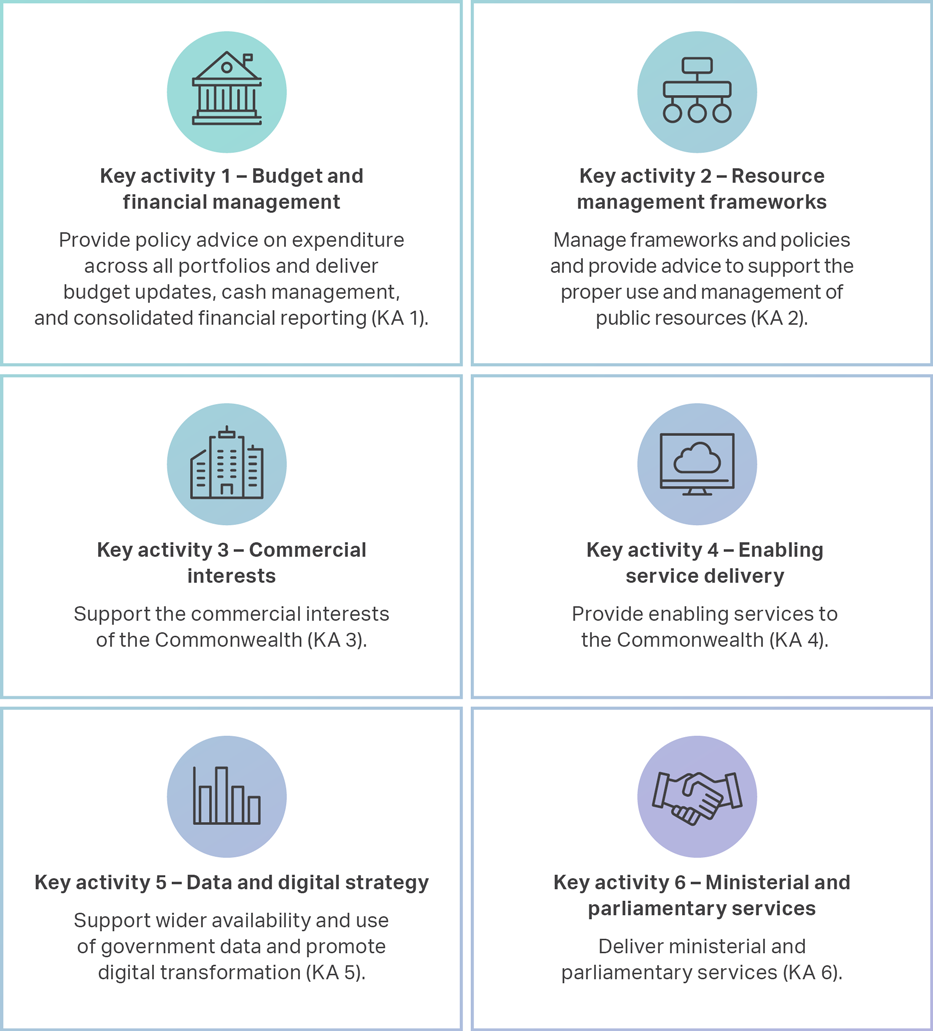
Key activity 1 – Budget and financial management
In 2026–27 and beyond, we will continue to provide high‑quality Budget advice that strengthens the effective and efficient use of public resources. Our focus will be on delivering forward‑looking analysis, information, and costings of expenditure proposals, shaping future Budget papers and appropriation bills, and contributing proactively to Cabinet processes.
We will deliver the Consolidated Financial Statements and Monthly Financial Statements to provide transparency and accountability of government finances for the Parliament and the Australian public. These statements will remain central to the Commonwealth’s accrual budgeting and reporting framework, offering clear insights into outcomes against Budget estimates.
We will provide banking and cash management services to ensure government entities have timely access to funds, supporting the Parliament and the Australian public through the reliable delivery of essential services and functions.
Key activity 2 – Resource management frameworks
We will continue to advance the government’s priorities and strengthen effective public sector practice through our active management of resource management frameworks and policies. These frameworks and policies will remain central to fostering an accountable, transparent and integrity‑driven public sector.
We will lead the ongoing development and management of frameworks and policies across procurement, grants, performance, risk management and property management. Our role will include a focus on building capability across the Commonwealth — providing effective advice and guidance, expanding formal learning and development opportunities, strengthening communities of practice, and deepening outreach and tailored engagement.
Our guidance, advice and support will be designed to help Commonwealth entities and companies meet their public sector management and accountability obligations.
Key activity 3 – Commercial interests
We will deliver commercially focused advice and support to the Commonwealth and the government across a broad and evolving range of responsibilities. Our work will span coordinated procurement arrangements, commercial transactions aligned with the Commonwealth Investment Framework, and oversight of Government Business Enterprises, Specialist Investment Vehicles and managed investment funds.
We continue to lead development of Stage 2 of the National Security Office Precinct, which will provide a permanent solution to the critical accommodation and capability requirements of several national security and other Commonwealth agencies.
We will also strengthen our role in guiding the Commonwealth’s approach to property, land and public works, discretionary payments, insurance and Comcover, and the nuclear‑powered submarine program.
Key activity 4 – Enabling service delivery
In 2026–27 and beyond, we will continue to provide a range of enabling services to the Commonwealth, including through government technology capabilities as well as transactional and technical services.
Our whole‑of‑government Information and Communications Technology (ICT) services will evolve to meet emerging needs and expectations. These services will include:
- GovCMS – delivering secure, modern content management and website hosting for government
- GovTEAMS – enabling seamless, secure online collaboration across government and with stakeholders
- GovLINK – providing trusted communication services for secure information exchange
- Ministerial Communications Network (MCN) - ensuring secure and reliable ministerial communications
- Parliamentary Document Management System – strengthening workflow and records management for parliamentary processes
- GovDNA – supporting the future management of government domain name registration
Key activity 5 – Data and digital strategy
Working with partners, we will continue to expand the availability and reuse of public sector data and drive the next wave of digital transformation across government. Together with the Digital Transformation Agency, the Australian Public Service Commission and other partners, we are building GovAI as a foundational service that will enable the safe, secure and responsible use of AI) across the public sector.
A key focus in 2026–27 and beyond will be supporting the implementation and ongoing evolution of an economy‑wide Digital ID System, giving Australians a voluntary, secure, convenient and inclusive way to verify their identity online.
We will advance the initiatives set out in the Data and Digital Government Strategy Implementation Plan, ensuring Australia moves toward a future of simple, secure and connected public services powered by world‑class data and digital capabilities.
Link to Regulatory Performance Best Practice Principles
The National Data Commissioner’s Statement of Intent sets out how the National Data Commissioner plans to operate in step with the Ministerial Statement of Expectations and the principles of regulator best practice (continuous improvement and building trust, risk based and data driven, and collaboration and engagement).
Key activity 6 – Ministerial and parliamentary services
In 2026–27 and beyond, our services will continue to evolve to meet the needs of a modern Parliament, including:
- strengthening the administration of pay, conditions and entitlements under the Members of Parliament (Staff) Act 1984 (MOP(S) Act), ensuring parliamentarians and their staff are supported by reliable, contemporary systems
- advancing policy development and strategic advice on parliamentary frameworks and service delivery, including future‑ready arrangements for office costs, accommodation and support services
- expanding safe, secure and resilient transport services for Australian high office holders and visiting foreign dignitaries and enhancing the Parliamentary Expenses Management System through forward‑looking project management and continuous improvement
- supporting the Independent Review of the Commonwealth Parliamentary Support System, to provide recommendations to create a modern, flexible and efficient framework that better supports parliamentarians and their staff, strengthens safety, and meets expectations for transparency and accountability.
1 Acting National Data Commissioners Statement of intent - JAN 2026.pdf
2 Ministerial Statement of Expectations for the National Data Commissioner 2025.pdf
In focus – the years ahead
Our purpose statement and key initiatives provide the framework for Finance’s priority initiatives. In line with our purpose, our priorities in 2026–27 and beyond include:
- supporting the delivery of the Budget, key economic updates, and the delivery of the Australian Government’s Fiscal Strategy, including advice on expenditure across all agencies
- building capability across the APS in AI including supporting the safe, responsible, and coordinated adoption of AI across government
- progressing regulatory reforms to support regulator performance and drive modern, fit-for-purpose regulation in a digital age
- supporting Commonwealth entities and companies to meet the requirements and policy intent of the Resource Management Framework, including in relation to the Public Governance, Performance and Accountability Act 2013 (PGPA Act)
- progressing the government’s commitment to reduce Australian Public Service (APS) emissions to net zero by 2030
- enhancing the Commonwealth Procurement Framework through collaboration with Commonwealth entities, the private sector and non-government organisations, with a focus on supplier integrity and ethical performance
- progressing initiatives in partnership with Commonwealth granting entities to enhance the efficiency and effectiveness of grants administration across government, including uplifting whole of government grants data to support evidence-based decision making
- progressing the government’s commitment to reduce APS emissions to net zero by 2030 and implementing the low emissions vehicle target for the Commonwealth fleet
- leading the development of the National Security Office Precinct, which will provide a permanent solution to the critical accommodation and capability requirements of several national security and other Commonwealth agencies
- implementing the Data and Digital Government Strategy, including enhancing the use of data across government to improve policy advice and broadening adoption of the economy-wide Digital ID system
- delivering quality and efficient ICT services to the Commonwealth and shared services to our client agencies
- working with portfolio entities to deliver a range of quality and efficient services for parliamentarians and their staff, including undertaking the Independent Review of the Commonwealth Parliamentary Support System
- delivering a new Defence capability cost assurance function and progressing property divestments arising from the Defence Estate Audit.
Operating environment
Our operating environment affects how we deliver our purpose and key activities. Many influencing factors are outside our control, requiring us to be flexible and innovative. Three key factors are likely to shape our operating environment over the 4 years of this plan.
Economic and geopolitical factors
Australia is facing a period of heightened uncertainty and economic and fiscal risk exacerbated by global conflict, particularly in the Middle East. This is expected to contribute to higher inflation and weaker growth in real incomes and household consumption.
Despite these challenges, Australia remains well positioned, supported by low unemployment, wages growth, and strong public finances. Growth is expected to recover as inflation moderates and global conditions stabilise.
We support delivery of the government’s agenda by overseeing policies that promote fiscal sustainability and economic efficiency, drive digital transformation and enable strategic investment to strengthen national capability, deliver sustainable productivity growth and build economic resilience in the long term. We also provide high quality, context aware advice to support government decision making in a complex global environment.
Trust and integrity
Australians have high expectations of government, particularly in relation to the integrity and effectiveness of government institutions, frameworks, and decision-making processes, and government needs to meet these expectations.
Finance is responsible for several frameworks that support entities across the APS in their use and management of public resources, including the overarching PGPA Act and the procurement, grants, and risk management frameworks. We provide guidance and engage directly with agencies to assist them in meeting their obligations and continuously adjust our approaches to respond to information about the effectiveness of these frameworks. We focus on improving the capability of APS agencies to operate consistently with these frameworks, including through our training and engagement activities.
In our roles as the owner of the Commonwealth Procurement Framework, and manager for key coordinated panel arrangements, we have a strong focus on procurement integrity and transparency, and the ethical conduct of suppliers. To support this, we have commissioned Dr Ian Watt AC to undertake an independent review of KPMG Australia’s ethical soundness. The review findings will help guide our focus on supplier ethical conduct over the coming years.
In our roles as the owner of the Commonwealth procurement framework, and manager for key coordinated panel arrangements, we have a strong focus on procurement integrity and transparency, and the ethical conduct of suppliers. Building on the significant work to date, we will continue to support Commonwealth officials through practical advice and guidance to undertake procurement responsibly and ethically and ensure the proper use and management of public resources to deliver for all Australians.
We will also continue to support Commonwealth officials through practical advice and guidance to undertake procurement responsibly and ethically and ensure the proper use and management of public resources to deliver for all Australians.
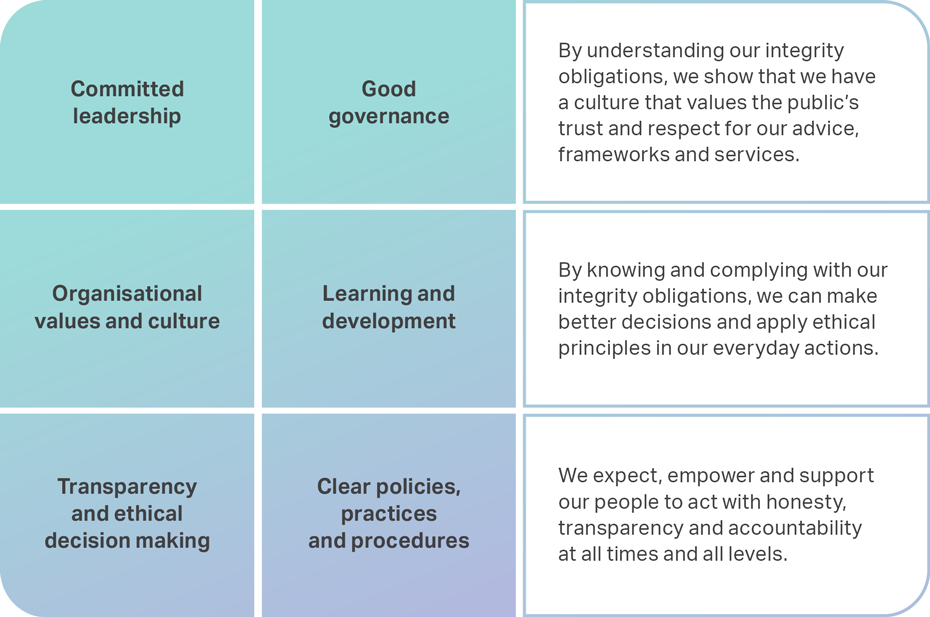
Internally, we are committed to a culture of professional integrity where our people act with honesty, transparency, and accountability at all times and at all levels. Our Integrity Framework (Figure 2) brings together key policies and procedures, as well as learning and development programs. It sets out key elements and expectations as they relate to integrity in the department. Staff are supported with access to skills development and training which strengthens our culture of integrity and transparency, reinforces the importance of ethical leadership and behaviours, and provides a strong focus on the values of professionalism and a commitment to delivering quality work.
Figure 2: Our integrity framework
Artificial intelligence and digital technology
AI is creating new opportunities for the APS to improve service delivery, policy outcomes, productivity and government operations. As technology evolves, Finance will support the safe, responsible and practical adoption of AI across the APS, while monitoring emerging risks and refining our approach over time.
Together with the Digital Transformation Agency and the Australian Public Service Commission, we support delivery of the AI Plan for the Australian Public Service (APS AI Plan) and advise government on AI use in the public service. We help accelerate APS AI adoption by addressing barriers, supporting priority AI use cases, and providing access to shared tools through the GovAI platform.
In 2026–27, we will focus on:
- Expanding GovAI Chat — building on the April 2026 alpha trial by improving functionality, strengthening information handling and supporting broader APS access over time
- Improving access to AI tools — providing safe and secure access to AI through the GovAI platform, including sandbox, hosting and brokerage services, and the APS AI Library of shared guidance, templates and reusable resources
- Supporting high-impact AI opportunities — helping agencies identify and progress AI use cases that address common APS challenges, reduce duplication, deliver public value and have potential for reuse across multiple agencies
- Strengthening APS AI leadership — supporting Chief AI Officers and cross-agency communities to build capability, share lessons and embed responsible AI adoption across the APS.
We will lead by example in the safe and practical adoption of AI, demonstrating how emerging technologies can be used to improve productivity, reduce duplication and deliver better outcomes for government and the community.
Through these initiatives, we will strengthen AI capability across the APS, reduce barriers to adoption and support a more coordinated, trusted and practical approach to AI use in government. This will help the APS build capability, adapt to emerging technologies and continue delivering high-quality services to the Australian community.
Risk management and oversight
Approach to risk management
We recognise that positive engagement with risk contributes to improved productivity and performance. Finance’s focus is on embedding a positive risk culture to promote efficient and effective use of resources through governance, planning and performance measures. We engage with risk to achieve our objectives and cultivate innovation.
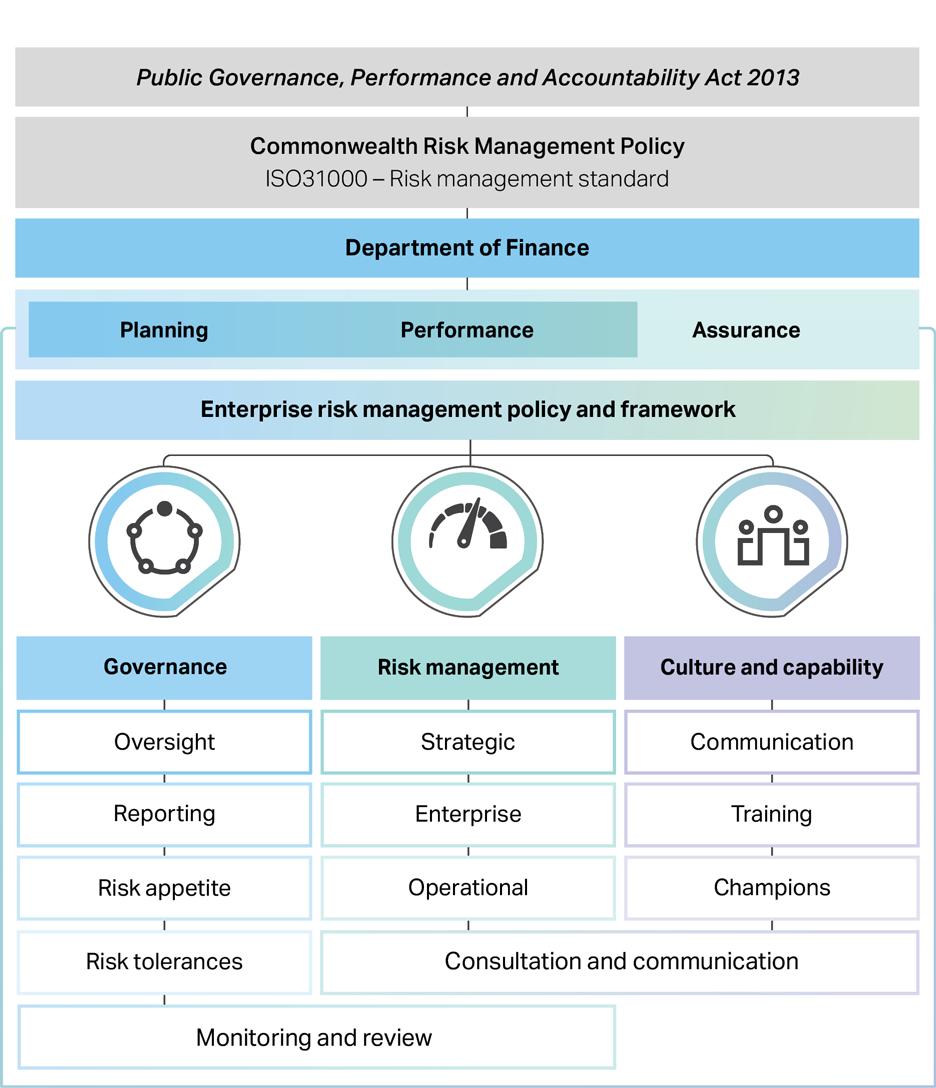
Our Enterprise Risk Management Framework has been designed to embed a consistent and systematic approach to identifying, assessing and managing our risks and incorporating these insights into decision making. Our approach to risk management supports our accountable authority, the Secretary, to meet their obligations under section 16 of the PGPA Act in-line with the Commonwealth Risk Management Policy.
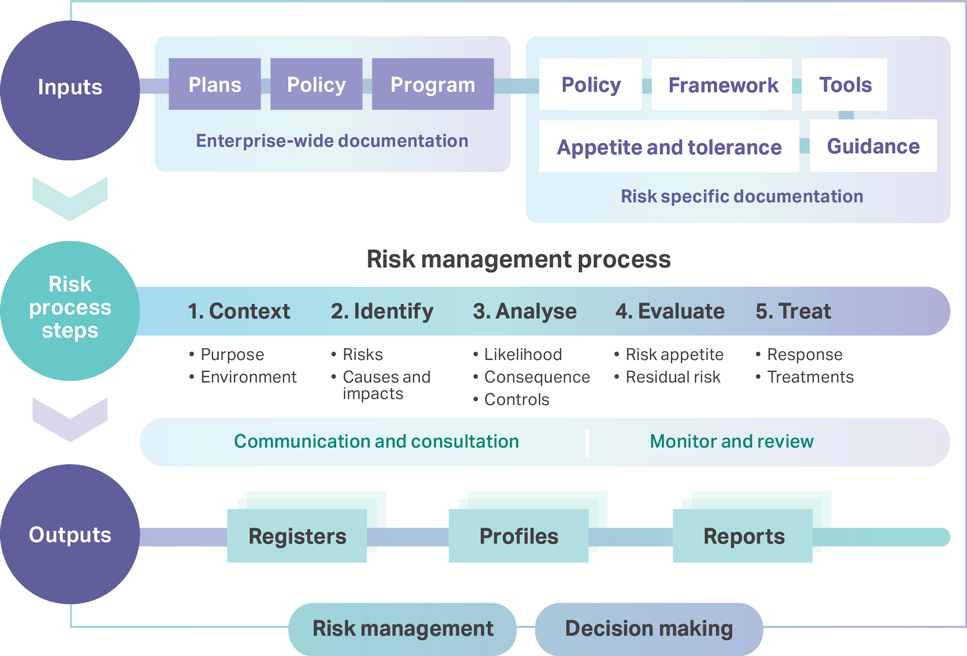
We provide a range of tools and resources to support staff to take a considered approach to risk identification, communication, monitoring and decision making. We identify and manage risks and opportunities at the strategic, enterprise and operational level.
Figure 3: Enterprise risk management process overview
We approach risk management through 3 key perspectives: strategic, enterprise and divisional risks.
Our strategic risks outline factors critical to our effectiveness as an organisation. They are framed positively to reflect our appetite to engage positively with risk and our use of risk management practices to help us achieve our strategic objectives. Our Executive Board own and actively manage our strategic risks supported by advice on our risk environment from our committees. Enterprise and divisional risks, and our assurance environment, inform our assessment of strategic risk.
Our enterprise risks set out our internal control environment by identifying the risks that are common across each business area and through active management, help identify opportunities to further strengthen processes or practices. Our Governance Framework includes the oversight and reporting on our enterprise risks.
Our divisional risks are those which may impact the operations or objectives of a business area. Divisional risk registers help to record and manage those risks at the local level and provide insight into monitoring and reporting on our system of internal control.
Our policy and framework includes risk management guidance designed to help staff at all levels to review controls to determine if they are effective, engage with emerging risks and provide advice to our governance committees. Our Risk Champion Network supports risk management through information sharing, development of risk tools and networking with a focus on risk management capability.
Risk environment
Our strategic risks reflect our current operating environment, challenges and opportunities. Key areas of risk and actions Finance is taking to mitigate them remain focused on:
Reputation
Approach to mitigation
Communicating and reinforcing our role as an adviser and enabler in public resource management and services to the Australian Government and broader community.
Capability
Approach to mitigation
Aligning the skills and capabilities of our professional workforce to deliver on key activities. Sustaining the right skills in the right areas so that we balance the skills of our internal workforce with additional external capabilities.
Agility
Approach to mitigation
Anticipating and responding to changes in our environment that impact our central agency role, including community trust and expectations and the government policy agenda.
Partnerships
Approach to mitigation
Building and maintaining strong and trusting relationships with partners and stakeholders to effectively deliver our strategic activities and manage shared risks.
Enabling
Approach to mitigation
Ensuring our whole-of-government policies, frameworks and advice are well understood, contemporary, solution-oriented and support good public policy outcomes.
Ensuring our whole-of-government policies, frameworks and advice are well understood, contemporary, solution-oriented and support good public policy outcomes.
Data
Approach to mitigation
Ensuring we lead and apply effective governance, management, use and sharing of data. Contributing to and leading government data initiatives to strengthen trust and availability of government services for all Australians.
Digital
Approach to mitigation
Understanding and preparing for the potential disruption from emerging digital advancements (such as AI) to achievement of our strategic purpose and whole-of-government objectives.
Continuing to engage in the emerging technology discussions at multiple levels and effectively develop strategies aimed at improving services and returning value to government, stakeholders and the public.
Our strategic, enterprise and operational risks are regularly monitored for emerging risks that could change where and how we focus our efforts. Risk conversations within our committees, with our risk stewards, stakeholders and risk owners guide the areas we may need to change focus and how we could be best placed to respond to emerging uncertainties.
Managing our risk environment
Together with our policy, framework and risk management guidelines, our risk appetite and tolerance statements inform how we articulate, communicate and understand our risks, including our strategic and enterprise risks across conservative, measured and increased postures. Our risk appetite and tolerance statements support staff in making informed decisions and engaging positively with risk by providing guidance on acceptable risk taking, and how to prioritise actions to mitigate or accept risk.
In 2026–27, we will continue to mature our risk management practices by further embedding risk-based decision-making into day-to-day operations and governance, in line with our policy and framework. We will prioritise risk scanning, emerging and shared risks, in recognition of our increasingly complex and dynamic operating environment.
Figure 4: Overview of our enterprise risk management framework
Capability and enablers
Our capabilities and enabling functions ensure we can deliver on our purpose and key activities in 2026–27 and beyond. This includes our internal operating and governance arrangements, as well as the behaviours and values that guide the way we work.
Governance
Our governance framework promotes strong governance and helps us deliver on our purpose and priorities (see Figure 5). The framework is reviewed annually to ensure it remains fit for purpose, supports effective decision making across Finance, aligns with our priorities and risk management, and assists the Secretary in meeting their responsibilities under the PGPA Act and the Public Service Act 1999.
Figure 5: Our governance framework
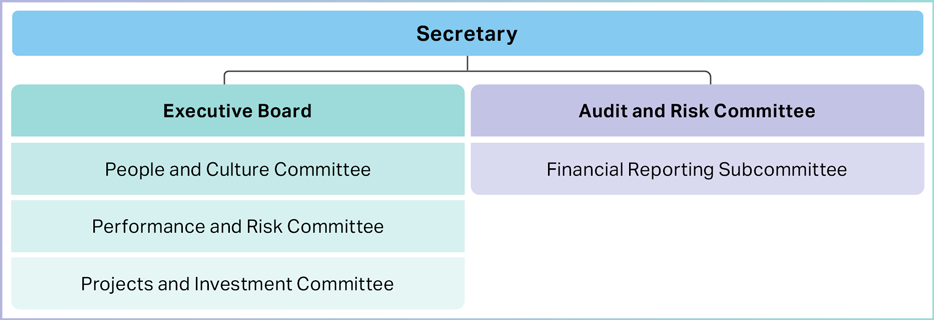
- Executive Board is our chief advisory and decision making body. Members of Executive Board provide strategic leadership to ensure we deliver on our purpose.
- People and Culture Committee provides oversight and advice on matters relating to people management, workforce strategy, diversity and inclusion, leadership development, and workforce capability.
- Performance and Risk Committee provides oversight and advice on our strategic direction, management of risk and data, and how we measure our performance and outcomes.
- Projects and Investment Committee provides advice and support on the implementation of the department’s projects and investments.
- Audit and Risk Committee provides independent advice to the Secretary on the appropriateness of our financial reporting, performance reporting, system of internal control and system of risk oversight and management under the PGPA Act.
- Financial Reporting Subcommittee is a subcommittee of the Audit and Risk Committee, which supports the committee to perform its functions in relation to the department’s financial reporting.
Stewardship in Finance
We define stewardship through our role as owners of key frameworks and policies on behalf of the Commonwealth. It guides how we work and how we serve the government and the Australian community. We demonstrate stewardship by:
- working with other entities and actively contributing to the delivery of government priorities through the provision of advice and support
- building capability across the APS in areas such as AI, procurement, regulation, performance, accounting and finance, including through training, forums, communities of practice and connecting others
- providing guidance, advice and support to help entities meet their obligations under the frameworks and policies we manage.
Values
We are guided by the APS Values - impartial, committed to service, accountable, respectful, ethical and stewardship. To support these values, we have also established a set of leadership values and behaviours that underpin effective leadership at all levels (see Figure 5).
Figure 6: Our leadership expectations

- Act with integrity – lead by example and work with transparency, accountability and honesty to deliver quality outcomes.
- Be part of the solution – take a positive, proactive approach by understanding challenges and contributing to practical solutions.
- Collaborate, innovate – build respectful, trusting relationships to improve how we work and deliver better results.
- Develop self and others – understand your strengths and development needs and invest time in supporting the growth of others.
People capability
We are a diverse, experienced and capable workforce of 2,284 employees as at 30 June 2026. Our workforce identifies as 1.4% Aboriginal and/or Torres Strait Islander peoples, 4.9% of staff have a disability, 52.1% of staff are female, and 52.9% of our senior executive staff are female. To achieve our purpose and deliver our priority initiatives, we continue to invest in our people.
In 2026–27, our focus is on implementing a new workforce strategy and strengthening workforce planning capability. This includes building our digital and data capability, with a strong emphasis on the responsible adoption of AI to support our workforce to adapt to emerging technologies and evolving service delivery needs. We will also act on the findings of the Australian Public Service Commission led capability review.
Division-level operational plans are completed as part of the business and risk planning cycle to support a holistic approach to managing workforce risks, critical roles and key workforce management levers. Leadership and culture are monitored through our 3-year Census Action Plan, group level analysis and local action planning.
Our Enterprise Agreement 2024–2027 commenced on 15 February 2024. Since then, we have embedded new conditions, updated policies and processes, strengthened understanding of entitlements and supported evidence-based decision making. We have enhanced our approach to change consultation through an internal online platform that enables timely, inclusive and better practice engagement.
Our employee performance management framework will continue to support building a high-performing, robust and diverse workforce through regular feedback, development opportunities and targeted support.
In 2026, we launched a new Learning and Development Framework and the Finance Stretch Reconciliation Action Plan 2026–2028, to advance the next stage of our reconciliation journey. Our employee-led networks continue to promote awareness of diversity issues and provide a safe, open forum for sharing views and experiences. Our diversity and inclusion initiatives align with whole-of-government strategies.
We remain committed to fostering a safe, healthy and respectful workplace culture where our people can thrive. Staff are supported through services including the Employee Assistance Program, dedicated and individualised case management services, flexible workplace arrangements, reasonable adjustments and access to mental health first aid officers.
Strategic commissioning framework
Our APS workforce continues to deliver key activities, including providing advice on expenditure, budget updates, and the frameworks and policies that support the use and management of public resources. We have built strong capability within our APS workforce to deliver our core functions and priority initiatives and make limited use of contractors and consultants for activities.
Consistent with the APS Strategic Commissioning Framework, outsourced resources are used only in limited circumstances, such as when independent or specialist advice is required, or when skills are not available within the APS.
Starting in 2025–26 and into the forward years to 2028–29, we expect to reduce contracted expenditure by insourcing ICT roles, including those supporting the Central Budget Management System. We remain on track to further reduce contractor support particularly for outsourced ICT work. Bringing maintenance, development and support of this core system in-house will strengthen APS capability and enable APS staff to drive delivery of this whole-of-government platform.
We are also expanding the in house delivery of general insurance functions and risk management activities by transitioning the Comcover claims management to an APS led model. We are reducing our reliance on external labour by converting 31 contractor roles and strengthening our internal claims management capability over the next 2 years.
Information and Communication Technology capability
We enable the business of government by delivering trusted digital platforms and services that support entities, improve productivity and strengthen government operations across the public service. Working with agency partners, we provide whole-of-government services that support collaboration, information management and service delivery, underpinned by strong active management, client engagement and value-focused investment.
To sustain these outcomes, Finance will continue to build workforce capability so we can respond to technological change, evolving expectations and emerging security risks.
In 2026–27, our priorities are to:
- modernise and scale whole-of-government platforms to meet growing demand and remain fit for purpose
- strengthen cyber resilience and governance through disciplined investment and the safe, responsible adoption of AI
- improve delivery by focusing on practical implementation and high-value outcomes that simplify services and support government operations.
We will prioritise secure, trusted and adaptable digital capabilities that improve productivity, support government operations and respond to future needs.
Data capability and enablers
We collect and use a wide range of data, including through our role in public sector resource management, the Budget process, governance and accountability frameworks, and the services we provide for members of parliament.
Finance’s Data Strategy 2025–28 sets out our key areas of focus to help us support the government’s expectations for building data-driven capability and to position us to capitalise on the benefits of new technologies and AI. These include:
- people and capability – identifying opportunities to boost data literacy and data skills to mature the data capabilities of our workforce
- data governance – providing guidance and support for Finance officials to manage data responsibly and maximise its value
- data management and practice – improving data management standards and consistency across Finance to ensure transparency and trust
- technologies, tools and analytics – streamlining reporting and modernising analytics to bring efficiencies and generate insights.
This work is led by our Chief Data Officer, supported by the enterprise data governance and analytics functions. We are committed to the ongoing development of our data and digital capabilities and fostering a strong data culture through collaboration and a shared understanding of the value and use of data.
Capability review
In 2026, we will participate in our five-yearly capability review under the Public Service Act 1999. The review is part of the Australian Public Service Commission’s Capability Review Program and provides an independent, forward-looking assessment of our ability to meet future objectives and challenges.
The review will examine capability across 5 domains: leadership and culture, collaboration, delivery, workforce and enabling functions. We have established a dedicated taskforce to support the review and lead our self-assessment. The taskforce will draw on a range of evidence and engagement methods, including interviews, workshops, surveys, data analysis, roundtables and self-assessment. Staff across the department will have opportunities to contribute, and open, honest participation will be essential to shaping our future priorities.
The review is expected to deliver its report by the end of the 2026 calendar year.
Strategic partnerships
Our strategic partnerships and relationships are crucial to enable us to deliver on our purpose and remain responsive to changes in our operating environment. We prioritise cooperation and collaboration across a diverse range of stakeholders, including with government and non-government sectors and across jurisdictions, both nationally and internationally.
Figure 7: Our key strategic partnerships and relationships
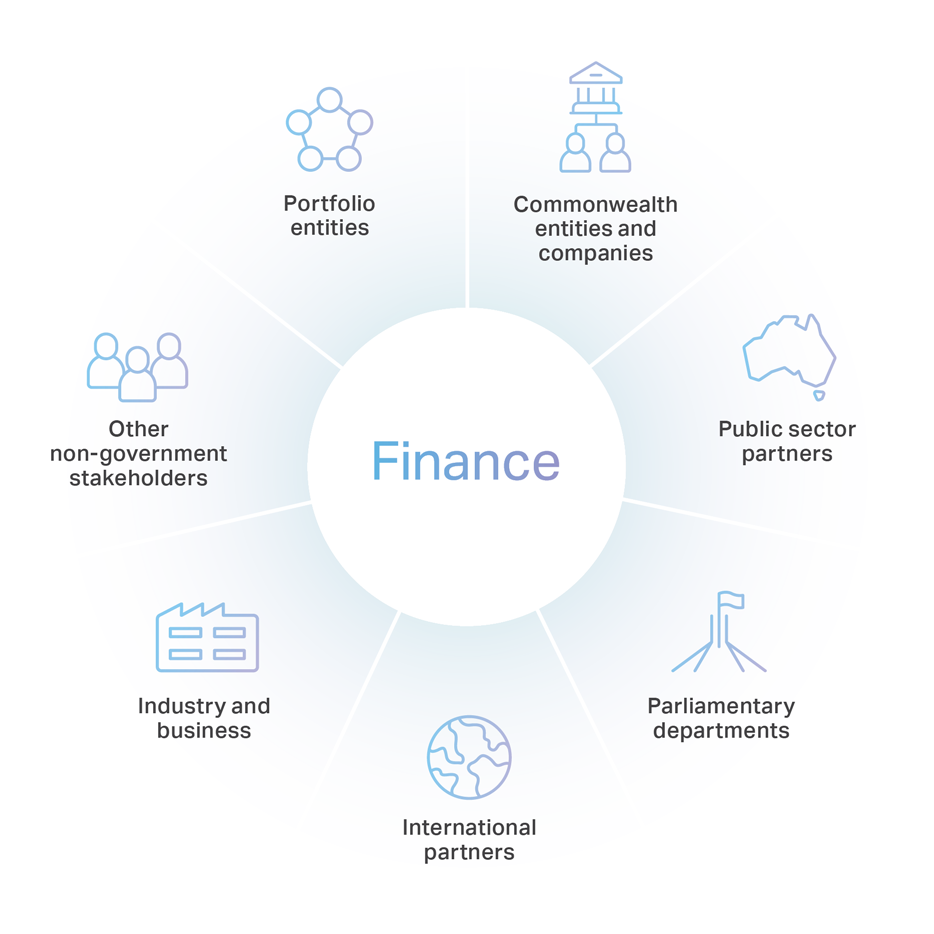
Figure 7 outlines our key partnerships and relationships that help us achieve our purpose. These include:
- Portfolio entities – working together to deliver shared outcomes in line with the Portfolio Budget Statements
- Commonwealth entities and companies – providing support, advice and guidance on financial, regulatory and policy matters
- Public sector partners - including state and territory governments – collaborating on broader issues such as improving budget outcomes, advancing data and digital priorities and enhancing the regulatory environment
- Parliamentary departments – delivering support, advice and services to parliamentarians and their staff
- International partners - including the Papua New Guinea Department of Finance, Indonesia’s Ministry of Finance, the Organisation for Economic Cooperation and Development and countries participating in the Net Zero Government Initiative
- Industry and business – supplying goods and services that support government operations
- Other non-government stakeholders – challenging our thinking, testing ideas and drawing on industry experience and better practice.
Performance
Our purpose is to provide high quality advice, frameworks and services to achieve value in the management of public resources for the benefit of all Australians.
We assess our performance against our purpose through the work for each of our key activities using both formal performance measures and targets and informal assessment of performance.
Overview of our performance measures framework
Our performance framework is designed to provide a clear line of sight between the Portfolio Budget Statements, corporate plan and annual report. This is summarised in Figure 8 below.
Figure 8: Our performance measures framework
| 2026-27 Portfolio Budget Statements | 2026-27 Corporate Plan | 2026-27 Annual Report |
|---|
| Outcome | Program | Purpose | Performance measures | Program | Key activities |
|---|---|---|---|---|---|
| Provide high quality advice, frameworks, and services to achieve value in the management of public resources for the benefit of Australians. | 1 2 3 |
||||
| Key activity | |||||
| 1 |
1.1
Budget and financial management
|
1
Budget and financial management
|
4 5 6 7 8 |
1.1 | 1 |
| 2 |
2.1
Public sector governance
|
2
Resource management frameworks
3
Commercial interests
4
Enabling service delivery
5
Data and digital strategy
|
9 10 11 12 13 14 15 16 17 18 19 20 |
2.1 | 2, 5 |
|
2.2
DATA scheme
|
2.2 | 5 | |||
|
2.3
Property and construction
|
2.3 | 2, 3 | |||
|
2.4
Insurance and risk management
|
2.4 | 2, 3 | |||
|
2.5
Procurement
|
2.5 | 2, 3 | |||
|
2.6
Delivery of government technology services
|
2.6 | 4 | |||
|
2.7
Service Delivery Office
|
2.7 | 4 | |||
|
2.8
Public sector superannuation
|
2.8 | 2 | |||
|
2.9
Australian Government investment funds
|
2.9 | 2, 3 | |||
|
2.10
Nuclear powered submarine program advice
|
2.10 | 1, 3 | |||
| 3 |
3.1
Ministerial and parliamentary services
|
6
Ministerial and parliamentary services
|
21 22 23 24 |
3.1 | 6 |
Assessing our performance
In addition to our formal performance measures, we assess our performance through other methods and information. This includes information that is published through other external reports, responses to parliamentary committee reviews or oversight activities, and additional information provided in our annual report and annual performance statements.
The 2026–27 Annual Performance Statements will provide information on our performance in relation to:
- managing the resource management frameworks
- delivering the National Security Office Precinct project
- continuing our support to regulatory reform
- progressing the Defence Estate Audit divestment program
- our support to the Independent Review of the Commonwealth Parliamentary Support System
- the Office of the National Data Commissioner and regulatory performance.
Our 2026–27 Annual Performance Statements will provide additional information, including markers and context to enable the reader to assess the value in the delivery of the services we perform.
In addition to the information provided in the annual performance statements, we provide an overview of key achievements or work undertaken during the reporting period in the year in focus section of our annual report.
Continuous improvement
Our performance measures framework is built on a principle of continuous improvement. We are committed to strengthening the performance information we provide to the Australian Parliament and the public. We formally review our performance measures framework in the preparation of the Portfolio Budget Statements and corporate plan.
In 2026–27, we have revised the structure and layout of our performance measures in response to feedback and to improve readability and simplicity across the framework. We have reviewed all performance measures in preparation of this corporate plan to assess their appropriateness in providing a meaningful assessment of performance against our purpose and key activities. This assessment has resulted in the removal of some existing performance measures or targets.
Finance’s annual performance statements are audited by the Australian National Audit Office (ANAO). We continue to value the insights of the ANAO in improving our enterprise performance framework and performance measures framework.
Performance measures
Finance’s purpose
Provide high quality advice, frameworks, and services to achieve value in the management of public resources for the benefit of all Australians.
| Measure 1 | 2026-27 to 2029-30 target |
|---|---|
| Percentage of stakeholders surveyed rate Finance's advice and support highly. | 75% or greater. |
Context
As a central agency, Finance supports the government’s priorities and promotes effective public sector practice through our advice and support across our key activities. The nature of our role means we are uniquely positioned to support our colleagues in Commonwealth entities and companies to achieve these priorities.
We play an integral role in supporting and building capability across the Commonwealth, through the provision of advice and guidance on budget and financial matters, our suite of frameworks and policies and commercial matters. This is supported by various activities including our formal learning and development offerings, communities of practice, proactive outreach, and tailored engagement activities. Our advice, guidance and support are designed to assist Commonwealth entities meet their public sector management and accountability obligations and support our ministers in their portfolio responsibilities.
This measure directly relates to our purpose and assesses work across multiple key activities. This measure is designed to assess the effectiveness and timeliness of our advice and support to Commonwealth entities and companies.
Methodology
Stakeholder survey with key stakeholders from Commonwealth entities and companies.
Presentation of results
The percentage of stakeholders surveyed that rated Finance’s advice and support highly.
Data sources
Stakeholder lists, stakeholder survey responses and final survey results report.
Measure type
Effectiveness and proxy for efficiency.
Caveats
Nil.
Owners
Budget Policy and Delivery Division, Commercial Investments Division, Digital ID and Data Policy Division, Financial Analysis, Reporting and Management Division, Government and Defence Division, Governance and Grants Division, Industry, Education, and Infrastructure Division, Legal, Risk and Claims Division, Procurement Division, Property and Construction Division, Regulatory Reform Division and Social Policy Division.
Link with 2026–27 Portfolio Budget Statements
Outcome 1, Program 1.1 – Budget and Financial Management p.23.
Outcome 2, Program 2.1 – Public sector governance p.38.
Outcome 2, Program 2.3 – Property and construction p.41.
Outcome 2, Program 2.4 – Insurance and risk management p.43.
Outcome 2, Program 2.5 – Procurement p.45.
Outcome 2, Program 2.8 – Public sector superannuation p.49.
Outcome 2, Program 2.9 – Australian Government investment funds p.50.
Outcome 2, Program 2.10 – Nuclear powered submarine program advice p.51.
Explanation of changes since the 2026–27 Portfolio Budget Statements
This measure has been restructured from a target for the Finance advice measure.
Explanation of changes since the 2025–26 Corporate Plan
This measure has been restructured from a single Finance advice measure (previously measure 0.1), with 3 supporting targets (targets 0.1.1, 0.1.2 and 0.1.3) to 3 individual measures (measure 1, 2 and 3) to improve the readability and simplicity of reporting.
The owners have been updated to reflect changes in divisions due to an organisational restructure.
| Measure 2 |
|---|
| The Minister for Finance, or their representative, rates Finance's advice as effective and timely. |
Context
As a central agency, Finance supports the government’s priorities and promotes effective public sector practice through our advice and support across our key activities. Our advice, guidance and support are designed to support our ministers in their portfolio responsibilities.
This measure directly relates to our purpose and assesses work across multiple key activities. This measure is designed to assess the effectiveness and timeliness of our advice and support to the Minister for Finance, or their representative.
Methodology
Structured interviews with the Minister for Finance, or their representative.
Presentation of results
- achieved – Finance’s advice is rated as effective and timely.
- partially achieved – not applicable.
- not achieved – Finance’s advice is not rated as effective and timely.
Data sources
The ministerial feedback questionnaire completed by the interviewer based on the interview and analysis of the questionnaires contained in the final survey results report.
Measure type
Effectiveness and proxy for efficiency.
Caveats
Nil.
Owners
AI Delivery and Enablement Division, Budget Policy and Delivery Division, Commercial Investments Division, Digital ID and Data Policy Division, Financial Analysis, Reporting and Management Division, Government and Defence Division, Governance and Grants Division, Industry, Education, and Infrastructure Division, Legal, Risk and Claims Division, Procurement Division, Property and Construction Division, Regulatory Reform Division and Social Policy Division.
Link with 2026–27 Portfolio Budget Statements
Outcome 1, Program 1.1 – Budget and Financial Management p.23.
Outcome 2, Program 2.1 – Public sector governance p.38.
Outcome 2, Program 2.3 – Property and construction p.41.
Outcome 2, Program 2.4 – Insurance and risk management p.43.
Outcome 2, Program 2.5 – Procurement p.45.
Outcome 2, Program 2.8 – Public sector superannuation p.49.
Outcome 2, Program 2.9 – Australian Government investment funds p.50.
Outcome 2, Program 2.10 – Nuclear powered submarine program advice p.51.
Explanation of changes since the 2026–27 Portfolio Budget Statements
This measure has been restructured from a target for the Finance advice measure.
Explanation of changes since the 2025–26 Corporate Plan
This measure has been restructured from a single Finance advice measure (previously measure 0.1), with 3 supporting targets (targets 0.1.1, 0.1.2 and 0.1.3) to 3 individual measures (measure 1, 2 and 3) to improve the readability and simplicity of reporting.
The owners have been updated to reflect changes in divisions due to an organisational restructure and expanded to include the new AI Delivery and Enablement Division.
| Measure 3 |
|---|
| The Special Minister of State, or their representative, rates Finance’s advice as effective and timely. |
Context
As a central agency, Finance supports the government’s priorities and promotes effective public sector practice through our advice and support across our key activities. Our advice, guidance and support are designed to support our ministers in their portfolio responsibilities.
This measure directly relates to our purpose and assesses work across multiple key activities. This measure is designed to assess the effectiveness and timeliness of our advice and support to the Special Minister of State, or their representative.
Methodology
Structured interviews with the Special Minister of State, or their representative.
Presentation of results
- achieved – Finance’s advice is rated as effective and timely.
- partially achieved – not applicable.
- not achieved – Finance’s advice is not rated as effective and timely.
Data sources
The ministerial feedback questionnaire completed by the interviewer based on the interview and analysis of the questionnaires contained in the final survey results report.
Measure type
Effectiveness and proxy for efficiency.
Caveats
Nil.
Owners
Governance and Grants Division, Legal, Risk and Claims Division, Ministerial and Parliamentary Services Division.
Link with 2026–27 Portfolio Budget Statements
Outcome 2, Program 2.4 – Insurance and risk management p.43.
Outcome 2, Program 2.8 – Public sector superannuation p.49.
Outcome 3, Program 3.1 – Ministerial and parliamentary services p.54.
Explanation of changes since the 2026–27 Portfolio Budget Statements
This measure has been restructured from a target for the Finance advice measure.
Explanation of changes since the 2025–26 Corporate Plan
This measure has been restructured from a single Finance advice measure (previously measure 0.1), with 3 supporting targets (targets 0.1.1, 0.1.2 and 0.1.3) to 3 individual measures (measure 1, 2 and 3) to improve the readability and simplicity of reporting.
The owners have been updated to reflect changes in divisions due to an organisational restructure.
Outcome 1
Support sustainable Australian Government finances through providing high-quality policy advice and operational support to the government and Commonwealth entities to maintain effective and efficient use of public resources.
Key activity 1 - Budget and financial management
Provide policy advice on expenditure across all portfolios and deliver Budget updates, cash management and consolidated financial reporting.
| Measure 4 |
|---|
| Budget papers and related updates meet timeframes set out in the Charter of Budget Honesty Act 1998. |
Context
The Budget provides a picture of Australia's forecast financial performance and the government's fiscal policy for the forward years. The Budget includes estimates of government revenue and expenses for the Commonwealth over a specified period.
This measure directly relates to key activity 1 and is designed to measure the timeliness of our delivery of budget updates and various publications required by the Charter of Budget Honesty Act.
Methodology
Timeliness is demonstrated by tabling dates of budget papers, and related economic updates recorded in Hansard.
Presentation of results
- achieved – the required publications are delivered within the specified timeframes.
- partially achieved – not applicable.
- not achieved – the required publications are not delivered within the specified timeframes.
Data sources
Budget publications, The Charter of Budget Honesty Act, and Hansard records.
Measure type
Output.
Caveats
Nil.
Owner
Budget Policy and Delivery Division, Financial Analysis, Reporting and Management Division, Government and Defence Division, Industry, Education, and Infrastructure Division and Social Policy Division.
Link with 2026–27 Portfolio Budget Statements
Outcome 1, Program 1.1 – Budget and Financial Management p.23.
Explanation of changes since the 2026–27 Portfolio Budget Statements
This measure has been restructured from a target for the Budget updates and appropriation bills measure.
Explanation of changes since the 2025–26 Corporate Plan
This measure has been restructured from a target (1.1.2) for the Budget updates and appropriation bills measure (1.1) to improve how performance is captured and reported. Below is a summary of changes for each target:
- the budget variance target (1.1.1) has been removed as it did not provide a meaningful indicator of performance and has been replaced by measure 4 (previous target 1.1.2) that better reflects our role in the delivery of the Budget
- targets 1.1.2 and 1.1.3 have been restructured into single measures for this year (measure 4 and 5).
| Measure 5 |
|---|
| Appropriation bills introduced at times intended by the government. |
Context
The appropriation bills provide the mechanism to allow the Australian Parliament to appropriate moneys from the Consolidated Revenue Fund on an annual basis to fund expenditure by the government.
This measure directly relates to key activity 1 and is designed to measure the timeliness of appropriation bills introduced in parliament.
Methodology
Timeliness is demonstrated by tabling dates of appropriation bills recorded in Hansard.
Presentation of results
- achieved – appropriation bills are introduced at times intended by the government.
- partially achieved – not applicable.
- not achieved – appropriation bills are not prepared in time for their introduction at times as intended by the government.
Data sources
Departmental records and Hansard records.
Measure type
Output.
Caveats
Nil.
Owner
Financial Analysis, Reporting and Management Division.
Link with 2026–27 Portfolio Budget Statements
Outcome 1, Program 1.1 – Budget and Financial Management p.23.
Explanation of changes since the 2026–27 Portfolio Budget Statements
This measure has been restructured from a target for the Budget updates and appropriation bills measure.
Explanation of changes since the 2025–26 Corporate Plan
This measure has been restructured from a target (1.1.2) for the Budget updates and appropriation bills measure (1.1) to improve how performance is captured and reported. Below is a summary of changes for each target:
- the Budget variance target (1.1.1) has been removed as it did not provide a meaningful indicator of performance and has been replaced by measure 4 (previous target 1.1.2) that better reflects our role in the delivery of the Budget
- targets 1.1.2 and 1.1.3 have been restructured into single measures for this year (measure 4 and 5).
| Measure 6 | 2026-27 to 2029-30 target |
|---|---|
| Monthly Financial Statements3 are provided to the Minister for Finance within agreed timeframes. | Within 21 days of the end of the month, on average. |
Context
The production of the Monthly Financial Statements is a key function of the government. Finance ensures compliance with requirements including standards and frameworks, as required by the Charter of Budget Honesty Act, PGPA Act and Financial Reporting Rule.
This measure assesses the timeliness of the Monthly Financial Statements.
Methodology
Timeliness is demonstrated by the date of correspondence to the Minister for Finance and date of providing Monthly Financial Statements.
Presentation of results
The average number of days taken to prepare the Monthly Financial Statements following the end of the month.
Data sources
Monthly Financial Statements and correspondence documents.
Measure type
Output.
Caveats
This measure excludes the June Monthly Financial Statements because they are incorporated into the Final Budget Outcome. The July and August Monthly Financial Statements are also excluded as they are delivered following the release of the Final Budget Outcome.
Owner
Financial Analysis, Reporting and Management Division.
Link with 2026–27 Portfolio Budget Statements
Outcome 1, Program 1.1 – Budget and Financial Management p.23.
Explanation of changes since the 2026–27 Portfolio Budget Statements
This measure has been restructured from a target for the financial reporting measure.
Explanation of changes since the 2025–26 Corporate Plan
This measure has been restructured from a target (1.2.2) for the financial reporting measure (1.2) to improve the readability and simplicity of reporting. Below is a summary of changes for each target:
- the unmodified audit report for the Consolidated Financial Statements target (1.2.1) has been removed as it is not a meaningful measure of performance
- target 1.2.2 and 1.2.3 have been restructured into single measures for this year (measures 6 and 7).
3 See caveats for exclusions for this measure.
| Measure 7 |
|---|
| The Consolidated Financial Statements meet timeframes set out in section 48 of the Public Governance, Performance and Accountability Act 2013 (PGPA Act). |
Context
The production of the Consolidated Financial Statements is a key function of the government. Finance ensures compliance with requirements including standards and frameworks, as required by the Charter of Budget Honesty, PGPA Act and Financial Reporting Rule.
This measure assesses the timeliness of the Consolidated Financial Statements.
Methodology
Timeliness is demonstrated by the date the 2025–26 Consolidated Financial Statements are provided to the Minister for Finance and the Auditor-General.
Presentation of results
- achieved – the Consolidated Financial Statements meet timeframes set out in section 48 of the PGPA Act.
- partially achieved – not applicable.
- not achieved – the Consolidated Financial Statements do not meet timeframes set out in section 48 of the PGPA Act.
Data sources
Consolidated Financial Statements and correspondence documents.
Measure type
Output.
Caveats
Nil.
Owner
Financial Analysis, Reporting and Management Division.
Link with 2026–27 Portfolio Budget Statements
Outcome 1, Program 1.1 – Budget and Financial Management p.23.
Explanation of changes since the 2026–27 Portfolio Budget Statements
This measure has been restructured from a target for the financial reporting measure.
Explanation of changes since the 2025–26 Corporate Plan
This measure has been restructured from a target (1.2.2) for the financial reporting measure (1.2) to improve the readability and simplicity of reporting. Below is a summary of changes for each target:
- the unmodified audit report for the Consolidated Financial Statements target (1.2.1) has been removed as it is not a meaningful measure of performance
- target 1.2.2 and 1.2.3 have been restructured into single measures for this year (measures 6 and 7).
| Measure 8 | 2026-27 to 2029-30 target |
|---|---|
| Commonwealth entities have access to cash within agreed timeframes. | 100% |
Context
Finance provides banking and cash management to the government ensuring the availability of funds for government expenditure to meet the needs of the Australian Parliament and public.
This measure is designed to measure the availability of funds to Commonwealth entities to enable them to deliver on government policy objectives and services in the required timeframes.
Methodology
A review of payment requests completed daily against CBMS and Reserve Bank of Australia (RBA) intraday data.
Presentation of results
The percentage of Commonwealth entities that have access to cash within agreed timeframes.
Data sources
CBMS records and daily data transmissions to the RBA input into the monthly reconciliations.
Measure type
Effectiveness.
Caveats
Payment of funds is dependent on the availability of the transactional banks and availability of ICT systems.
Owner
Financial Analysis, Reporting and Management Division.
Link with 2026–27 Portfolio Budget Statements
Outcome 1, Program 1.1 – Budget and Financial Management p.23.
Explanation of changes since the 2026–27 Portfolio Budget Statements
The measure description has been updated.
Explanation of changes since the 2025–26 Corporate Plan
The measure description has been updated. This measure has been renumbered from target 1.3 to measure 8.
Outcome 2
Support an efficient and high-performing public sector through providing leadership to Commonwealth entities in ongoing improvements to public sector governance, including through systems, frameworks, policy advice, service delivery, and managing, acquiring, and divesting government investments.
Key activity 2 - Resource management frameworks
Manage frameworks and policies and provide advice to support the proper use and management of public resources.
| Measure 9 |
|---|
| The application of the Commonwealth Procurement Framework, including the Commonwealth Procurement Rules is effectively supported. |
Context
The Commonwealth Procurement Framework is a subset of the Resource Management Framework related to the procurement of goods and services. It includes the Commonwealth Procurement Rules, procurement policy, Commonwealth Supplier Code of Conduct, and other guidance. As custodians of the Commonwealth Procurement Framework, Finance assists both government and business through advice, support and services to promote the proper use and management of public resources within a devolved environment.
This measure directly relates to key activity 2 and is designed to measure the effectiveness of our support to the application of the Commonwealth Procurement Framework.
Methodology
Assessment of the outputs and activities undertaken to support the application of the Commonwealth Procurement Framework.
Presentation of results
- achieved – assessment of the outputs and activities undertaken during the year demonstrates Finance effectively supporting the application of the Commonwealth Procurement Framework.
- partially achieved – assessment of the outputs and activities undertaken during the year demonstrates Finance was partially effective in supporting the application of the Commonwealth Procurement Framework.
- not achieved – assessment of the outputs and activities undertaken during the year demonstrates Finance did not effectively support the application of the Commonwealth Procurement Framework.
Data sources
Departmental records, correspondence and feedback documents.
Measure type
Effectiveness.
Caveats
This measure is designed to assess the effectiveness of our support to the application of the Commonwealth Procurement Framework, which reflects our ownership of the framework and supporting guidance.
Accountable Authorities are accountable for establishing appropriate internal control systems for their relevant entity, including in relation to procurement.
Owner
Procurement Division.
Link with 2026–27 Portfolio Budget Statements
Outcome 2, Program 2.5 – Procurement p.45.
Explanation of changes since the 2026–27 Portfolio Budget Statements
Nil.
Explanation of changes since the 2025–26 Corporate Plan
This measure has been restructured from a target (2.1.1) for the financial reporting measure (2.1) to improve the readability and simplicity of reporting. Below is a summary of changes for each target:
- the AusTender and GrantConnect systems are available 99% of the time during business hours, excluding scheduled outages target (2.1.3) has been removed as it is no longer a meaningful measure of performance
- target 2.1.1 and 2.1.2 have been restructured into single measures for this year (measures 9 and 13).
| Measure 10 | 2026-27 and 2028-29 target | 2027-28 and 2029-30 target |
|---|---|---|
| The Commonwealth Risk Management Policy and supporting advice, services, education, and outreach activities promote effective risk management across the Commonwealth. | Sustained or positive improvement to the risk management maturity rating across the General Government Sector. | Target not measured in this year. |
Context
The Comcover Risk Management Benchmarking Survey measures entity risk management capability maturity by reference to the requirements of the Commonwealth Risk Management Policy and indicators of success. Improved risk management maturity reduces the pressure and liability on the Budget, which contributes to achieving value in the management of public resources.
This measure assesses the effectiveness of risk management frameworks and policies, and risk management outreach and capability building activities.
Methodology
Independent evaluation of the results is undertaken by an external consultant to determine each entity’s maturity level and the collective maturity level across the General Government Sector. A report is prepared with analysis of the collective maturity level, demonstrating program outcomes.
Presentation of results
- achieved – sustained or positive improvement to the risk management maturity rating across the General Government Sector.
- partially achieved – decline of up to and including 0.25 (5% of total scale) to the risk management maturity rating across the General Government Sector.
- not achieved – a decline greater than 0.25 in the risk management maturity rating across the General Government Sector.
Data sources
Comcover Risk Management Benchmarking Survey, including the Benchmarking Program Key Findings Report and Fund Member survey responses and attachments.
Measure type
Effectiveness.
Caveats
The Comcover Risk Management Benchmarking Survey is conducted every second year in recognition of the time it takes to enhance organisational capability and culture, and for such changes to become evident. This provides participants the necessary time to understand their results and identify, implement, and evaluate improvements prior to the next survey.
The survey is mandatory for all entities classified to the General Government Sector with an average staffing level of 10 or more employees.
Owner
Legal, Risk and Claims Division.
Link with 2026–27 Portfolio Budget Statements
Outcome 2, Program 2.4 – Insurance and risk management p.43.
Explanation of changes since the 2026–27 Portfolio Budget Statements
Nil.
Explanation of changes since the 2025–26 Corporate Plan
This measure has been renumbered from measure 2.2 to measure 10.
Key activity 3 - Commercial
Support the commercial interest of the Commonwealth.
| Measure 11 | 2026-27 to 2029-30 target |
|---|---|
| The annual Property Operating Expenses savings target is achieved. | The Property Operating Expenses savings target is met or exceeded. |
Context
The whole‑of‑Australian Government (WoAG) Property Services Coordinated Procurement Arrangements aim to achieve whole-of-government property‑related outcomes, maximise market benefits and deliver efficiencies. They exist to optimise the efficiency of property services to the Commonwealth, establish fair, equitable and transparent processes, and maximise the value
for money that can be achieved by consolidating the Commonwealth’s purchasing power. Finance manages the Arrangements on behalf of the Commonwealth.
This measure is designed to assess our oversight of Commonwealth property to achieve value for money across property, and its related services in line with the Commonwealth Property Management Framework.
Methodology
Calculation of the Property Operating Expenses savings achieved against the target.
Presentation of results
- achieved – the Property Operating Expenses savings target is met or exceeded.
- partially achieved – less than the Property Operating Expenses savings target, but more than zero savings are achieved.
- not achieved – no Property Operating Expenses savings are achieved.
Data sources
Property Services Coordinated Procurement Arrangements – Property Operating Expenses Report, and departmental records.
Measure type
Effectiveness and efficiency.
Caveats
Due to the timing of the availability of data, performance results for Property Operating Expenses are reported with a one‑year lag. The 2026–27 Annual Performance Statements will report on the 2025–26 Property Operating Expenses savings results.
Owner
Property and Construction Division.
Link with 2026–27 Portfolio Budget Statements
Outcome 2, Program 2.3 – Property and construction p.41.
Explanation of changes since the 2026–27 Portfolio Budget Statements
Nil.
Explanation of changes since the 2025–26 Corporate Plan
This measure has been renumbered from target 3.1.1 to measure 11.
| Measure 12 | 2026-27 to 2029-30 target |
|---|---|
| Percentage of monthly Key Performance Indicators (KPIs) below target that are raised at the next contract management meeting. | 85% or greater. |
Context
As custodians of the Commonwealth Property Management Framework, Finance is responsible for the whole-of-government Property Services Coordinated Procurement Arrangements.
This measure is intended to assess the effectiveness of our management of the Property Services Coordinated Procurement Arrangements through regular engagement on monthly KPIs, rather than through a single operational metric. It recognises that effectiveness of the Arrangements is multi-dimensional and depends on the quality of the delivery of contracted services, the management of issues and risks, and the experience of participating entities.
Methodology
Percentage of reported monthly KPIs below target for the whole-of-government Property Services Coordinated Procurement Arrangements that are raised at the next contract management meeting.
Presentation of results
- achieved – 85% or greater of monthly KPIs below target that are raised at the next contract management meeting.
- partially achieved – less than 85%, but greater than 70% of monthly KPIs below target that are raised at the next contract management meeting.
- not achieved – less than 70% of monthly KPIs below target that are raised at the next contract management meeting.
Data sources
Key performance indicator results captured in the Australian Government Property Register, contract management meeting minutes and property service provider deliverables, such as monthly or quarterly reports, property management plans.
Measure type
Effectiveness and output.
Caveats
Performance against these key performance indicators may also depend in part on factors outside our direct control, including market conditions and entity-level demand.
Source data for this measure relies on information provided by property service providers.
Owner
Property and Construction Division.
Link with 2026–27 Portfolio Budget Statements
Outcome 2, Program 2.3 – Property and construction p.41.
Explanation of changes since the 2026–27 Portfolio Budget Statements
Nil.
Explanation of changes since the 2025–26 Corporate Plan
This measure is new for 2026–27 and replaces previous target 3.1.2. This measure will be reviewed for the 2027–28 Corporate Plan.
| Measure 13 | 2026-27 to 2029-30 target |
|---|---|
| Percentage of reported non-compliance identified and raised with suppliers within the next quarter. | 85% or greater. |
Context
As custodians of the Commonwealth Procurement Framework, Finance is responsible for the whole-of-Australian-government coordinated procurement arrangements.
This measure is designed to assess the effectiveness of our management of the whole-of-Australian-government coordinated procurement arrangements.
Methodology
Percentage of reported non-compliance with panel arrangement conditions and requirements for the whole-of-Australian-government coordinated procurement arrangements identified and raised in the subsequent quarter.
Presentation of results
- achieved – 85% or greater of identified non-compliance raised with the supplier within the next quarter.
- partially achieved – less than 85%, but greater than 70% of identified non-compliance raised with the supplier within the next quarter.
- not achieved – less than 70% of identified non-compliance raised with the supplier within the next quarter.
Data sources
Departmental records, performance data from contracted service providers.
Measure type
Effectiveness and output.
Caveats
Some data sources for this measure rely on information provided by external parties.
Owner
Procurement Division.
Link with 2026–27 Portfolio Budget Statements
Outcome 2, Program 2.5 – Procurement p.45.
Explanation of changes since the 2026–27 Portfolio Budget Statements
The measure description has been updated.
Explanation of changes since the 2025–26 Corporate Plan
This measure has been restructured from a target (2.1.2) for the financial reporting measure (2.1) to improve the readability and simplicity of reporting. Below is a summary of changes for each target:
- the AusTender and GrantConnect systems are available 99% of the time during business hours, excluding scheduled outages target (2.1.3) has been removed as it is no longer a meaningful measure of performance
- target 2.1.1 and 2.1.2 have been restructured into single measures for this year (measures 9 and 13).
| Measure 14 | 2026-27 to 2029-30 targets |
|---|---|
| The Australian Government’s self-managed insurance fund, Comcover, is financially sustainable to meet an ordinary level of claims. | As at 30 June, Comcover’s special account balance can cover at least 3 years of forecasted cash outflow, as actuarially assessed. As at 30 June, Comcover’s asset to liability ratio is not outside the Comcover Sufficiency Operating range for more than 2 consecutive financial years. |
Context
Comcover is the Australian Government's self-managed insurance fund. More than 170 Fund Members are insured through Comcover. The Comcover Statement of Cover outlines the terms and conditions under which a wide range of insurable losses are covered.
This measure is designed to assess Finance’s administration of the Comcover scheme, by assessing Comcover’s financial sustainability.
Methodology
Assessment of performance is measured by:
- at 30 June each year, the Comcover special account balance is compared to the actuarially assessed cash outflow forecast for the next 3 years
- at 30 June each year, the Comcover’s asset to liability ratio is calculated using the asset and liabilities, adjusted by unfunded claims above $100m, and assessed against the Comcover Sufficiency Operating range.
Presentation of results
- achieved – both performance targets are achieved.
- partially achieved – one performance target is achieved.
- not achieved – none of the performance targets are achieved.
Data sources
Reports from the appointed actuary, Comcover's Annual Budget Workbook, monthly management report showing Comcover's special account balance, quarterly actuarial valuation reports showing forecasted payment, Finance’s annual financial statements and data on committed funds (under s23(3) of the PGPA Act), and balance sheet or trial balance from the Financial Information Management System (FMIS).
Measure type
Effectiveness.
Caveats
Nil.
Owner
Legal, Risk and Claims Division.
Link with 2026–27 Portfolio Budget Statements
Outcome 2, Program 2.4 – Insurance and risk management p.43.
Explanation of changes since the 2026–27 Portfolio Budget Statements
This measure has been restructured from a single measure with 3 targets to 2 separate measures.
Explanation of changes since the 2025–26 Corporate Plan
This measure has been restructured from a single measure (previously 3.2) with 3 targets to 2 separate measures (measures 14 and 15) to improve the readability and simplicity of reporting.
| Measure 15 | 2026-27 to 2029-30 targets |
|---|---|
| No identified breaches of the model litigant obligation under the Legal Services Directions. | Zero. |
Context
Comcover is the Australian Government's self-managed insurance fund. More than 170 Fund Members are insured through Comcover. The Comcover Statement of Cover outlines the terms and conditions under which a wide range of insurable losses are covered.
This measure is designed to assess Finance’s administration of the Comcover scheme, by assessing Comcover’s claims management by monitoring breaches of the model litigant obligation under the Legal Services Directions.
Methodology
Assessment of identified allegations of breaches of the model litigant obligation, along with confirmation from the Office of Legal Services Coordination within the Attorney-General’s Department that no breaches of the model litigant obligation were found.
Presentation of results
• achieved – no identified breaches of the model litigant obligation under the Legal Services Directions.
• partially achieved – not applicable.
• not achieved – one or more identified breaches of the model litigant obligation under the Legal Services Directions.
Data sources
Departmental records and Office of Legal Services Coordination communications and reports.
Measure type
Effectiveness.
Caveats
Nil.
Owner
Legal, Risk and Claims Division.
Link with 2026–27 Portfolio Budget Statements
Outcome 2, Program 2.4 – Insurance and risk management p.43.
Explanation of changes since the 2026–27 Portfolio Budget Statements
This measure has been restructured from a single measure with 3 targets to 2 separate measures to improve the readability and simplicity of reporting.
Explanation of changes since the 2025–26 Corporate Plan
This measure has been restructured from a single measure (previously 3.2) with 3 targets to 2 separate measures (measures 14 and 15).
Key activity 4 - Enabling service delivery
Provide enabling services to the Commonwealth.
| Measure 16 | 2026-27 to 2029-30 target |
|---|---|
| Key metrics outlined in the Service Delivery Office’s (SDO) service level agreements with client entities are met. | Correctly submitted invoices are processed in line with the Australian government policy (accounts payable). Financial documents are processed, and debts administered in line with client Accountable Authority Instructions (AAIs) and Australian Government policy (accounts receivable). Payslips for employees are paid correctly (following delegate approval) and on time (payroll administration). The HUB (ERP) System is available 99.5% of the time, excluding scheduled outages. The average resolution time of client requests is less than 10 business days. |
Context
The Service Delivery Office (SDO) is a shared services provider that focuses on delivering quality and valued corporate transactional and technical services to government in the areas of pay and conditions, payroll administration, financial operations and the support of the Enterprise Resource Planning (ERP) system to enable client entities to focus on their core business.
This measure is designed to assess the quality and timeliness of services provided to client entities against the service level agreements.
Methodology
Performance of the key metrics outlined in the service level agreements are measured by calculating the percentage for the following services:
- accounts payable – proportion of correctly submitted invoices processed in line with Australian Government policy
- accounts receivable – proportion of financial documents processed, and debts managed in line with client Accountable
Authority Instructions (AAIs) and Australian Government policy - payroll administration – proportion of employee payslips processed correctly and on time, following delegate approval
- HUB usage – the availability of the HUB (ERP) System, excluding scheduled outages.
The resolution time of client requests is measured using the timeframe for closing a ticket to calculate the average in business days.
Presentation of results
- achieved – all 5 performance targets are achieved.
- partially achieved – 3 or 4 of the performance targets are achieved.
- not achieved – 2 or less of the performance targets are achieved.
The 2026–27 Annual Performance Statements will include information on value for money in the delivery of these services.
Data sources
Departmental records, including volumetric data from the enterprise resource planning system.
Measure type
Output.
Caveats
This measure is designed to assess the performance of the services performed by the SDO, and not the performance of client agencies.
Owner
Enterprise Systems and Services Division.
Link with 2026–27 Portfolio Budget Statements
Outcome 2, Program 2.7 – Service Delivery Office p.48.
Explanation of changes since the 2026–27 Portfolio Budget Statements
The measure and target descriptions have been updated.
Explanation of changes since the 2025–26 Corporate Plan
This measure has been renumbered from 4.1 to 16. The measure and target descriptions have been updated.
| Measure 17 | 2026-27 to 2029-30 target |
|---|---|
| The availability of identified Information and Communication Technology (ICT) services, excluding scheduled outages. | 99% or greater. |
Context
Finance delivers government technology services that underpin the delivery of public services across government and its partners. Our whole-of-government ICT and digital services drive value and efficiency across government by enabling reuse of proven, fit-for-purpose ICT services, achieving cost avoidance, consistent user experiences and economies of scale through consolidated buying power. Operating in a contestable environment alongside industry, these services are delivered through a mix of in-house capability and external providers. Value for money is demonstrated through ongoing service performance monitoring, benchmarking against comparable offerings, and market engagement where appropriate. Sustained voluntary uptake demonstrates that the services remain competitive, trusted and scalable, providing a strong platform for continued efficiencies across government.
This measure is designed to assess how effectively ICT services are being delivered to government and non-government entities to achieve value in the management of public resources.
Methodology
Performance is measured through uptime statistics, demonstrating the platforms are available, excluding scheduled outages.
Presentation of results
The percentage of system availability for the ICT services listed below, excluding scheduled outages.
The 2026–27 Annual Performance Statements will present the following markers:
- total number of arrangements in place for entities using the identified services
- estimated number of Finance full-time-equivalent (FTE) staff to manage day-to-day operations for the identified ICT services.
Data sources
Uptime statistics for all services, and departmental records.
Measure type
Output.
Caveats
This measure covers a wide range of ICT services Finance administers. Some data sources rely on information provided by external parties (such as Microsoft).
Due to the availability of data, the following services are included in this measure: GovDNA, GovLINK, GovCMS, MCN (National Telepresence Service), GovTEAMS OFFICIAL and Parliamentary Document Management System (PDMS).
Owner
ICT Division.
Link with 2026–27 Portfolio Budget Statements
Outcome 2, Program 2.6 – Delivery of government technology services p.47.
Explanation of changes since the 2026–27 Portfolio Budget Statements
This measure has been restructured from a single measure with 2 targets to 2 separate measures. The measure and target descriptions have been updated.
Explanation of changes since the 2025–26 Corporate Plan
This measure has been restructured from a single measure (previously 4.2) with 2 targets to 2 separate measures (measures 17 and 18) to improve the readability and simplicity of reporting. The measure and target descriptions have been updated.
| Measure 18 | 2026-27 to 2029-30 target |
|---|---|
| GovCMS meets or exceeds a customer satisfaction target for closed or resolved service requests or tickets. | 85% or greater. |
Context
Finance delivers government technology services that underpin the delivery of public services across government and its partners. Our whole-of-government ICT and digital services drive value and efficiency across government by enabling reuse of proven, fit-for-purpose ICT services, achieving cost avoidance, consistent user experiences and economies of scale through consolidated buying power. Operating in a contestable environment alongside industry, these services are delivered through a mix of in-house capability and external providers. Value for money is demonstrated through ongoing service performance monitoring, benchmarking against comparable offerings, and market engagement where appropriate. Sustained voluntary uptake demonstrates that the services remain competitive, trusted and scalable, providing a strong platform for continued efficiencies across government.
This measure is designed to assess how effectively ICT services are being delivered to government and non-government entities to achieve value in the management of public resources.
Methodology
Performance is measured through a survey issued to service desk users when their support request or service ticket is resolved and closed. Users can select from a 5-point scale and optionally provide qualitative feedback.
Presentation of results
The percentage of closed or resolved service requests or tickets that met or exceeded the target for customer satisfaction with the GovCMS platform and the quality of the service provided by the contracted service provider.
Data sources
A customer survey administered and managed using the GovCMS service desk tool.
Measure type
Effectiveness.
Caveats
This measures the GovCMS program only.
Owner
ICT Division.
Link with 2026–27 Portfolio Budget Statements
Outcome 2, Program 2.6 – Delivery of government technology services p.47.
Explanation of changes since the 2026–27 Portfolio Budget Statements
This measure has been restructured from a single measure with 2 targets to 2 separate measures to improve the readability and simplicity of reporting. The measure and target descriptions have been updated.
Explanation of changes since the 2025–26 Corporate Plan
This measure has been restructured from a single measure (previously 4.2) with 2 targets to 2 separate measures (measures 17 and 18). The measure and target descriptions have been updated.
Key activity 5 - Data and digital strategy
Support wider availability and use of Government data and promote digital transformation.
| Measure 19 | 2026-27 to 2029-30 target |
|---|---|
| Finance effectively supports the implementation of Australia’s Digital ID System. | The identified deliverables have been delivered or are progressing as scheduled with no material delays or risks related to time, scope or quality. |
Context
Digital ID provides individuals with a secure and convenient alternative to traditional forms of ID and can reduce the amount of personal information that needs to be provided to organisations. Finance supports the implementation of Australia’s Digital ID System, including leading interagency coordination, developing policies, governance and legislative outputs and through industry engagement. We also provide advice to the government on ways to strengthen and increase the use of Digital ID in Australia.
This measure is designed to assess our role in supporting the effective implementation of Australia’s Digital ID System.
Methodology
Assessment of the outputs and activities undertaken to support the implementation of Australia’s Digital ID System.
Presentation of results
- achieved – the identified deliverables have been delivered or are progressing as scheduled with no material delays or risks related to time, scope or quality.
- partially achieved – minor delays or emerging risks have been identified, but mitigation strategies are in place, and delivery remains achievable within the planned timeframes.
- not achieved – the identified deliverables have been significantly delayed, rescoped or are unlikely to be completed within the reporting period without intervention.
Data sources
Departmental records, including correspondence documents, external reviews, the Federal Register of Legislation and Digital ID website.
Measure type
Effectiveness.
Caveats
This measure is designed to assess the activities and outputs that Finance is accountable for. Other entities have a role in Australia’s Digital ID System, including Services Australia and the Australian Taxation Office which are accredited as service providers within the Australian Government Digital ID System and the Office of the System Administrator (within Services Australia) which administers the operations of the Australian Government Digital ID System.
As the Digital ID Regulator, the Australian Competition and Consumer Commission accredit and regulates government and other Digital ID service providers, while the Office of the Australian Information Commissioner regulates privacy aspects of the Digital ID legislative framework.
Digital ID data standards are issued by an independent Data Standards Chair, supported by a Data Standards Body located within Treasury.
Owner
Digital ID and Data Policy Division.
Link with 2026–27 Portfolio Budget Statements
Outcome 2, Program 2.1 – Public sector governance p.38.
Explanation of changes since the 2026–27 Portfolio Budget Statements
Nil.
Explanation of changes since the 2025–26 Corporate Plan
This measure has been renumbered from measure 5.2 to measure 19.
| Measure 20 | 2026-27 target | 2027-28 to 2029-30 target |
|---|---|---|
| Finance supports implementation of the AI Plan for the Australian Public Service (APS AI Plan). | All 4 initiatives are delivered. | To be determined. |
Context
AI is creating new opportunities for the Australian Public Service to improve service delivery, policy outcomes, productivity and government operations. Finance supports implementation of the APS AI Plan through practical initiatives that help address common adoption barriers, enable access to shared tools and resources, and support capability uplift across the APS.
This measure is designed to assess our role in supporting implementation of the APS AI Plan through the activities and outputs we are accountable for.
Methodology
Performance is measured by whether the following deliverables are completed during the reporting period. A deliverable is assessed as completed where there is documented evidence that the activity, output or implementation described has been finalised or operationalised during the reporting period:
- release of expanded GovAI functionality, including strengthening information handling to PROTECTED and establishment or expansion of APS access to AI tools through the GovAI platform
- publication of shared guidance, templates or reusable resources through the APS AI Library
- progress priority AI use cases with potential for reuse across the Australian Public Service
- establishment and ongoing support to the Chief AI Officers community.
Presentation of results
- achieved – all 4 initiatives are delivered.
- partially achieved – 2 or 3 initiatives are delivered.
- not achieved – 1 or no initiatives are delivered.
Data sources
Departmental records.
Measure type
Output.
Caveats
The implementation of the APS AI Plan is a joint responsibility, led by Finance, the Digital Transformation Agency and the Australian Public Service Commission. This measure is designed to the activities and outputs that Finance is accountable for.
This measure is an interim measure for 2026–27 only. This measure will be reviewed for the 2027–28 Corporate Plan to identify an appropriate measure for next year to assess our role in the implementation of the AI Plan for the Australian Public Service.
Owner
AI Delivery and Enablement Division.
Link with 2026–27 Portfolio Budget Statements
Outcome 2, Program 2.1 – Public sector governance p.38.
Explanation of changes since the 2026–27 Portfolio Budget Statements
Nil.
Explanation of changes since the 2025–26 Corporate Plan
This measure is new for 2026–27.
Outcome 3
Support for parliamentarians and others as required by the Australian Government through the delivery of, and advice on, work expenses and allowances, entitlements and targeted programs.
Key activity 6 - Ministerial and parliamentary services
Deliver ministerial and parliamentary services.
| Measure 21 | 2026-27 to 2029-30 target |
|---|---|
| Payroll payments are made accurately and on time. | 99.5% |
Context
Finance provides parliamentarians, their employees and others as required by the Australian Government, with a range of facilities and services to assist them in undertaking their duties, including payroll payments processing, electoral office relocation and fitout, and transport services.
This measure is designed to assess the effectiveness of our administration of payroll payments.
Methodology
Performance is measured through an assessment of payroll payment against the timeliness and accuracy criteria.
Presentation of results
Percentage of payroll payments made accurately, and percentage of payroll payments made on time.
Data sources
Departmental records, including payments data.
Measure type
Output.
Caveats
This measure is designed to assess the services for which Finance is directly accountable only. Other entities provide a range of services to parliamentarians including the parliamentary departments, Independent Parliamentary Expenses Authority (IPEA) and Parliamentary Workplace Support Service (PWSS).
The methodology excludes payments made late or paid incorrectly due to causes outside of Ministerial and Parliamentary Services payroll control.
Owner
Ministerial and Parliamentary Services Division.
Link with 2026–27 Portfolio Budget Statements
Outcome 3, Program 3.1 – Ministerial and parliamentary services p.54.
Explanation of changes since the 2026–27 Portfolio Budget Statements
This measure has been restructured from a target for the ministerial and parliamentary services measure.
Explanation of changes since the 2025–26 Corporate Plan
This measure has been restructured from a target (6.1.1) for the ministerial and parliamentary services measure (6.1) to improve the readability and simplicity of reporting. Below is a summary of changes for each target:
- the expense payments target (6.1.2) has been removed as the function has transitioned to IPEA as part of the Parliamentary Business Resources Legislation Amendment (Machinery of Government Change).
- targets 6.1.1, 6.1.3 and 6.1.4 have been restructured into single measures for this year (measures 21, 22 and 23).
| Measure 22 | 2026-27 to 2029-30 target |
|---|---|
All projects to establish or relocate permanent offices are delivered in accordance with the:
| 100% |
Context
Finance provides parliamentarians, their employees and others as required by the Australian Government, with a range of facilities and services to assist them in undertaking their duties, including payroll payments processing, electoral office relocation and fitout, and transport services.
This measure is designed to assess the effectiveness of our management of permanent electoral office establishment and relocation projects.
Methodology
For projects started prior to 4 May 2026, performance is demonstrated through project documents, including plans for electorate or ministerial office fit-outs, Certificate of Occupancy or equivalent, and other documentation.
For projects started after 4 May 2026, performance is demonstrated using checklists to determine compliance with the National Construction Code and National fit-out guideline at key steps in the process of establishing or relocating permanent electoral offices.
Both methodologies will be used for this measure in 2026–27.
Presentation of results
Proportion of projects to establish or relocate permanent offices delivered during the year that comply with the requirements listed above.
Data sources
Departmental records and project documentation.
Measure type
Output.
Caveats
This measure is designed to assess the services for which Finance is directly accountable only. Other entities provide a range of services to parliamentarians including the parliamentary departments, IPEA and PWSS.
Under the National Construction Code, where exemptions apply, such as heritage protection requirements, those limitations will affect projects delivered under this measure. Each building may also present unique constraints that influence what can be incorporated into the design. When this happens, alternative solutions are explored. If these limitations impact projects, Finance will include relevant commentary in the Annual Performance Statements.
Owner
Ministerial and Parliamentary Services Division.
Link with 2026–27 Portfolio Budget Statements
Outcome 3, Program 3.1 – Ministerial and parliamentary services p.54.
Explanation of changes since the 2026–27 Portfolio Budget Statements
This measure has been restructured from a target for the ministerial and parliamentary services measure.
Explanation of changes since the 2025–26 Corporate Plan
This measure has been restructured from a target (6.1.3) for the ministerial and parliamentary services measure (6.1) to improve the readability and simplicity of reporting. Below is a summary of changes for each target:
- the expense payments target (6.1.2) has been removed as the function has transitioned to IPEA as part of the Parliamentary Business Resources Legislation Amendment (Machinery of Government Change).
- targets 6.1.1, 6.1.3 and 6.1.4 have been restructured into single measures for this year (measures 21, 22 and 23).
The methodology for measure 22 (previously target 6.1.3) has changed for projects started after 4 May 2026. Projects that were started prior to this date will continue to be measured by the 2025–26 methodology.
4 See caveats related to this performance measure.
| Measure 23 | 2026-27 to 2029-30 target |
|---|---|
| Percentage of COMCAR reservations that are completed without service failure. | 99% |
Context
Finance provides parliamentarians, their employees and others as required by the Australian Government, with a range of facilities and services to assist them in undertaking their duties, including payroll payments processing, electoral office relocation and fitout, and transport services.
This measure is designed to assess the effectiveness of our delivery of COMCAR services to our clients.
Methodology
Performance is measured through calculating the percentage of COMCAR reservations that are completed without service failure.
Presentation of results
Percentage of COMCAR reservations that were completed without service failure.
The 2026–27 Annual Performance Statements will present the following markers to provide the reader context around the resources required to deliver the outcome:
- number of COMCAR trips completed
- number of COMCAR drivers and administrative staff (expressed as FTE).
Data sources
Departmental records, including data in the COMCAR Automated Resource System, reservations and service data.
Measure type
Output.
Caveats
This measure is designed to assess the services for which Finance is directly accountable only. Other entities provide a range of services to parliamentarians including the parliamentary departments, IPEA and PWSS.
In accordance with the COMCAR procedures, trips that COMCAR is unable to service due to the short notice and trips over which COMCAR has no oversight (such as trips delivered by Parliamentary Transport Offices) are excluded from this measure.
Owner
Ministerial and Parliamentary Services Division.
Link with 2026–27 Portfolio Budget Statements
Outcome 3, Program 3.1 – Ministerial and parliamentary services p.54.
Explanation of changes since the 2026–27 Portfolio Budget Statements
This measure has been restructured from a target for the ministerial and parliamentary services measure.
Explanation of changes since the 2025–26 Corporate Plan
This measure has been restructured from a target (6.1.4) for the ministerial and parliamentary services measure (6.1) to improve the readability and simplicity of reporting. Below is a summary of changes for each target:
- the expense payments target (6.1.2) has been removed as the function has transitioned to IPEA as part of the Parliamentary Business Resources Legislation Amendment (Machinery of Government Change).
- targets 6.1.1, 6.1.3 and 6.1.4 have been restructured into single measures for this year (measures 21, 22 and 23).
| Measure 24 | 2026-27 to 2029-30 target |
|---|---|
| The availability of the Parliamentary Expenses Management System (PEMS), excluding scheduled outages. | 99% |
Context
Finance provides parliamentarians, their employees and others as required by the Australian Government, with a range of facilities and services to assist them in undertaking their duties, including payroll payments processing, electoral office relocation and fitout, and transport services.
This measure is designed to measure the availability of the Parliamentary Expenses Management System (PEMS) that supports the delivery of a range of ministerial and parliamentary services offered to parliamentarians.
Methodology
Performance is measured through uptime statistics, demonstrating the platform is available, excluding scheduled outages.
Presentation of results
Percentage of system availability for PEMS, excluding scheduled outages.
Data sources
Uptime statistics, departmental records, including data in PEMS.
Measure type
Output.
Caveats
This measure is designed to assess our oversight of PEMS that supports Finance to deliver services to parliamentarians, their employees and others as required by the Australian Government.
Owner
Ministerial and Parliamentary Services Division.
Link with 2026–27 Portfolio Budget Statements
Outcome 3, Program 3.1 – Ministerial and parliamentary services p.54.
Explanation of changes since the 2026–27 Portfolio Budget Statements
This measure has been restructured from a target for the ministerial and parliamentary systems measure.
Explanation of changes since the 2025–26 Corporate Plan
This measure has been restructured from a target (6.2.2) for the ministerial and parliamentary services measure (6.2) to improve the readability and simplicity of reporting.
Previous target 6.2.1 has been removed as an individual target, with reporting integrated into measure 24.
Appendix A – Summary of changes to performance measures
The table below provides a description of changes made in 2026–27 to performance measures, in comparison to the 2025–26 Corporate Plan.
| 2026-27 | 2025-26 | Description of change |
|---|---|---|
| Measure 1 – Percentage of stakeholders surveyed rate Finance’s advice and support highly. | Target 0.1.1 – 75% of stakeholders surveyed rate Finance’s advice and support highly. | This measure has been restructured from a single Finance advice measure (previously measure 0.1), with 3 supporting targets (targets 0.1.1, 0.1.2 and 0.1.3) to 3 individual measures (measure 1, 2 and 3) to improve the readability and simplicity of reporting. The owners have been updated to reflect changes in divisions due to an organisational restructure. |
| Measure 2 – The Minister for Finance, or their representative, rate Finance’s advice as effective and timely. | Target 0.1.2 – The Minister for Finance, or their representative, rate Finance’s advice as effective and timely. | This measure has been restructured from a single Finance advice measure (previously measure 0.1), with 3 supporting targets (targets 0.1.1, 0.1.2 and 0.1.3) to 3 individual measures (measure 1, 2 and 3) to improve the readability and simplicity of reporting. The owners have updated to reflect changes in divisions due to an organisational restructure and expanded to include the new AI Delivery and Enablement Division. |
| Measure 3 – The Special Minister of State, or their representative, rate Finance’s advice as effective and timely. | Target 0.1.3 – The Special Minister of State, or their representative, rate Finance’s advice as effective and timely. | This measure has been restructured from a single Finance advice measure (previously measure 0.1), with 3 supporting targets (targets 0.1.1, 0.1.2 and 0.1.3) to 3 individual measures (measure 1, 2 and 3) to improve the readability and simplicity of reporting. The owners have updated to reflect changes in divisions due to an organisational restructure. |
Measure 4 – Budget papers and related updates meet timeframes set out in the Charter of Budget Honesty Act 1998. Measure 5 - Appropriation bills introduced at times intended by the government. | Measure 1.1 – Budget updates and appropriation bills. | This measure has been restructured from a target (1.1.2) for the Budget updates and appropriation bills measure (1.1) to improve how performance is captured and reported. Below is a summary of changes for each target:
|
| Measure 6 – Monthly Financial Statements are provided to the Minister for Finance within agreed timeframes. | Target 1.2.2 – Monthly Financial Statements are prepared within 21 days of the end of the month, on average. | This measure has been restructured from a target (1.2.2) for the financial reporting measure (1.2) to improve the readability and simplicity of reporting. Below is a summary of changes for each target:
|
| Measure 7 – The Consolidated Financial Statements meet timeframes set out in section 48 in the Public Governance, Performance and Accountability Act 2013 (PGPA Act). | Target 1.2.3 – The Consolidated Financial Statements meet timeframes set out in section 48 in the Public Governance, Performance and Accountability Act 2013. | This measure has been restructured from a target (1.2.2) for the financial reporting measure (1.2) to improve the readability and simplicity of reporting. Below is a summary of changes for each target:
|
| Measure 8 – Commonwealth entities have access to cash within agreed timeframes. | Measure 1.3 – Cash management. | The measure description has been updated. This measure has been renumbered from target 1.3 to measure 8. |
| Measure 9 – The application of the Commonwealth Procurement Framework, including the Commonwealth Procurement Rules is effectively supported. | Target 2.1.1 – The Commonwealth Procurement Framework, including the Commonwealth Procurement Rules are effectively managed. | This measure has been restructured from a target (2.1.1) for the financial reporting measure (2.1) to improve the readability and simplicity of reporting. Below is a summary of changes for each target:
|
| Measure 10 – The Commonwealth Risk Management Policy and supporting advice, services, education, and outreach activities promote effective risk management across the Commonwealth. | Measure 2.2 – Risk management. | This measure has been renumbered from measure 2.2 to measure 10. |
| Not applicable. | Measure 2.3 – Administration of pension schemes. | This measure has been removed as it has been assessed as non-material to the overall performance of Outcome 2. |
| Measure 11 – The annual Property Operating Expenses savings target is achieved. | Target 3.1.1 – The annual Property Operating Expenses savings target is achieved. | This measure has been renumbered from target 3.1.1 to measure 11. |
| Measure 12 – Percentage of monthly Key Performance Indicators (KPIs) below target that are raised at the next contract management meeting. | Target 3.1.2 - Engagement with stakeholders under the whole-of-Australian Government (WoAG) Property Services Coordinated Procurement Arrangements supports the effective delivery of services. | This measure is new for 2026–27 and replaces previous target 3.1.2. This measure will be reviewed for the 2027–28 Corporate Plan. |
| Measure 13 – Percentage of reported non-compliance with panel arrangement conditions and requirements for the whole-of-Australian-Government coordinated procurement arrangements. | Target 2.1.2 – Finance effectively manages the whole-of-Australian-government coordinated procurement arrangements. | This measure has been restructured from a target (2.1.2) for the financial reporting measure (2.1) to improve the readability and simplicity of reporting. Below is a summary of changes for each target:
|
Measure 14 – The Australian Government’s self-managed insurance fund, Comcover, is financially sustainable to meet an ordinary level of claims. Measure 15 – No identified breaches of the model litigant obligation under the Legal Services Directions. | Measure 3.2 – Comcover. | This measure has been restructured from a single measure (previously 3.2) with 3 targets to 2 separate measures (measures 14 and 15) to improve the readability and simplicity of reporting. |
| Measure 16 – Key metrics outlined in the Service Delivery Office’s service level agreements with client entities are met. | Measure 4.1 – Service Delivery Office. | This measure has been restructured from a single measure (previously 4.2) with 2 targets to 2 separate measures (measures 17 and 18) to improve the readability and simplicity of reporting. The measure and target descriptions have been updated. |
Measure 17 – The availability of identified Information and Communication Technology services, excluding scheduled outages. Measure 18 – GovCMS meets or exceed a customer satisfaction target for closed or resolved service requests or tickets. | Measure 4.2 – ICT systems and services. | On 3 March 2026, the Minister for Finance tabled the final report of the Statutory Review of the Data Availability and Transparency Act 2022. This measure has been paused while a government response to the statutory review is under development and is not included in the performance measures for 2026–27 listed above. |
| Not applicable | Measure 5.1 – Office of the National Data Commissioner. | This measure has been renumbered from measure 5.2 to measure 19. |
| Measure 19 – Finance effectively supports the implementation of Australia’s Digital ID System. | Measure 5.2 – Digital ID. | This measure is new for 2026–27. |
| Measure 20 – Finance supports implementation of the AI Plan for the Australian Public Service. | Not applicable. | This measure has been restructured from a target (6.1.1) for the ministerial and parliamentary services measure (6.1) to improve the readability and simplicity of reporting. Below is a summary of changes for each target:
|
Measure 21 – Payroll payments are made accurately and on time. Measure 22 – All projects to establish or relocate permanent offices are delivered in accordance with the:
Measure 23 – Percentage of COMCAR reservations that are completed without service failure. | Measure 6.1 – Ministerial and parliamentary services. | This measure has been restructured from a target (6.1.1) for the ministerial and parliamentary services measure (6.1) to improve the readability and simplicity of reporting. Below is a summary of changes for each target:
|
| Measure 24 – The availability of the Parliamentary Expenses Management System, excluding scheduled outages. | Target 6.2.2 – The Parliamentary Expenses Management System is available 99% of the time, excluding scheduled outages. | This measure has been restructured from a target (6.2.2) for the ministerial and parliamentary services measure (6.2) to improve the readability and simplicity of reporting. Previous target 6.2.1 has been removed as an individual target, with reporting integrated into measure 24. |
Appendix B – PGPA Act requirements
| Requirement | Page(s) |
|---|---|
| Introduction | 2 and 4 |
| 2 |
| 2 |
| 2 |
| Purpose | 5 |
| Key activities | 5-8 |
| Operating context | 10 |
| 10-12 |
| 16-19 |
| 13-15 |
| 20 |
| Not applicable |
| Performance | 21-53 |
