
In response to the 2023 Defence Strategic Review, the government commissioned an independent audit of the Defence estate to assess whether the estate footprint was fit for purpose and aligned with current and future capability needs.
The Defence Estate Audit found that some sites were:
- underutilised
- ageing or
- no longer aligned with Defence capability requirements.
The audit recommended a focused program of consolidation and divestment to ensure the Defence estate can support current and future security challenges.
The government accepted the recommendations and is progressing a program for divestment.
The Department of Finance is leading the divestment process.
Divestment process
Divestment refers to the disposal of surplus or underutilised government properties and ending leases that are no longer required.
Divestments can happen:
- within government - for example, off-market divestments to other Commonwealth entities or state governments or
- through sale to the private sector via the open market.
Divestments will be conducted under the Lands Acquisition Act 1989, which sets out how the Australian Government acquires and disposes of interests in land. The government must also comply with the Commonwealth Property Disposal Policy.
The audit identified 68 properties.
Of these properties:
- the Department of Defence is responsible for 10 properties, including one that Defence will retain
- Finance will lead the divestment of 46 owned surplus properties and 12 leased properties, located across all states and territories.
For more information on the sites, go to the Defence website.
Key steps
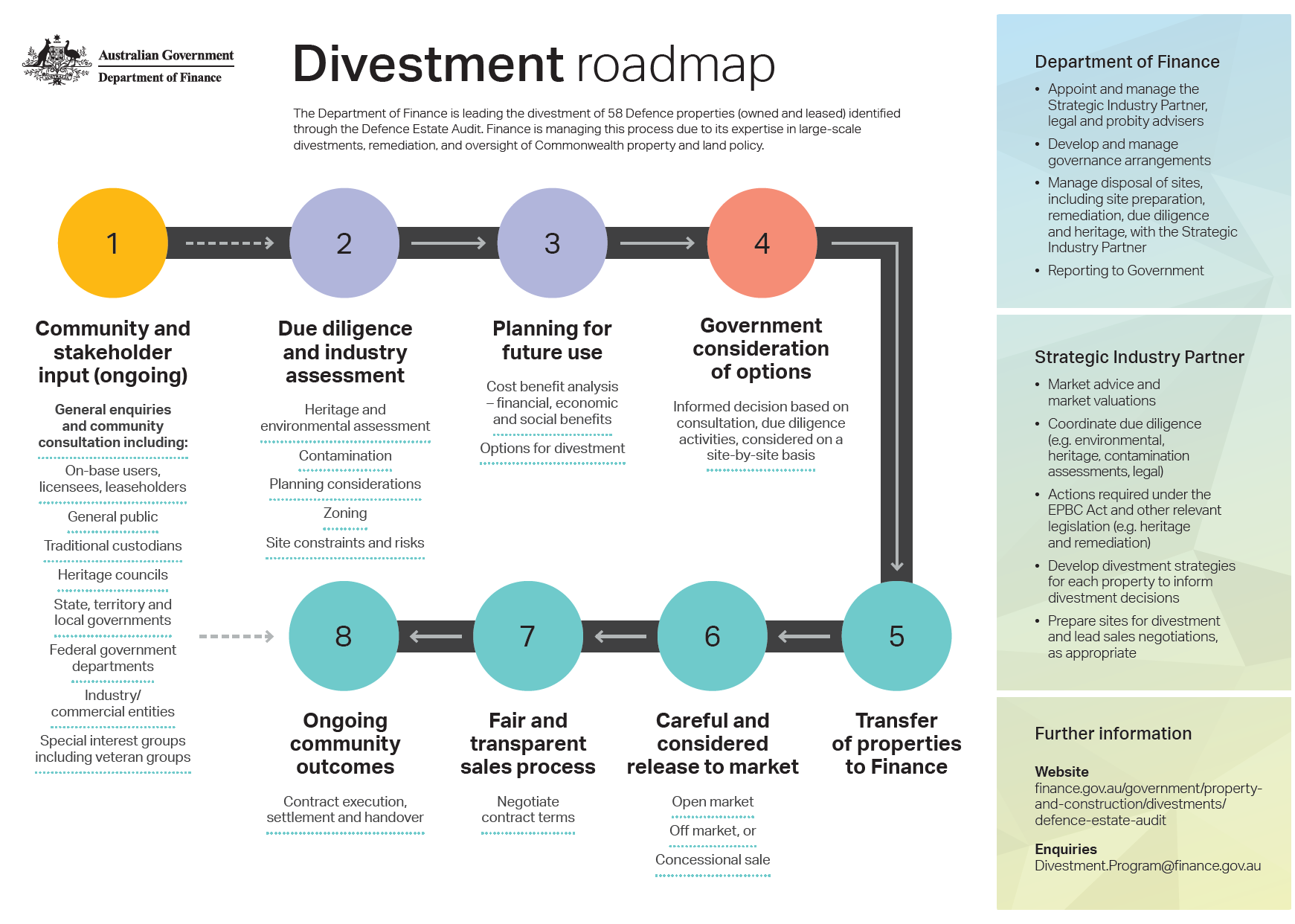
Each property progresses through a structured divestment process.
1. Community and stakeholder input
Community engagement occurs throughout the divestment process.
This includes:
- local communities
- site users, licence holders and leaseholders
- First Nations communities
- local councils
- state and territory governments
- relevant Commonwealth agencies
- industry and commercial stakeholders
- community and heritage groups.
Feedback helps identify opportunities, issues and community priorities for each site, which will inform divestment strategies for government consideration.
2. Due diligence and industry assessment
Finance has appointed a Strategic Industry Partner to undertake due diligence activities and support development of site-specific divestment strategies.
Assessments may consider:
- environmental conditions including contamination and remediation requirements
- heritage values
- First Nations cultural heritage
- site constraints and risks like planning and zoning arrangements
- market conditions.
Project timeframes will be established following completion of this phase of work.
3. Planning for future use
Information gathered through due diligence and stakeholder engagement will help inform future use options and site-specific divestment strategies.
Considerations may include:
- financial factors
- economic factors
- social factors
- environmental factors
- community feedback
- potential future uses.
Existing public access, recreational use and community activities may also be considered as part of site-specific planning and consultation activities.
The government is committed to preserving and, where possible, enhancing public access to historically significant sites and collections. Defence will work with local councils, community organisations and relevant stakeholders to support continuity of community activities where feasible.
4. Government consideration of options
Recommendations will be considered by the government on a site-by-site basis.
Decisions will be informed by:
- community feedback
- due diligence findings
- site assessments
- future use opportunities
- legislative and policy requirements.
5. Transfer of properties to Finance
Properties will be transferred to Finance for divestment. Finance will develop and manage governance arrangements and work with Defence and the Strategic Industry Partner to prepare sites for disposal.
6. Careful and considered release to market
Where a property is approved for sale, Finance will manage the disposal process in line with the Commonwealth Property Disposal Policy and other relevant requirements.
Open market disposal methods may include:
- auction
- expression of interest
- tender
- private treaty
- other approved disposal pathways.
Where appropriate, Finance will work with the Strategic Industry Partner to release properties to market.
Appropriate contractual, legal, environmental and heritage considerations will be addressed throughout the process.
7. Fair and transparent sales process
Sales processes (where applicable) will be conducted fairly, transparently and in line with Commonwealth requirements.
8. Ongoing community outcomes
Environmental, heritage, cultural and community considerations identified during the divestment process will continue to be managed through:
- legislative protections, including covenants in contracts
- planning controls
- conservation arrangements
- land use restrictions
- conditions of sale.
Environment, heritage and cultural considerations
Environmental, heritage and cultural considerations are an important part of the divestment process.
Due diligence activities will assess:
- environmental and biodiversity considerations
- contamination risks, including PFAS where relevant
- heritage values
- First Nations interests.
Managing identified issues
Finance and Defence are committed to complying with all relevant legislative requirements under the Environment Protection and Biodiversity Conservation Act 1999 and other applicable laws. The departments will also work with stakeholders to ensure these considerations are appropriately addressed during the divestment process.
The government has commenced engagement with First Nations stakeholders and communities to help identify and manage cultural heritage considerations.
Defence manages contamination on its properties under the Defence Contamination Management Manual. It is designed to reduce risks to human health, the environment and Defence capability. Per- and poly-fluoroalkyl substances (PFAS) and other contaminants are considered as part of this framework. PFAS reports can be found on the Defence website.
Where additional contamination is identified through due diligence, appropriate management measures will be implemented based on the nature and extent of the issue and the proposed future use of the site.
Protecting significant values
The Defence Estate Audit divestment program aims to facilitate the transition of surplus Defence land to efficient future uses while protecting significant heritage, environmental and cultural values. Finance will consider a range of stewardship mechanisms, including heritage covenants, conservation covenants and planning controls to achieve appropriate long-term outcomes.
Community consultations
Community feedback remains important in informing site-specific divestment strategies, future use opportunities and considerations for individual sites.
Defence and Finance have been conducting community consultation sessions in each region, including community walk-in sessions and direct engagement opportunities. For more information, go to the Defence website.
Register your interest or provide feedback and future use options
Finance welcomes feedback and future use options on sites identified through the Defence Estate Audit.
Your interest, feedback and future use options will help Finance understand community views, future use opportunities, and market interest.
Please note that due diligence needs to occur to understand the unique constraints of each site before divestment strategies can be developed and considered by the government.
Findings of due diligence and community feedback will all be considered in developing a divestment strategy for a site.
Important information before submitting
Participation in this process is voluntary and at the sole cost and risk of the respondent.
Submitting this form:
- does not form part of a sale process
- does not create any rights or obligations
- does not guarantee that a site will be divested
- does not provide any preference or special consideration in any future disposal process.
Finance makes no representation that any divestment will proceed.
Any questions or correspondence should be directed to the contact provided below.
Responding to this Feedback and Future Use Options is on a voluntary basis and will be at the sole cost and risk of the respondent.
This webform is not a commitment to any particular course of action. It is not a notice or part of any proposed or actual divestment or sale process.
This webform does not create any representation, either express or implied, that:
- any divestment or sale will proceed; or
- if a divestment or sale does proceed, that a potential interested buyer’s other form of application (if any) will be given any preference or special consideration.
Finance makes no representation and does not warrant that any information contained in this webform is accurate, current or complete.
Finance, including through this Feedback and Future Use Options webform, will not be liable to any potential interested buyer on the basis of any promissory estoppel, quantum merit or other contractual, quasi contractual or restitutionary grounds whatsoever or in negligence as a consequence of any matter relating or incidental to a potential interested buyer’s participation in this process, including instances in which:
- Finance decides not to proceed with divestment for all or any of the requirements; or
- Finance exercises or fails to exercise any of its rights under or in relation to this webform.
Any questions or correspondence should be directed to the contact provided below. Finance reserves the right to respond, or not respond, to specific questions or Feedback and Future Use Options at its own discretion.
Select a property
To view the properties, use the dropdown next to each state / territory. Please select the sites you are interested in, noting more than one property can be selected.
