
The Commonwealth Property Management Framework’s Special Purpose Property policy is currently under review. For further information, please contact propertypolicy@finance.gov.aus.
The Commonwealth Property Management Framework (CPMF) establishes principles for informed decision-making in relation to property leased or owned by the Commonwealth to ensure the proper use of resources.
The CPMF supports officials to meet their obligations under the Public Governance, Performance and Accountability Act 2013 (PGPA Act). It supplements the Commonwealth Procurement Rules (CPRs) and should be read in conjunction with relevant legislation and government policies and frameworks.
The CPMF applies to all Australian Government property managed by non-corporate Commonwealth entities (NCEs), whether owned, leased, office, operational or residential.
Corporate Commonwealth entities (CCEs) may be subject to legislative and policy aspects of the Commonwealth Property Management Framework, including the Lands Acquisition Act 1989 and Public Works Committee Act 1969 (PWC Act) and are responsible for ensuring compliance.
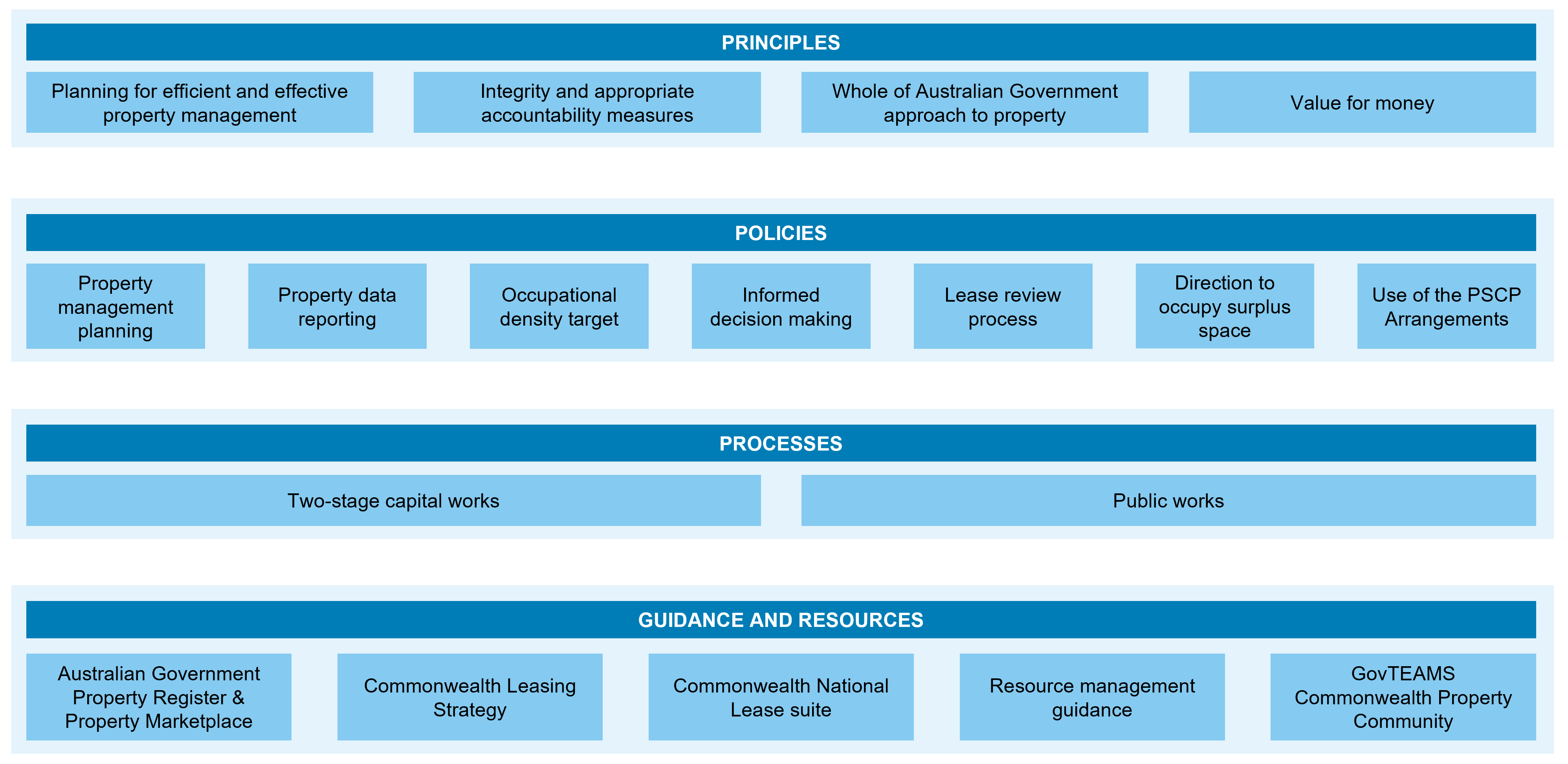
The 4 property management principles
The CPMF is underpinned by 4 principles:
1. Planning for efficient and effective property management
Undertake robust property planning to inform high quality decision making and timely action, enabling efficient and effective property outcomes throughout a property’s lifecycle.
2. Integrity and appropriate accountability measures
Undertake property management in a manner consistent with the highest standards of integrity, and with robust, transparent, well documented, and timely decisions and actions, supporting high quality property outcomes.
3. Whole of Australian Government approach to property (WoAG)
Promote cooperation on property matters to deliver optimal Australian Government outcomes, striving to align decisions with whole-of-government objectives alongside entity-specific needs.
4. Value for money
Undertake balanced decision making considering all government policy requirements, monetary and non-monetary benefits, and impacts against cost to determine efficient, effective, economical, and ethical property outcomes throughout a property’s lifecycle.
The 7 property management policies
The CPMF comprises 7 mandatory policies that support informed decision making and achievement of WoAG outcomes.
1. Property management planning
All non-corporate Commonwealth entities are to have a Property Management Plan in place, approved by the accountable authority of the entity.
The Minister for Finance may prescribe the requirements relating to property management plans.
2. Property data reporting
All non-corporate Commonwealth entities must provide data to Finance in accordance with prevailing Australian Government Property Data Collection Specifications, regarding domestic property (including external territories) owned or leased by the entity.
3. Occupational density target
An occupational density target, of 14 square metres of usable office area per occupied work point, applies to domestic office accommodation (including external territories) owned or leased by non-corporate Commonwealth entities for new lease/buildings and for existing office accommodation on completion of a major fit out.
The occupational density target does not apply to:
- Properties with less than 500m2 of office space, or
- Department of Defence properties, Special Purpose Properties, and shopfronts - where office work is not the main activity conducted within these properties.
4. Informed decision-making
Non-corporate Commonwealth entities must use cost-benefit analysis methodologies on a whole-of-life basis when considering options for all decisions to own, lease, divest or transfer Commonwealth property. The cost-benefit analysis must assess the value for money, including all heritage, social, and environmental considerations, for all options.
5. Lease review process
When seeking to establish a new lease or extend an existing lease, all non-corporate Commonwealth entities must:
- obtain appropriate endorsement prior to approaching the market, and
- following approach to market, obtain appropriate support, prior to entering into a property lease or extension
- ensure their leasing decisions are consistent with the Commonwealth Leasing Strategy.
The Minister for Finance will set and may amend the criteria for leases requiring ministerial endorsement, or endorsement by the Department of Finance.
6. Direction to occupy surplus space
When seeking lease endorsement entities will be required to relocate to current surplus Commonwealth leased accommodation, subject to consideration of business requirements as determined by the Minister for Finance (the Minister) or the Minister’s nominees.
7. Use of the Property Services Coordinated Procurement Arrangements
Non-corporate Commonwealth entities must use the Property Services Coordinated Procurement (PSCP) Arrangements.
The Arrangements provide access to property and facilities managements services, including leasing support, facilities management, and supplementary and additional services. Further details on the Arrangements are available in RMG-500 and through the GovTEAMS Commonwealth Property Community.
Officials can request access to the community by emailing pscp@property.finance.gov.au.
Guidance
Detailed guidance supports officials to meet CPMF requirements. The core guidance is contained in Resource Management Guide 500 – Commonwealth Property Management (RMG 500) with additional resources that provide information on specific aspects of property management, including:
- Australian Government Property Register (AGPR) and Property Marketplace: tools for managing and advertising Commonwealth property assets.
- Commonwealth Leasing Strategy: provides direction for officials on leasing strategies, for their future office accommodation needs, to maximise value for money and WoAG property outcomes.
- Commonwealth National Lease suite: standardised lease templates and guidance to streamline leasing processes.
Additional property management guidance is available through the Commonwealth Property Community in GovTEAMS.
Officials can request access to the community by emailing pscp@property.finance.gov.au
