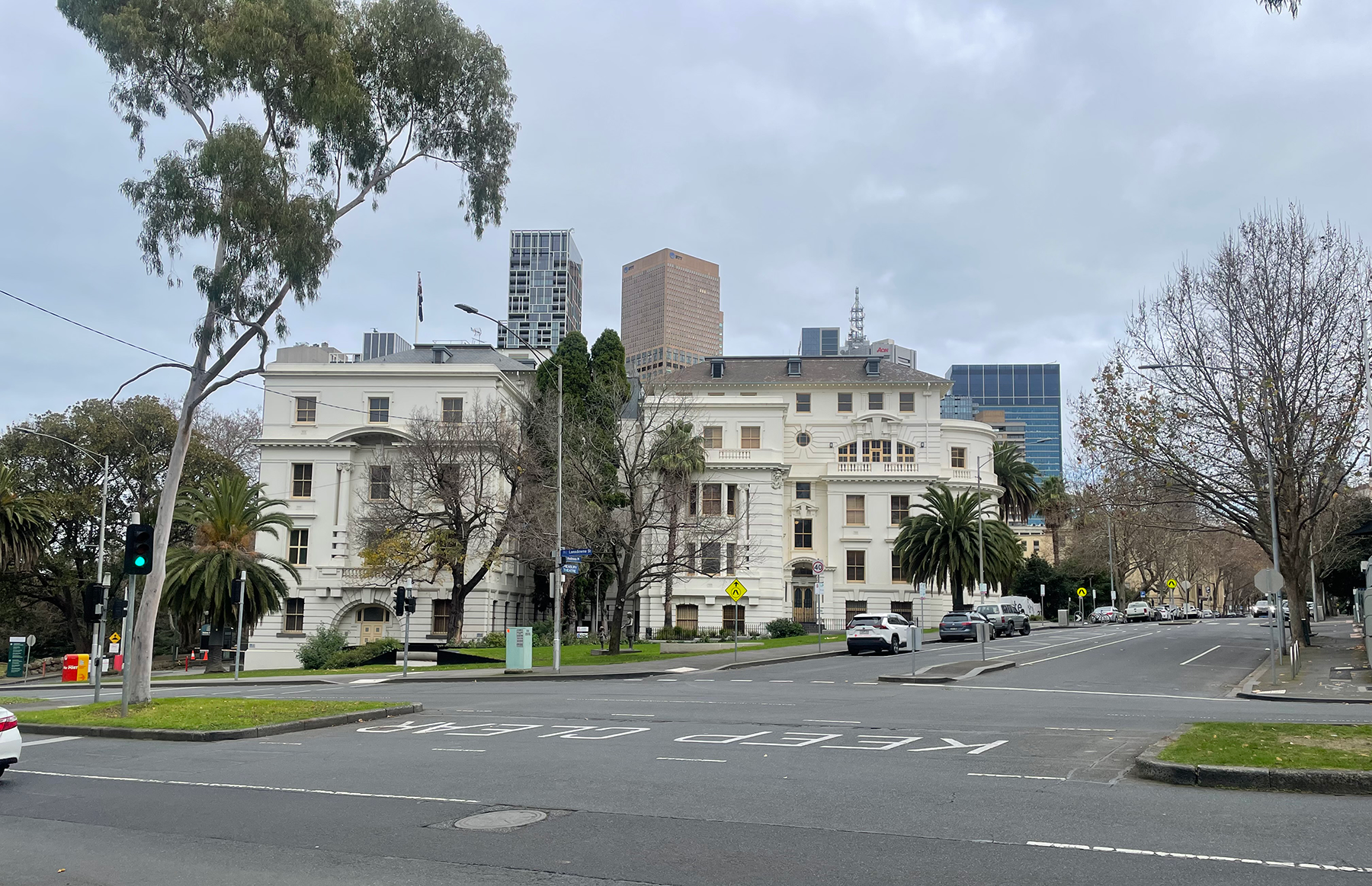
Commonwealth Offices Building, 4 Treasury Pl, East Melbourne, VIC, Australia
The Commonwealth Offices Building was the first office building constructed by and for the Commonwealth of Australia. Built between 1911 and 1913, when Melbourne was the temporary capital of Australia, the Prime Minister and Cabinet met here until 1927. After that, the federal government moved its operations to Old Parliament House in the nation’s new capital, Canberra.
Many important decisions about national and international events were made within the building's walls.
History
The Commonwealth of Australia commissioned John Smith Murdoch as the architect for its new Commonwealth Offices Building.
Aiming to embody Australia’s national spirit and a new era, Murdoch designed the building in the Edwardian Baroque style. This was more decorative than the conservative, classical styles that had been popular during the 1800s.
The Commonwealth Offices Building witnessed its fair share of controversy.
Home Affairs Minister King O’Malley introduced ‘wet-weather pay’ for labourers during construction, where workers were paid even when it was too wet to work.
The building also hosted many heated debates around the First World War, including the push for compulsory conscription for overseas military service.
The prime ministers who served their terms here during the First World War were Joseph Cook (1913 to 1914), Andrew Fisher (1914 to 1915) and William ‘Billy’ Hughes (1915 to 1923).
Significance
The Commonwealth Offices Building is of aesthetic, architectural, historical, technical and social significance at a national level. It is important because of the following:
- Association with the foundation of the Commonwealth of Australia and as a physical reminder that Melbourne was once Australia’s temporary capital city.
- Application of labour principles by the Home Affairs Minister, King O’Malley. During the building’s construction, O’Malley broke from previous government practices by introducing ‘wet-weather pay’ for workers and employing direct labour.
- Design by John Smith Murdoch, who was the first architect of the new Commonwealth. Murdoch used reinforced concrete, which was a new technology, in his design and incorporated Gippsland marble in the building’s foyers. He also used the Edwardian Baroque style of architecture, which was a move away from the strictness of classical architectural styles. Murdoch’s design marked the beginning of the Federation Freestyle movement that celebrated the new national spirit.
- Rarity as an outstanding example of a Commonwealth building designed in the Edwardian Baroque style, as seen in features such as the exaggerated keystones, occuli, cartouche, heavy cornicing and giant arches.
- Rarity as the first office building constructed by and for the Commonwealth of Australia. It is also the only office building outside of Canberra to have continuously been owned and used by the Commonwealth.
- Contribution to other notable buildings and the streetscape of this important Melbourne precinct.